ABOUT THIS TIMELINE
This timeline offers a rough outline of Dan River’s corporate milestones, Danville’s social history, and the history of the development of Dan River’s mill village of Schoolfield. Much of the timeline derives from the Dan River Company Archives at UNC-Chapel Hill as well as secondary literature about the company including historical accounts like Mill on the Dan: A History of Dan River Mills 1882-1951 by Robert Sidney Smith. Any questions about this timeline may be directed to Ina Dixon: ina@storiedcapital.org.

June 10, 1882 – Riverside Cotton Mills chartered: Benjamin Franklin Jefferson, Dr. Howson White Cole, Thomas Benton Fitzgerald (president), Robert Addison Schoolfield, James Edward Schoolfield, and John Harrell Schoolfield founded the textile company that would become Dan River Inc. The company first operates in downtown Danville, relying on water power from the Dan River.
1882 – T.B Fitzgerald serves as first mill president until 1899
October 1882 – The Danville Circular is penned, a public letter that decried “the injustice and humiliation to which our white people have been subjected and are daily undergoing by the domination and misrule of the radical or negro party [the Readjusters, a bi-racial political party].” One of the twenty-eight white local men to sign the document was James Edward Schoolfield, a founder of Dan River Mills.
November 1883 – The Danville Riot occurs just days before an election. The bi-racial political party known as the Readjusters lose control over the city as a result of subsequent voter intimidation tactics aimed at Black voters. Robert Addison Schoolfield himself participated in voter suppression following the riot by patrolling the streets on the days leading up to the election with “a big pistol buckled around me and a gun on my shoulder” ensuring that when the day of the election came there were “practically no [N]egroes voting.” The poll tally for the 1883 election showed that only 31 of the 1,300 Black voters registered had submitted ballots.
1889 – F.X.Burton serves as mill president until 1903
1903 – Robert Addison Schoolfield becomes president of Riverside Cotton Mills. R.A. Schoolfield serves as president until 1918.
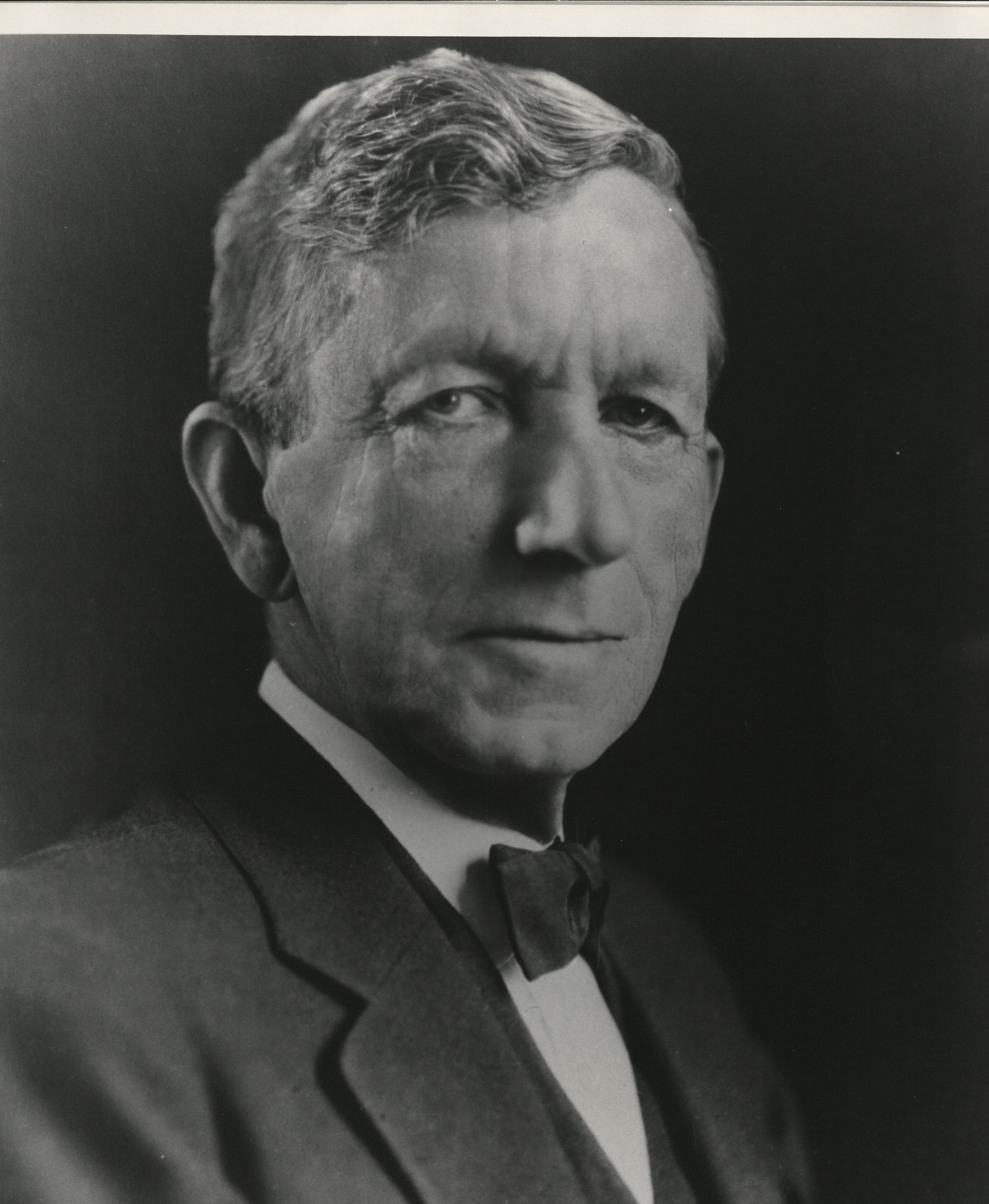
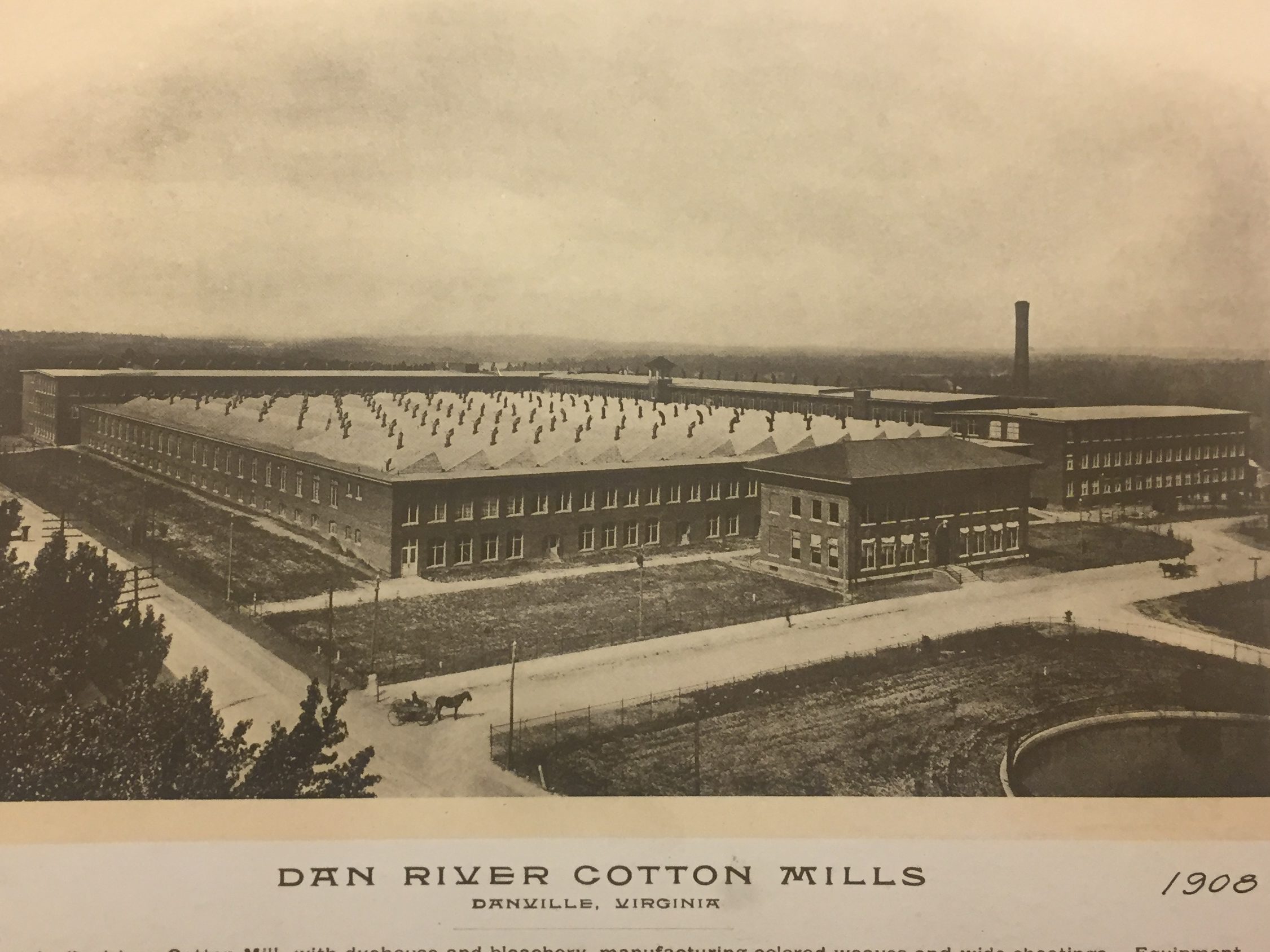
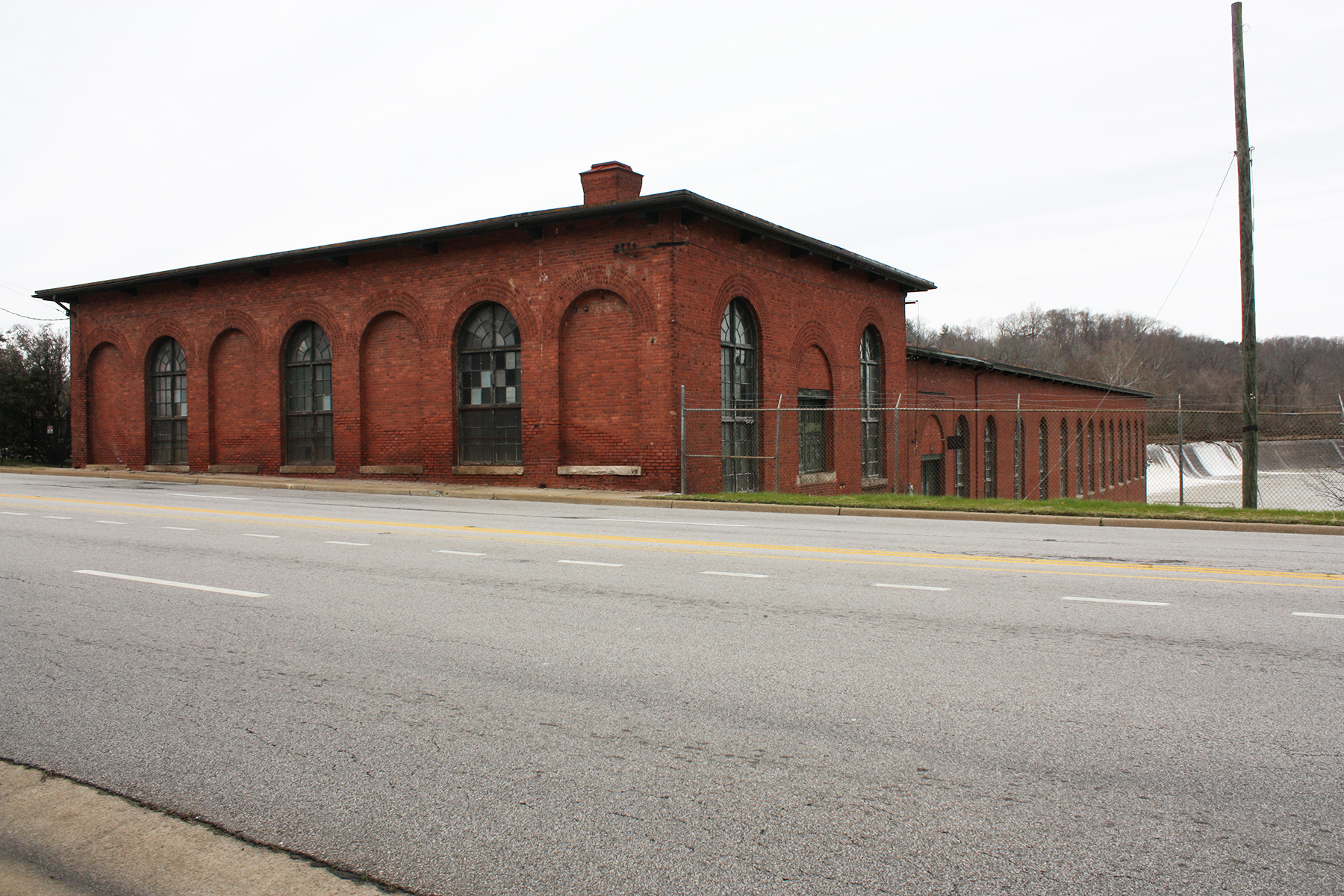
A portrait of Robert Addison Schoolfield, courtesy of UNC-Chapel Hill Southern Historical Collection Dan River Mills Inc July 22, 1903– Riverside Cotton Mills contracts with Lockwood Greene contracts with to design and build initial mill buildings in Schoolfield, including the Schoolfield Dam, Park Place Mercantile, and Company Office Building, pictured in the forefront here.
September 1903 – Schoolfield’s first houses and residential streets laid out with electricity (houses did not receive electricity until 1917).
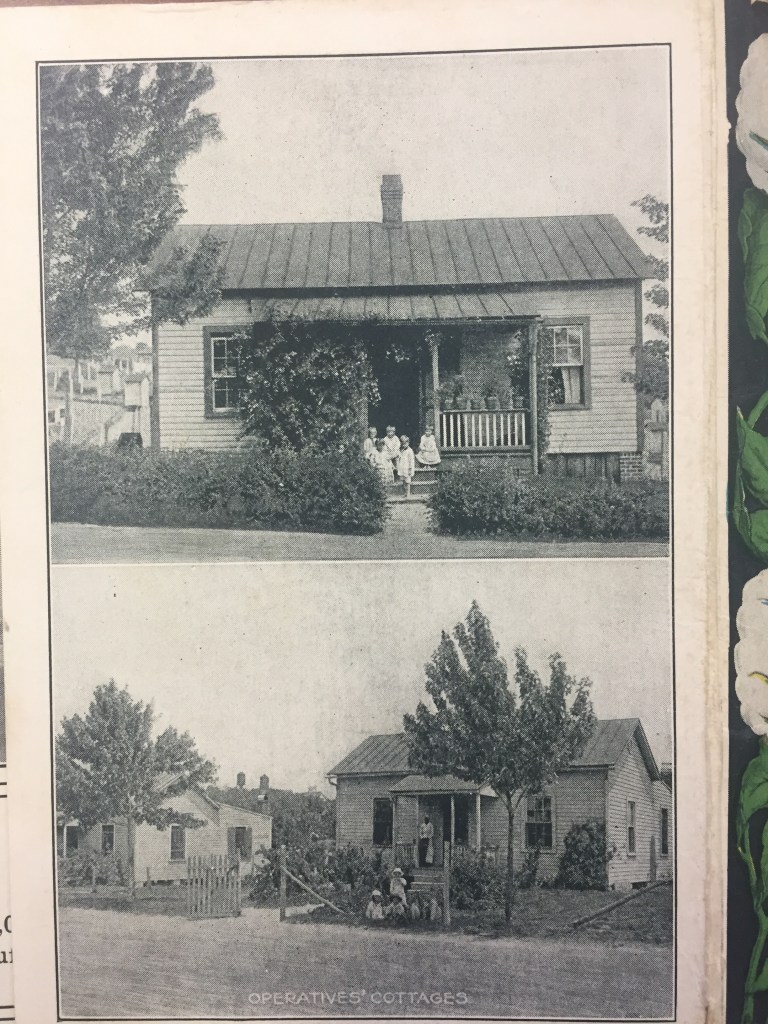
Operatives cottages as shown in a 1917 Schoolfield promotional postcard. Courtesy of Carol Handy. 1907 – Hattie Hylton hired to open Kindergarten in Schoolfield and became superintendent of welfare programs in 1908. Hylton served as superintendent until 1921.
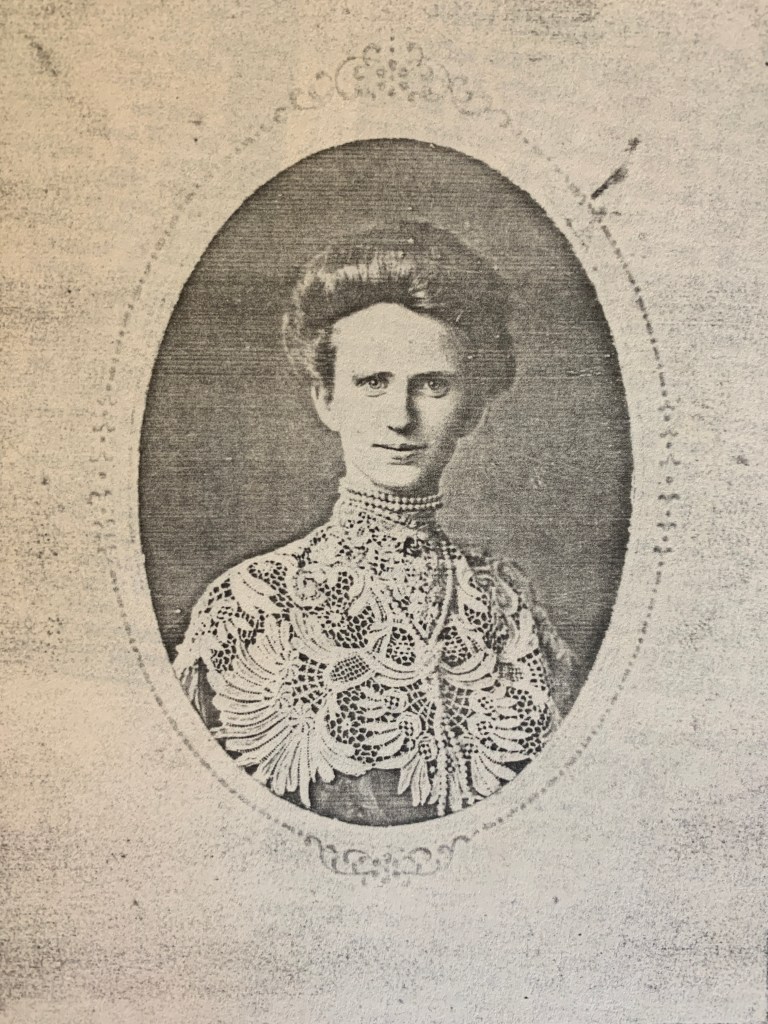
This 1900s portrait shows a young Hattie Hylton, Hylton Hall’s namesake and the director of Dan River’s extensive welfare program. Courtesy of UNC-Chapel Hill Wilson Library’s Southern Historical Collection Dan River Inc. Papers. 1909 – Dan River Power and Manufacturing Company and Riverside Cotton Mills merged; become Riverside and Dan River Cotton Mills.
1912 – Dan River donates land to the Pittsylvania County School Board for a school for millworkers’ children. This Prairie Style School at 31 Baltimore Avenue was designed by Charles G. Pettit Jr. and served elementary school students in its first years.
1914 – Schoolfield Lunch starts as a hotdog stand serving mill workers. Dan River acquires more land near Schoolfield. As one historian describes the area: “It hardly needs to be mentioned that this [Schoolfield] was an all-white settlement. When (as in 1914) the company acquired land and cabins occupied by Negroes, the tenants were required to vacate.” (Mill on the Dan, 257)
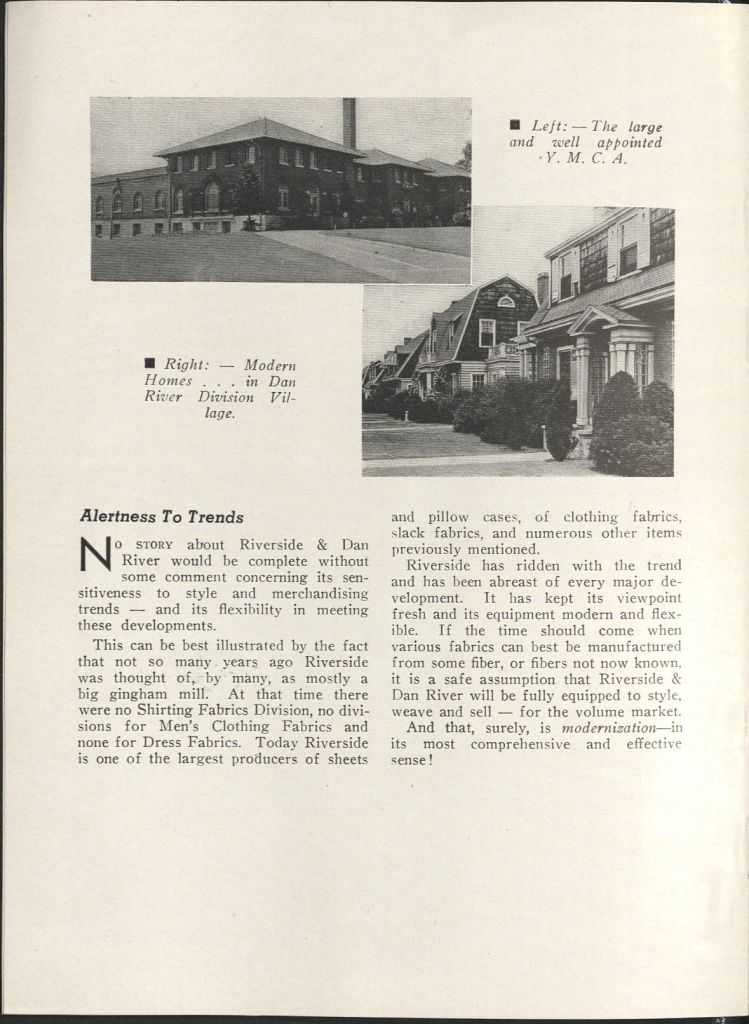
1916 – The Schoolfield YMCA, aka “Schoolfield Rec Center” built. The Schoolfield YMCA was home to the company-run union program known as “Industrial Democracy,” the brain child of John Leitch, with whom Harry Fitzgerald had an on-going correspondence.
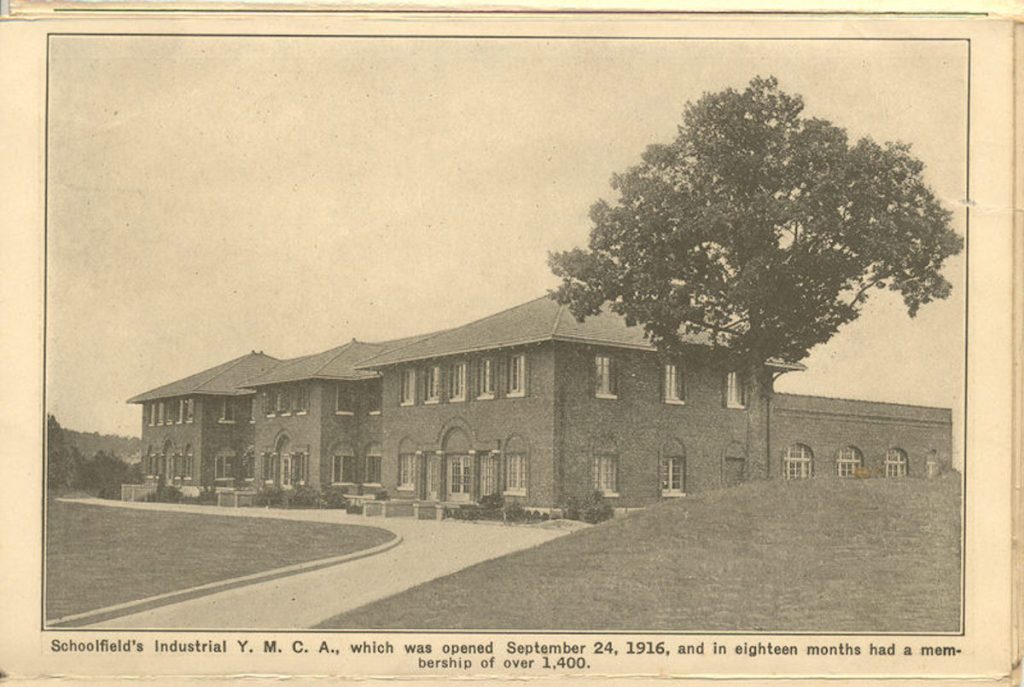
In a 1917 promotional postcard, Dan River advertised the newly built YMCA. Photo courtesy of the Virginia Department of Historic Resources 1917 – Welfare Building built and electricity was wired into Schoolfield mill workers’ homes.
1918 – Harrison Robertson Fitzgerald becomes President of the mills; R.A. Schoolfield becomes Chairman of the Board.
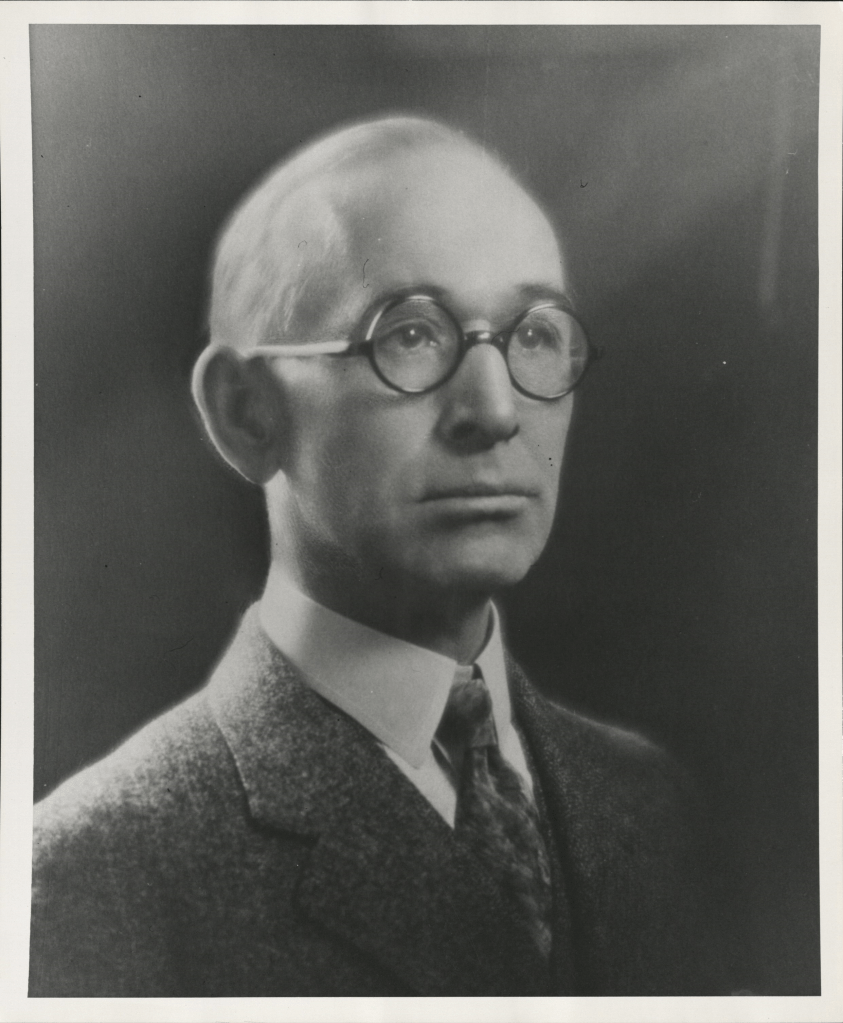
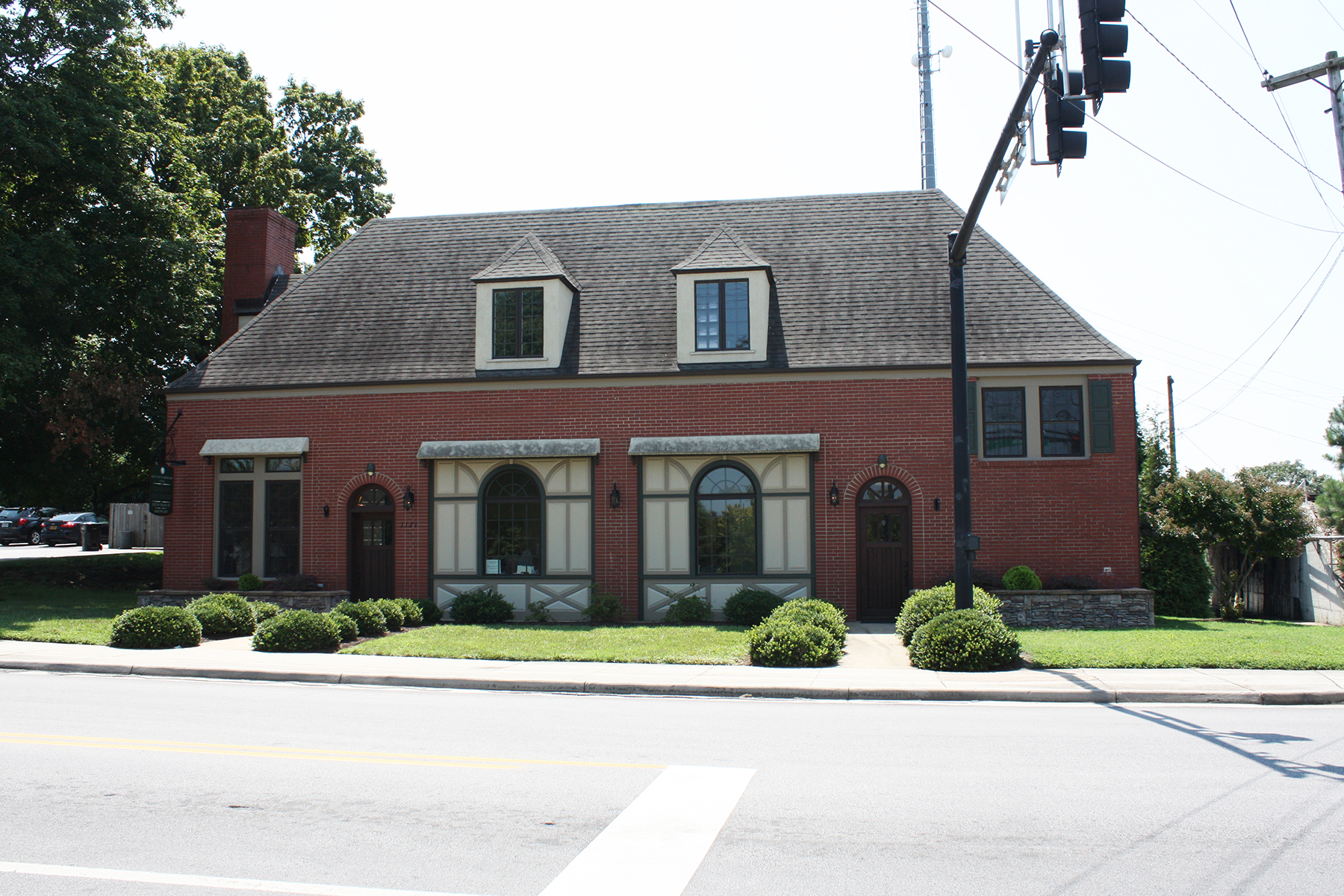
Harrison Robertson Fitzgerald, also known as Harry Fitzgerald expanded welfare in the village until his untimely death in 1931. Courtesy of UNC-Chapel Hill Wilson Library’s Southern Historical Collection Dan River Inc. Papers. 1919 – As the final piece of Dan River’s expanding Welfare Program and a haven for single white women millworkers, Hylton Hall, a women’s dormitory, is completed. In the YMCA, a company-run baseball league is started. Dan River also buildings a Colonial Revival Schoolfield Fire House on West Main Street.
1925 – Schoolfield grows after a post-World War I boom with some fifty houses on Bishop Avenue, some of the most unique in the village, designed by E.R. James.
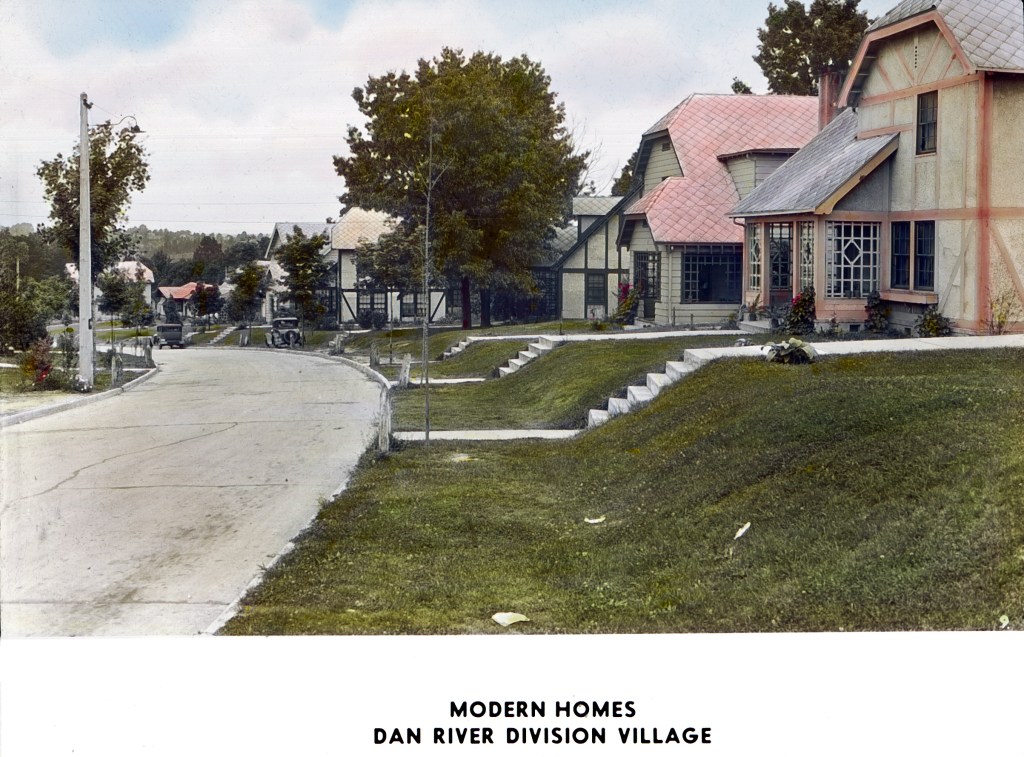
This 1930s image shows the new housing along Bishop Avenue. Courtesy of Danny from Schoolfield. September 1930 – Dan River Mills workers join the United Textile Workers of America and strike due to wage cuts. The strike eventually leads a cease of welfare programs and evictions of strikers from company homes in November and December of that year. For a more detailed timeline of events, see the Dan River Strike Timeline compiled by then-UVa PhD student Aldona Dye in 2017.
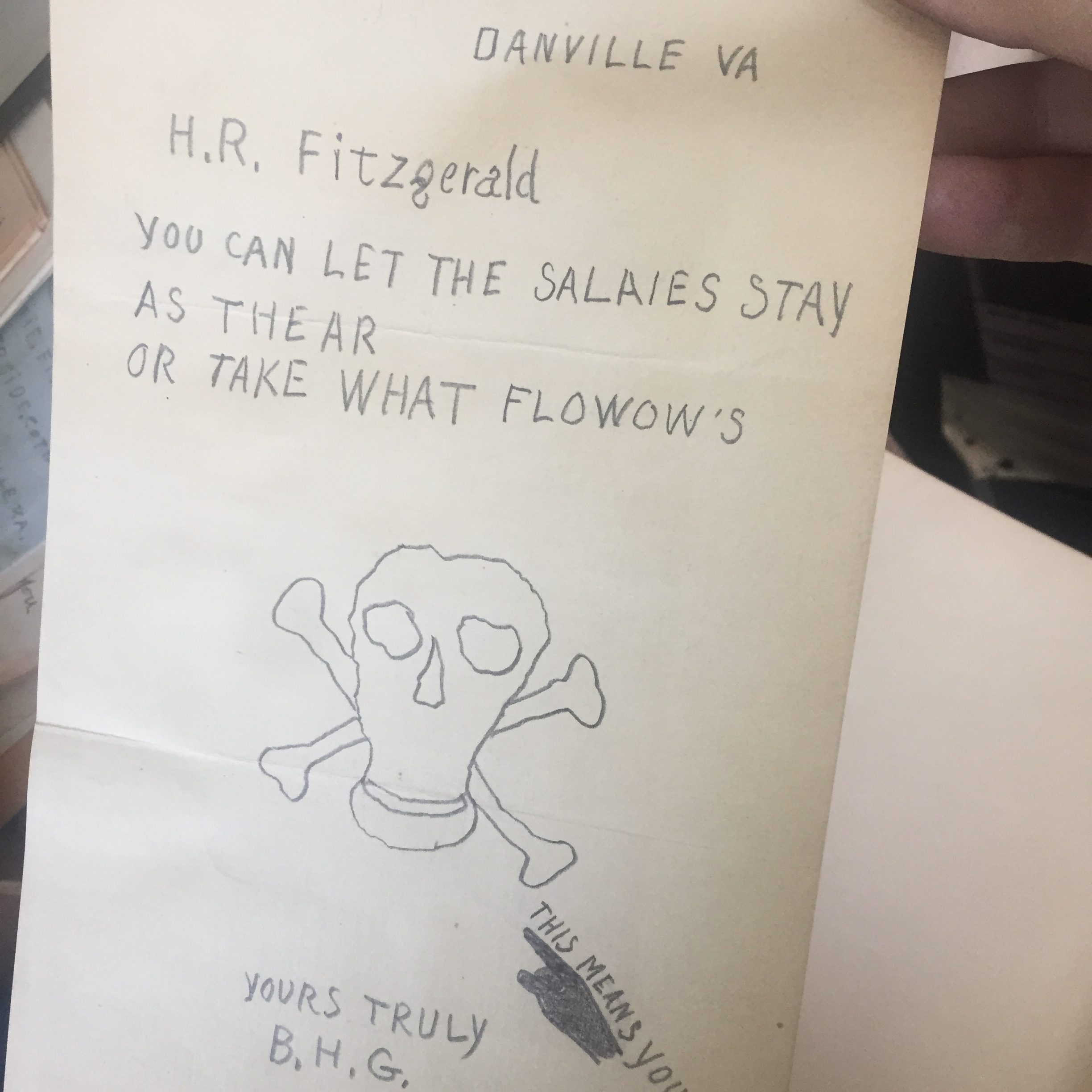
Tensions ran high in the labor strike at Dan River in the winter of 1930 and 31 when workers’ wages and the company welfare program were cut, as this anonymous letter to Harry Fitzgerald shows. Courtesy of UNC-Chapel Hill Wilson Library’s Southern Historical Collection Dan River Inc. Papers January 1931 – The strike at Dan River is called off. The following month, Harry Fitzgerald dies unexpectedly. Many attribute his death to the stress of the strike and the failure of his welfare programs to secure harmony between workers and management. James Ira Pritchett steps in as president and treasurer of Dan River until he is killed in an automobile accident in September 1932.
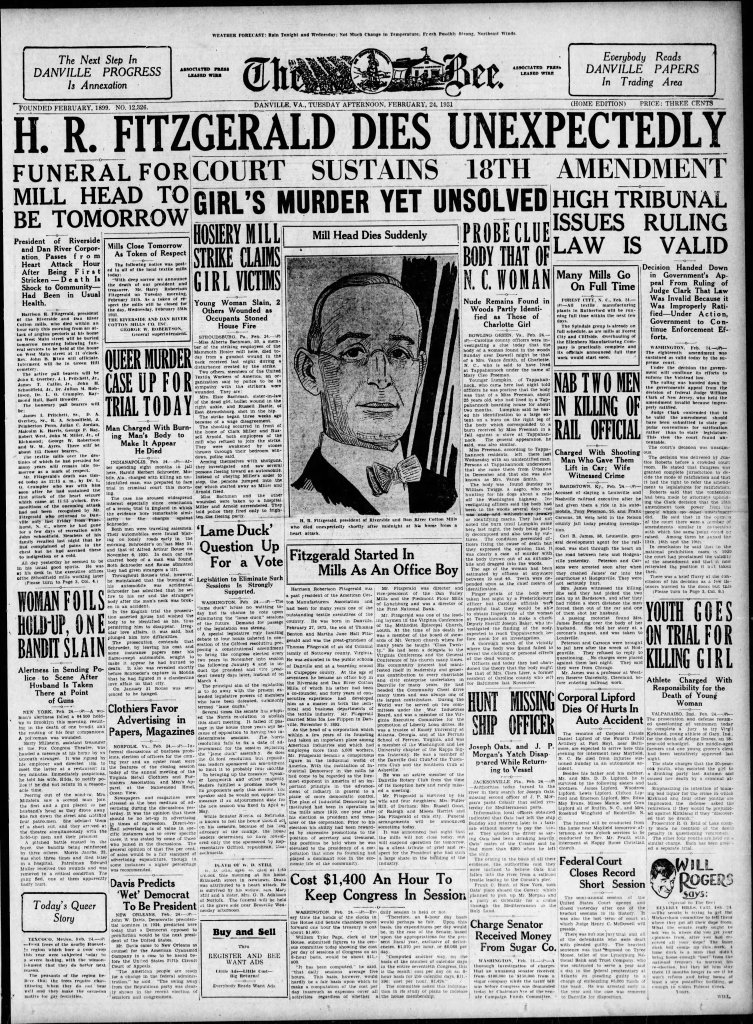
“HR Fitzgerald Dies Unexpectedly” The Bee. February 24, 1931. 1932 – The “Nine Lean Years” begins at the company, when sales and earnings dropped in tandem with the Great Depression rippling throughout the world. Following James Ira Pritchett death in a car accident, Robert R. West was made president. Riverside and Dan River Cotton Mills simplifies its name to Dan River Mills, Incorporated.
1933 – Schoolfield population reaches approximately 4,854 souls, with 90% Dan River Division workers housed in company housing or renting non-company houses.
1935 – Danville Textile School created to encourage further training for millhands at Dan River.
1936 – The H.R.Fitzgerald Apartments on W. Main Street are completed, named for the late president Harry Fitzgerald.
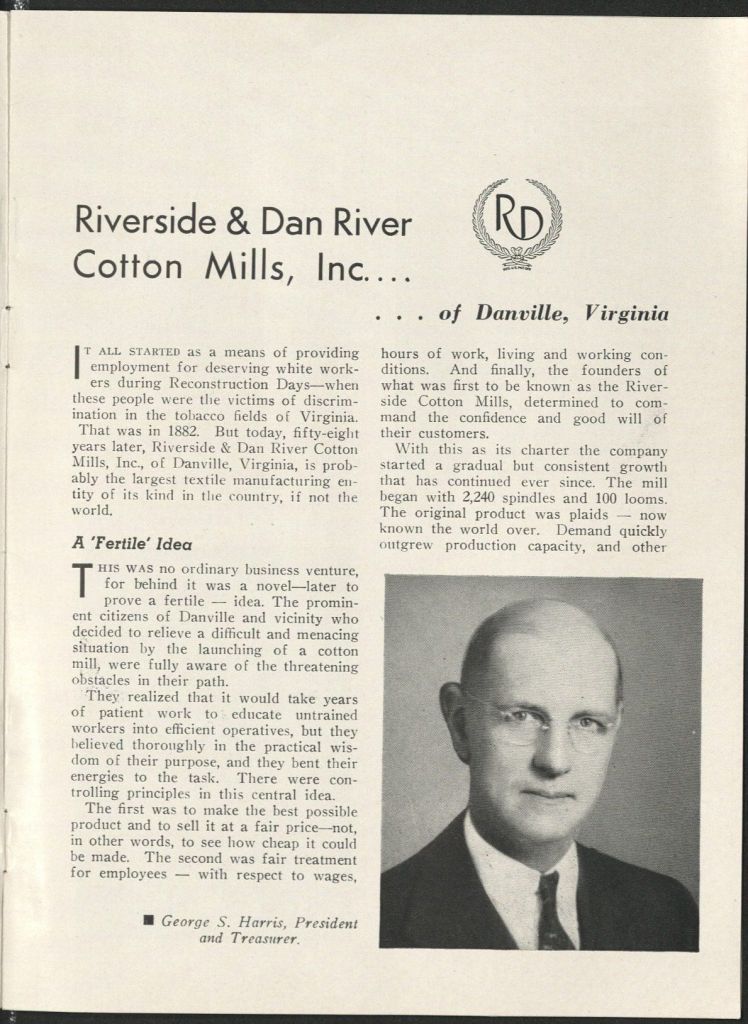
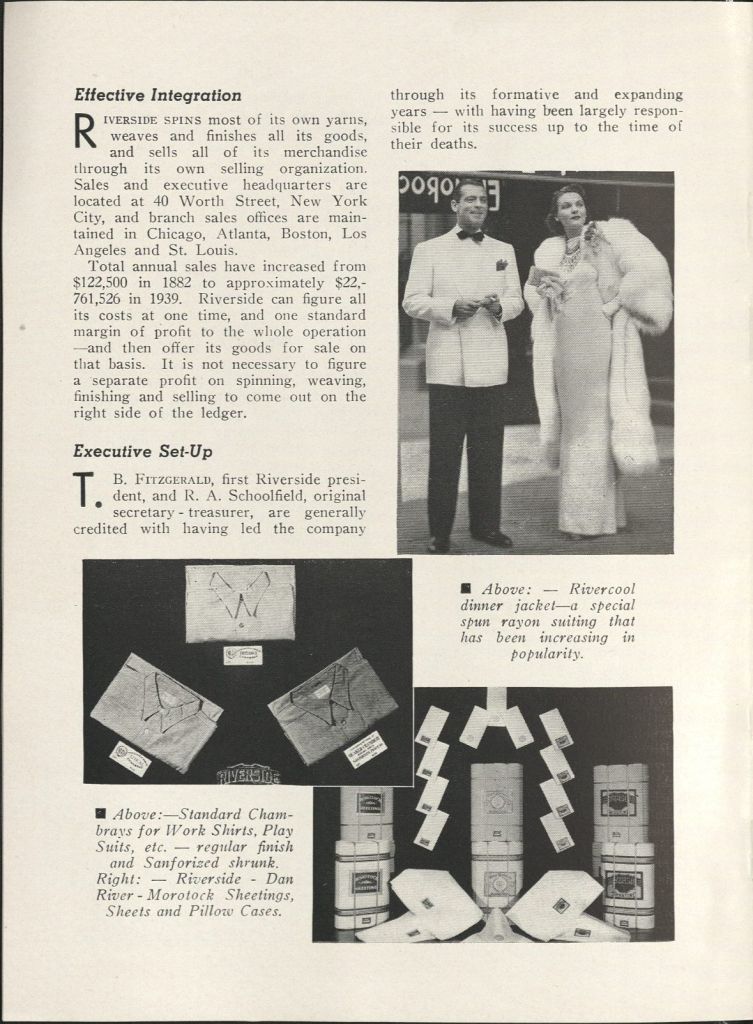
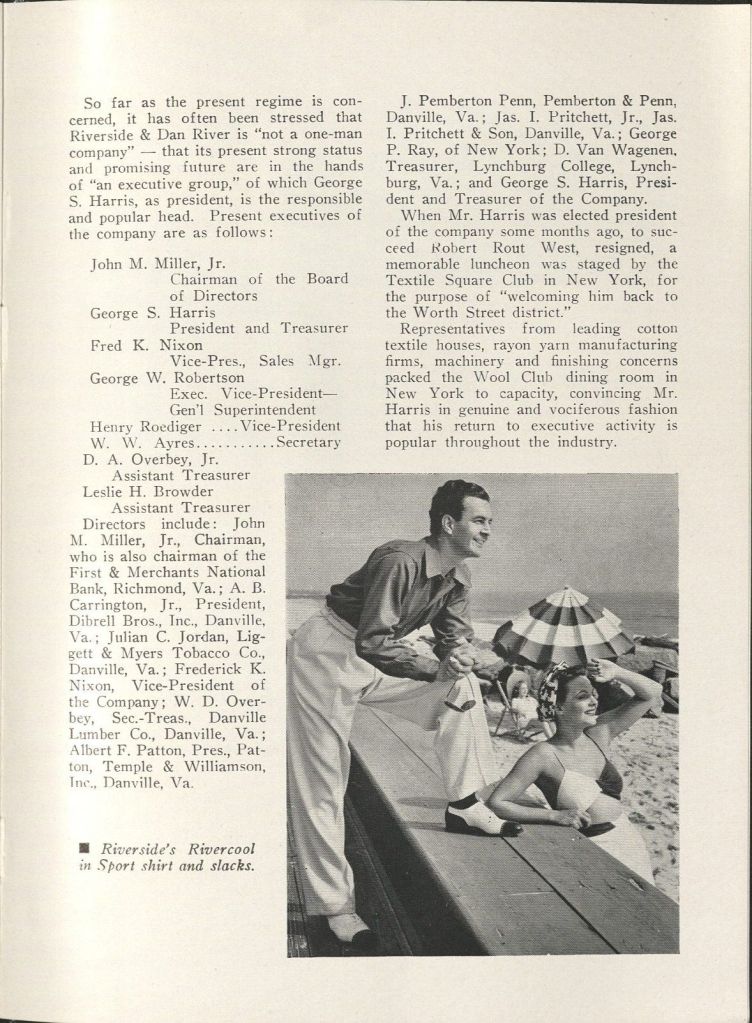
March 1940 – Differences in business philosophy between President West and the Dan River board of directors resulted in West’s resignation in March. Following West’s resignation, George Harris, a professional manager, became president beginning an era of modern management at the company. Below is an August 1940 copy of Textile Age featuring Dan River Mills, courtesy of UNC-Chapel Hill Wilson Library’s Southern Historical Collection Dan River Inc. Papers
1941-1945 – World War II breaks out and Dan River Mills booms with orders for the military.
1942 – Dan River forms the company’s Research and Development Department, which will be responsible for producing new synthetic fabrics such as Wrinkl-Shed.
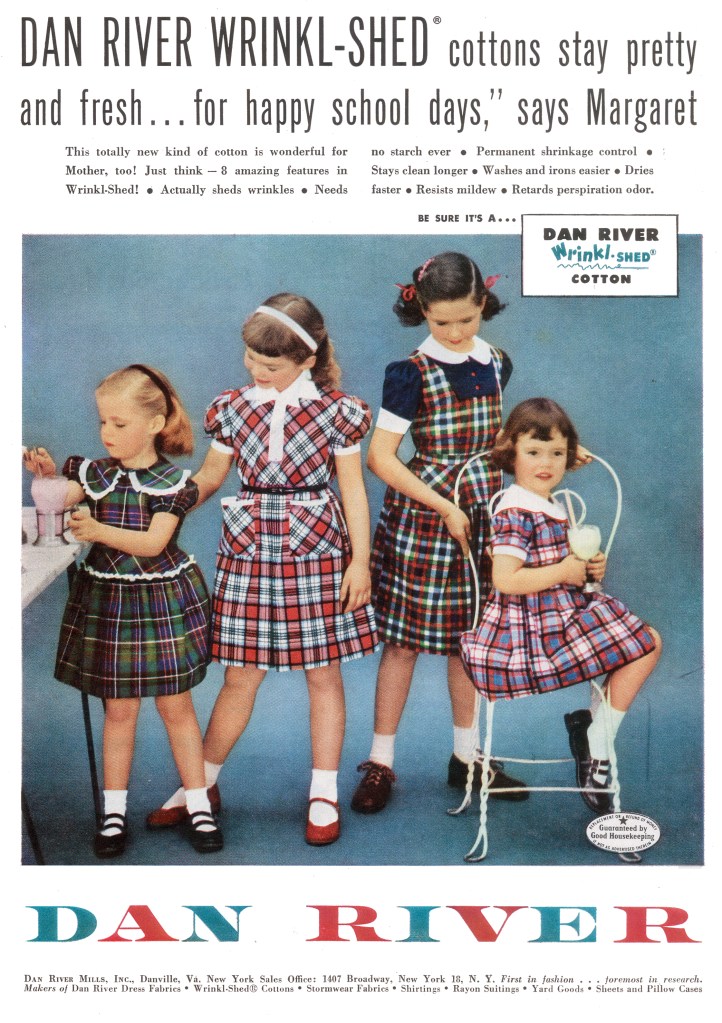
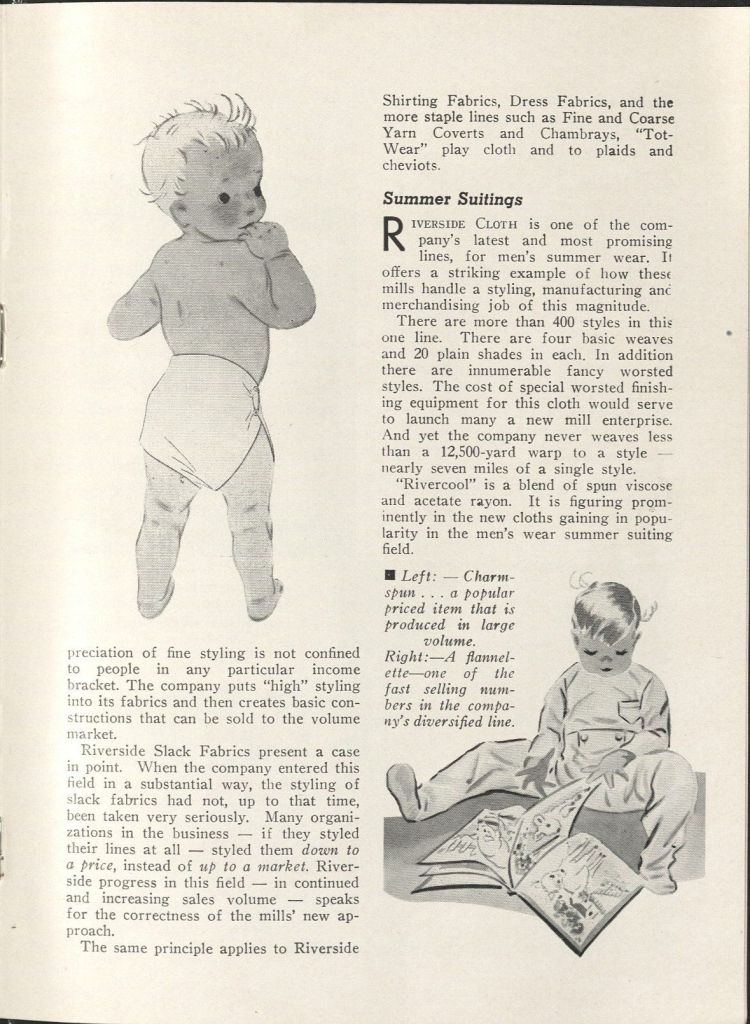
A 1950s ad for Wrinkl-Shed fabrics. Courtesy of UNC-Chapel Hill Wilson Library’s Southern Historical Collection Dan River Inc. Papers. 1943 – Dan River establishes the Riverdan Benevolent Fund, Inc. a corporation capitalized initially with $20,000. Dan River transferred its non-manufacturing assets owned to the Riverdan Fund and used profits to support “welfare, recreational, and community development programs of Schoolfield.” Contributions were also made to “meet unusual needs of churches, schools, and other groups.”
June 1943 – The National War Labor Board presses Dan River to sign its first union contract on June 25, 1943, with the Textile Workers Union of America (CIO) certified as employees’ bargaining agency.
June 1945 – A tally of houses owned by Dan River included 119 for Riverside Division (mostly 3 bedroom, then 4 and 6-bedroom); and 839 for Schoolfield Division (mostly 3 and 4-bedroom).
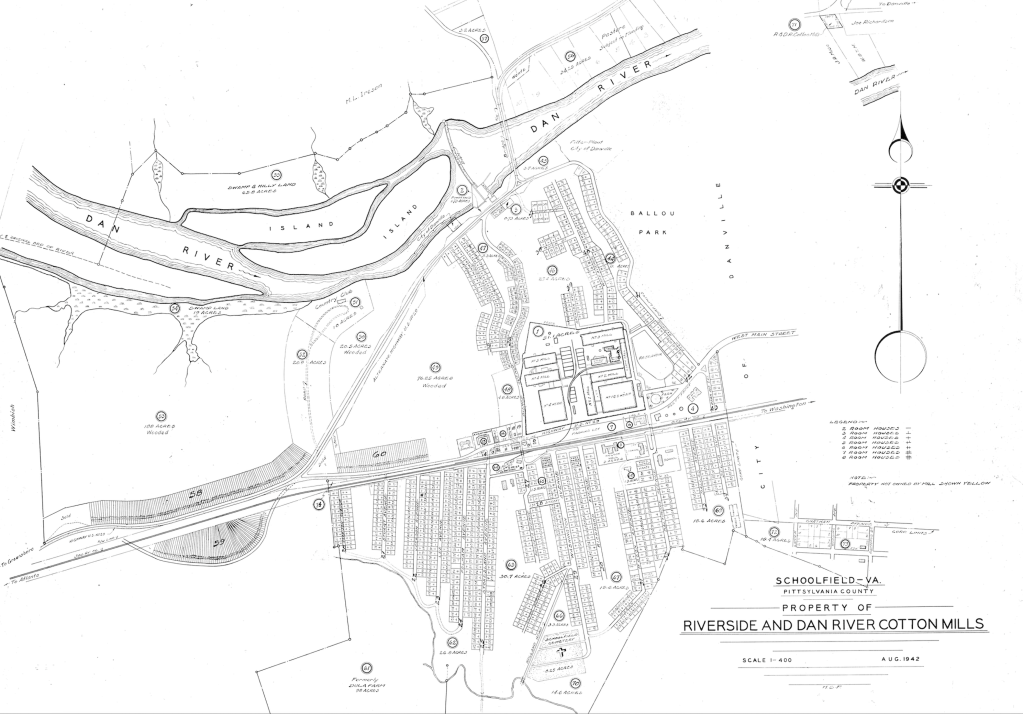
A 1942 map showing Dan River property in Schoolfield. Courtesy of the City of Danville Engineering Department. 1946 – Dan River completes a World War II veterans’ housing project. Fifty homes around Arlington Road were constructed and sold at cost to Dan River employees who were veterans. The fifty 2-and 6-room homes were built by Allen J. Saville of Richmond.
Riverside and Dan River Cotton Mills become Dan River Mills, Incorporated.
1948/9 – City planning consultants, Harland Bartholemew, recommend the City’s annexation of Schoolfield.
1949 – Russell B. Newton becomes mill president.
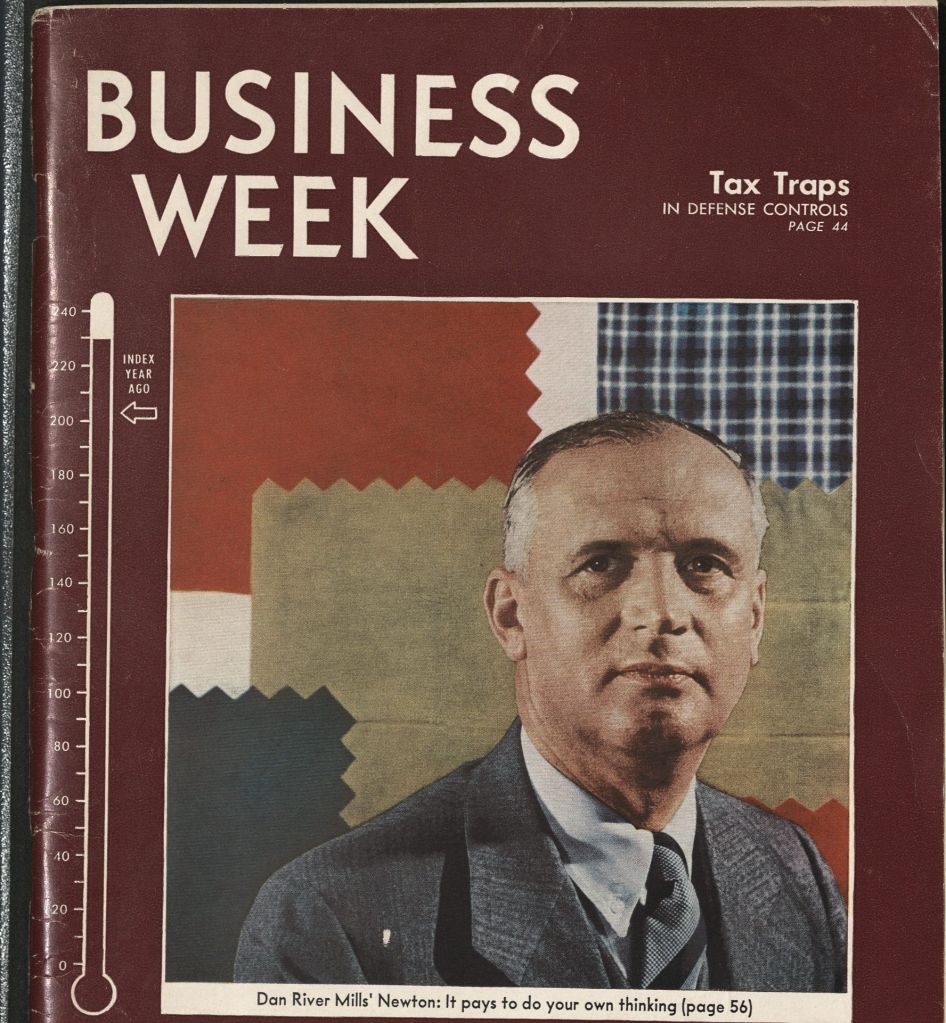
A 1951 cover of Business Week featuring Russell Newton, the President of Dan River from 1949-1953. Courtesy of UNC-Chapel Hill Wilson Library’s Southern Historical Collection Dan River Inc. Papers. October – November 1949 – Dan River sells 94 of its company-owned Riverside Division houses to workers and makes plans to sell off Schoolfield company houses as well.
1950 – Dan River begins selling Schoolfield mill village houses to workers. The terms of sale include 10% down payment, 5% interest on a mortgage, and buyers were not required to apply for a mortgage loan. Potential Black residents were excluded as official deeds to Schoolfield homes included covenants against allowing occupancy or selling the property to “any person of Negro descent” for a period of twenty years after the sale.
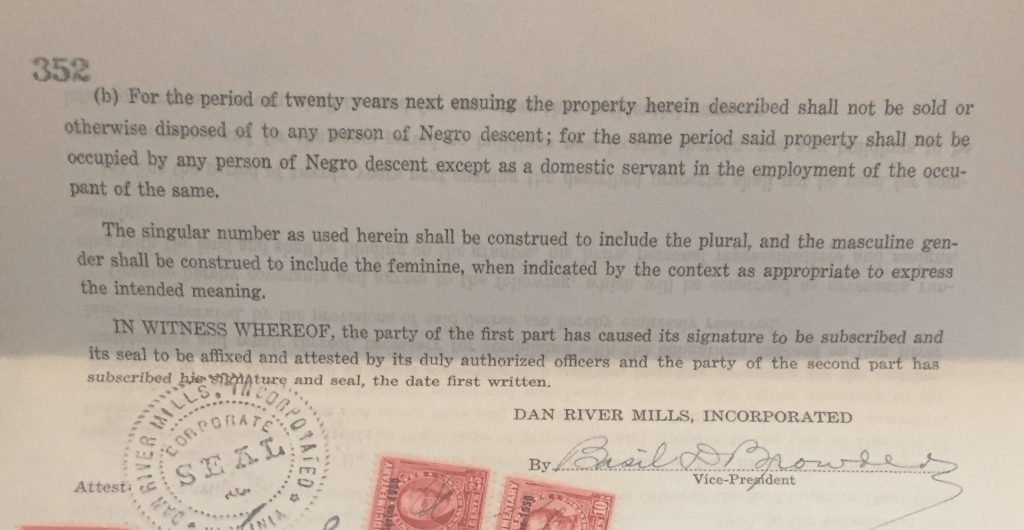
A portion of a 1951 deed to a Schoolfield house. May 31, 1950 – A three-judge court decides that the City can annex Schoolfield.
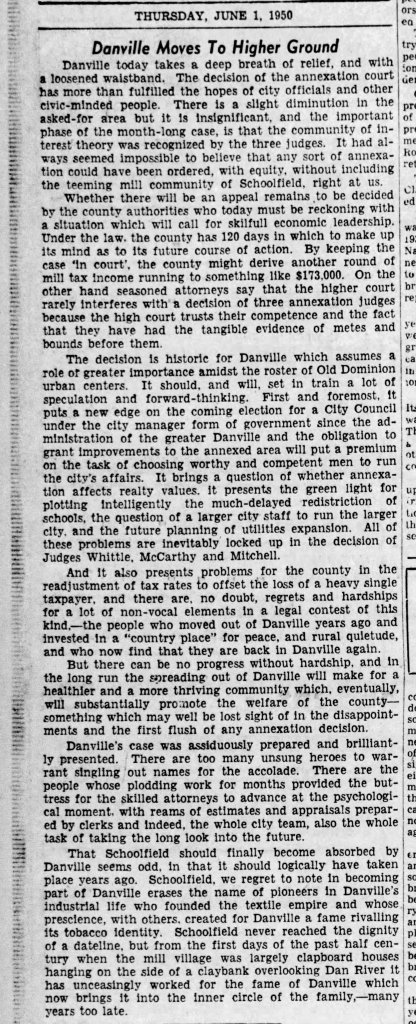
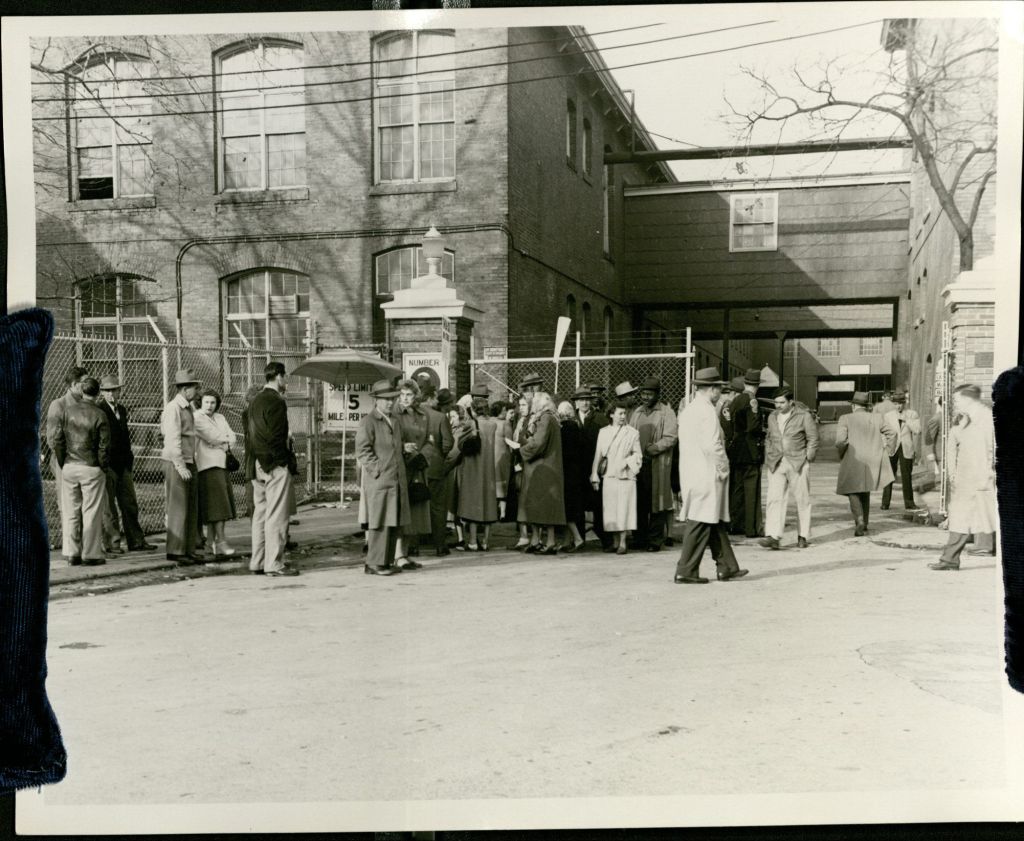
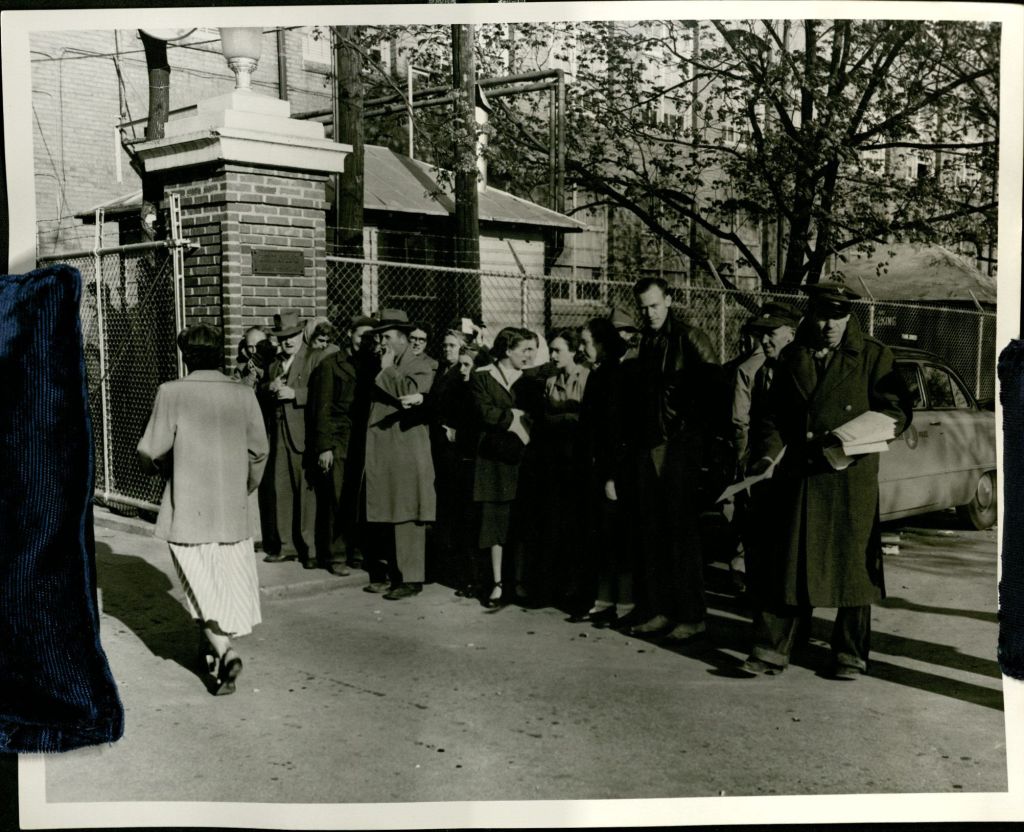
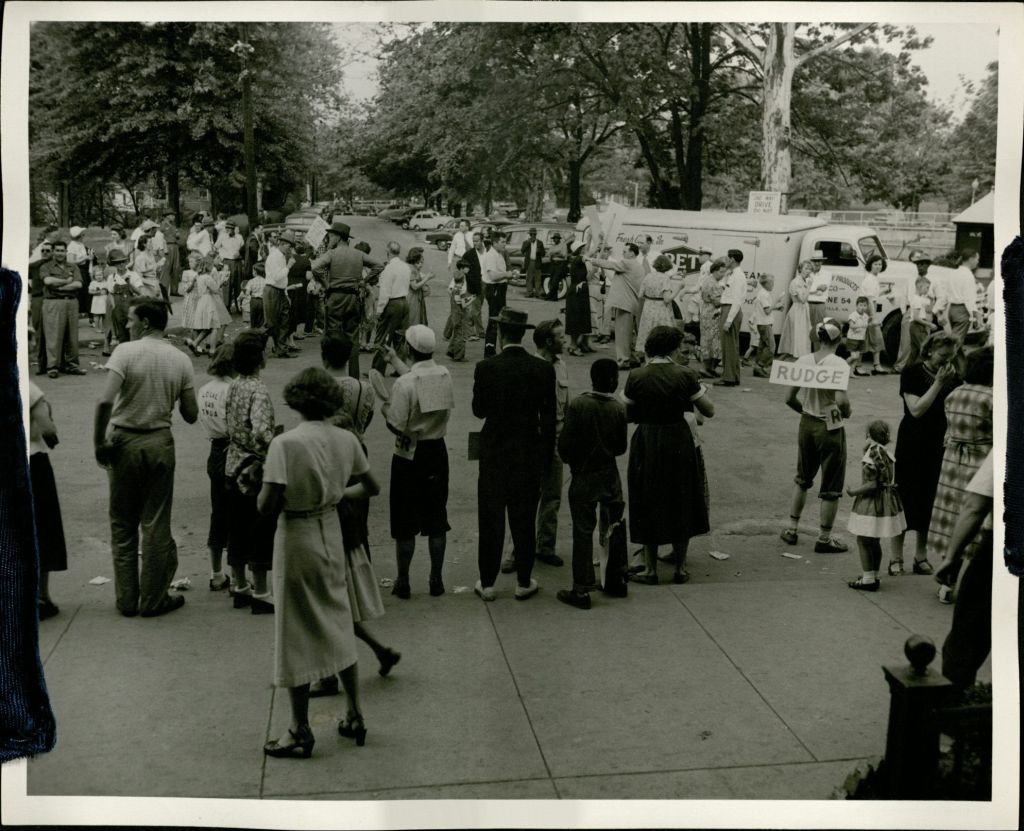
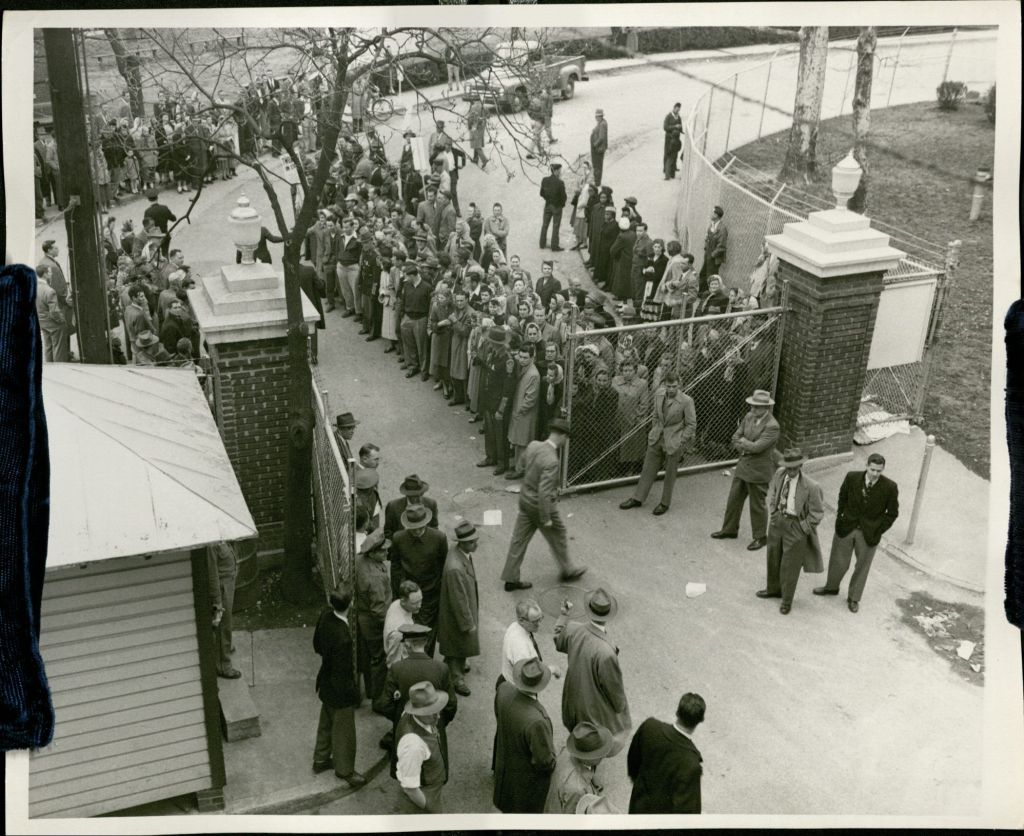
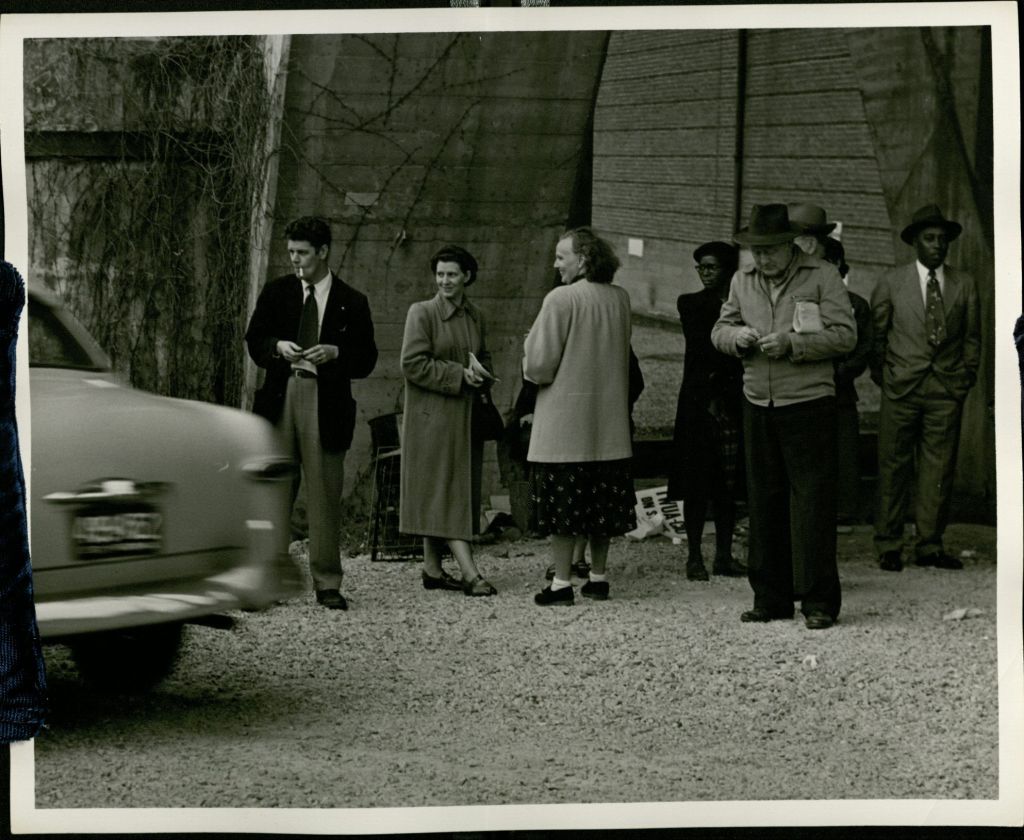
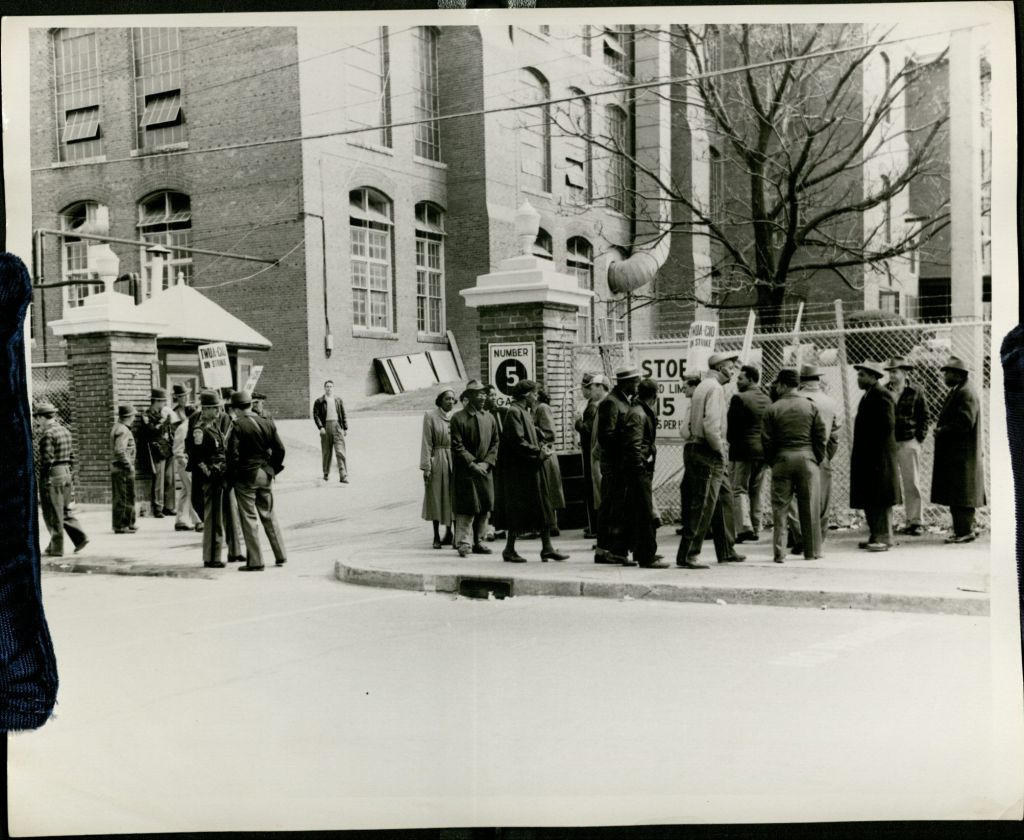
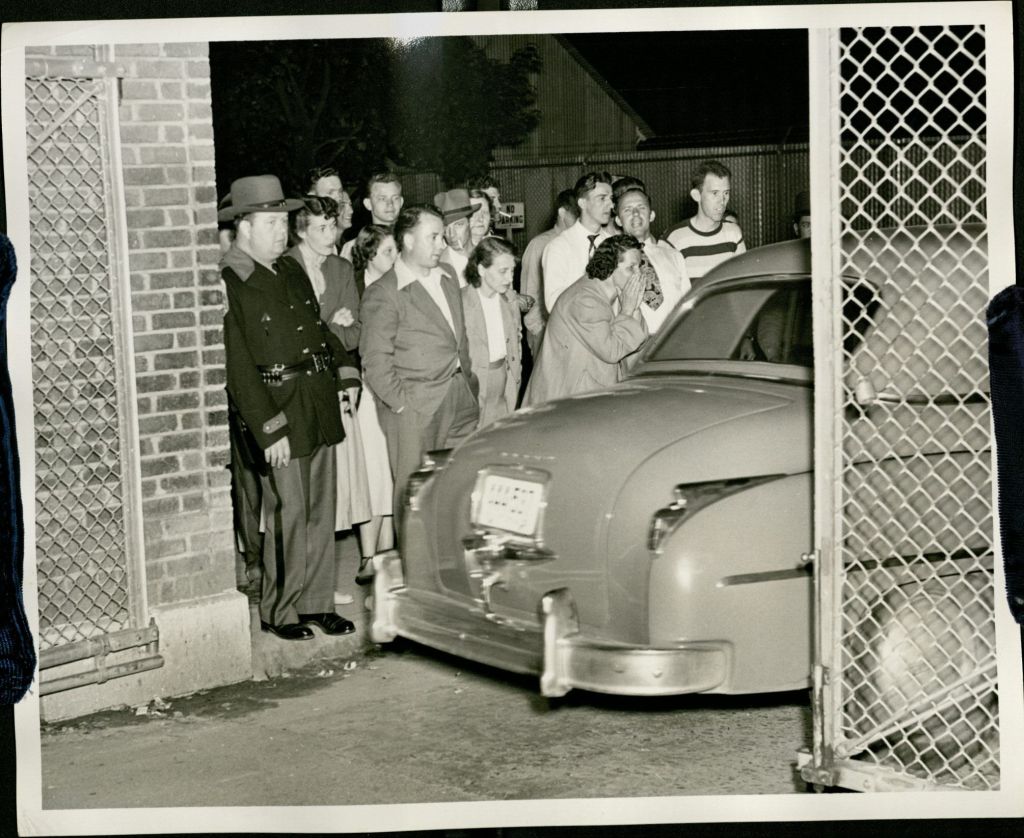
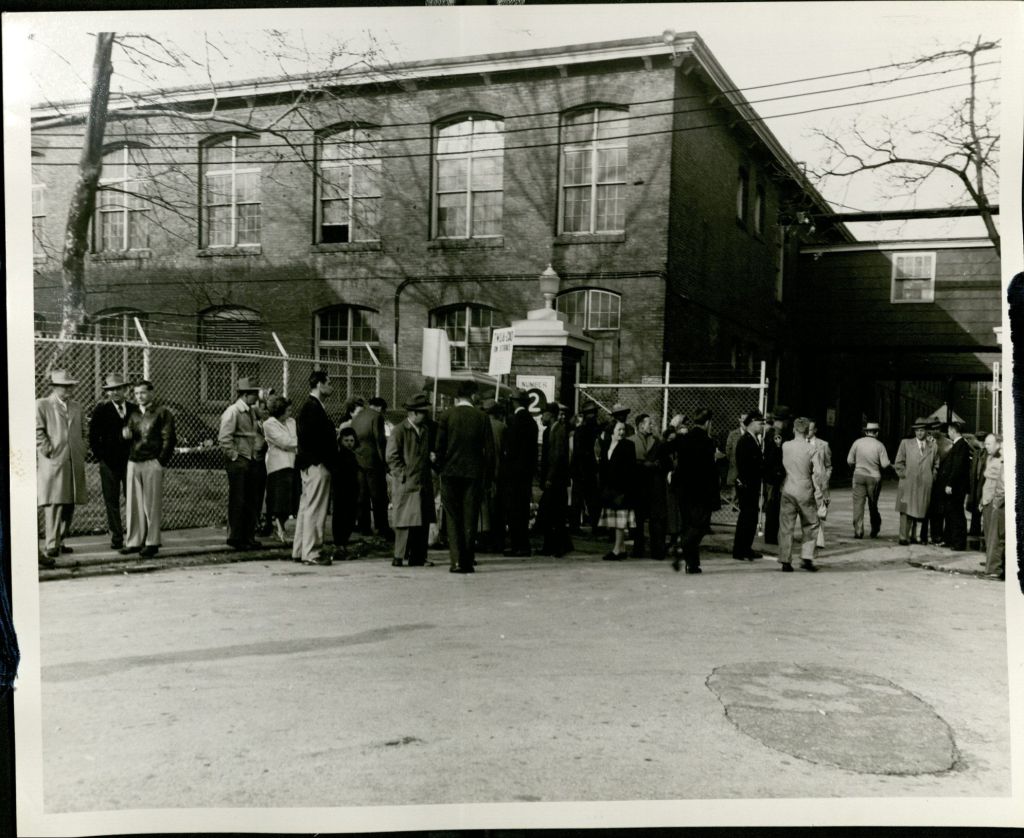
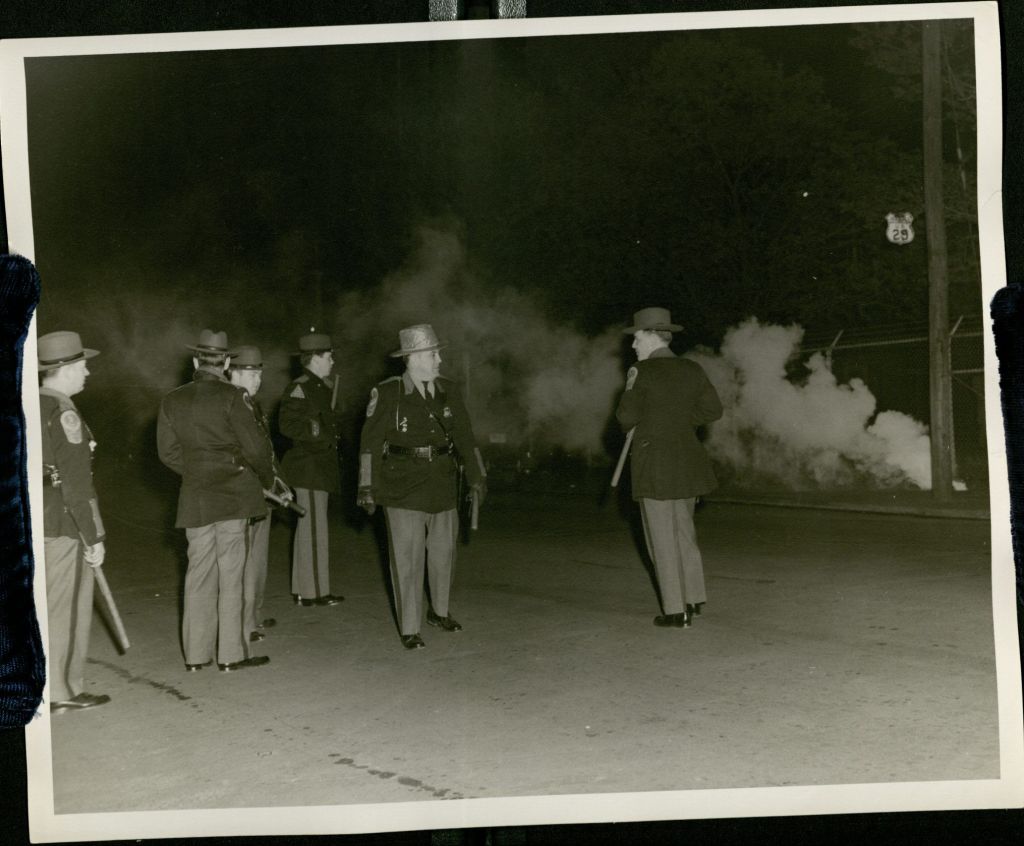
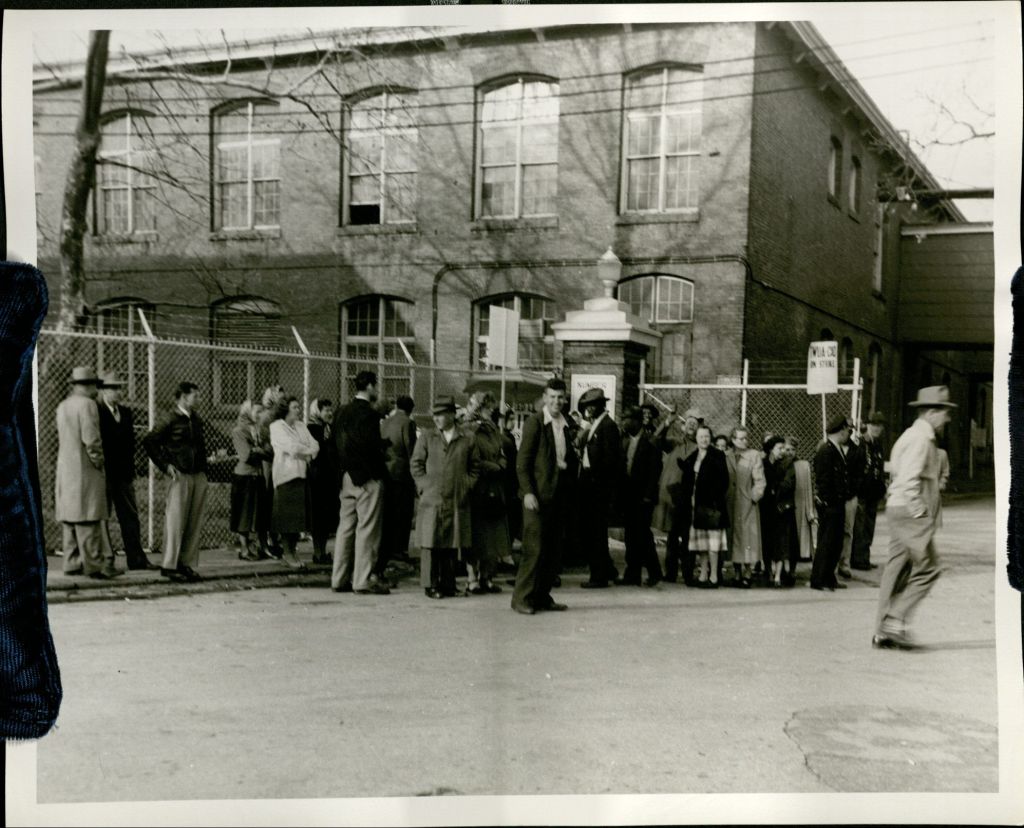
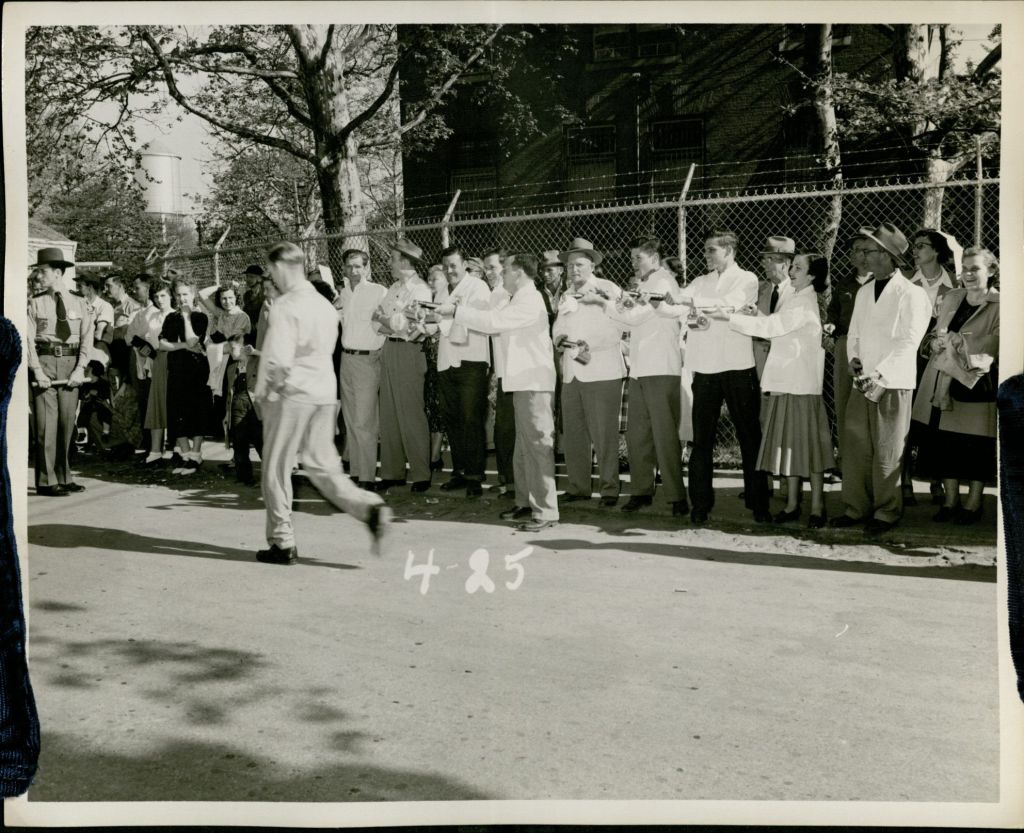
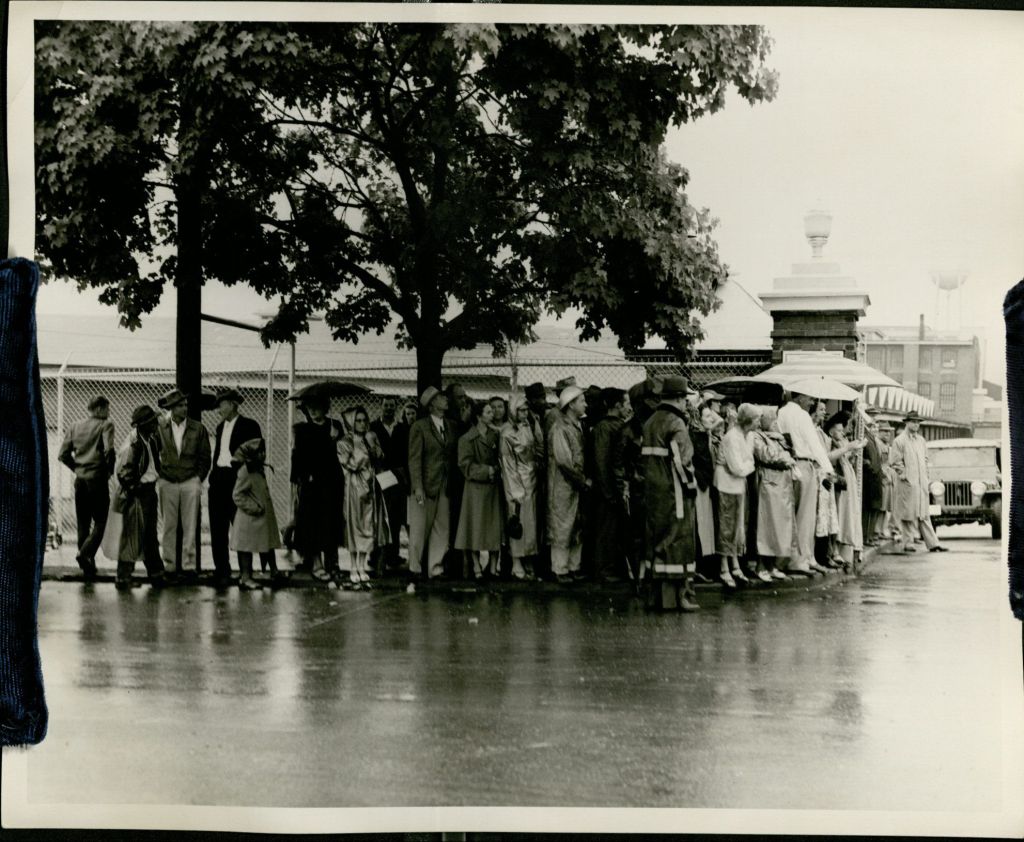
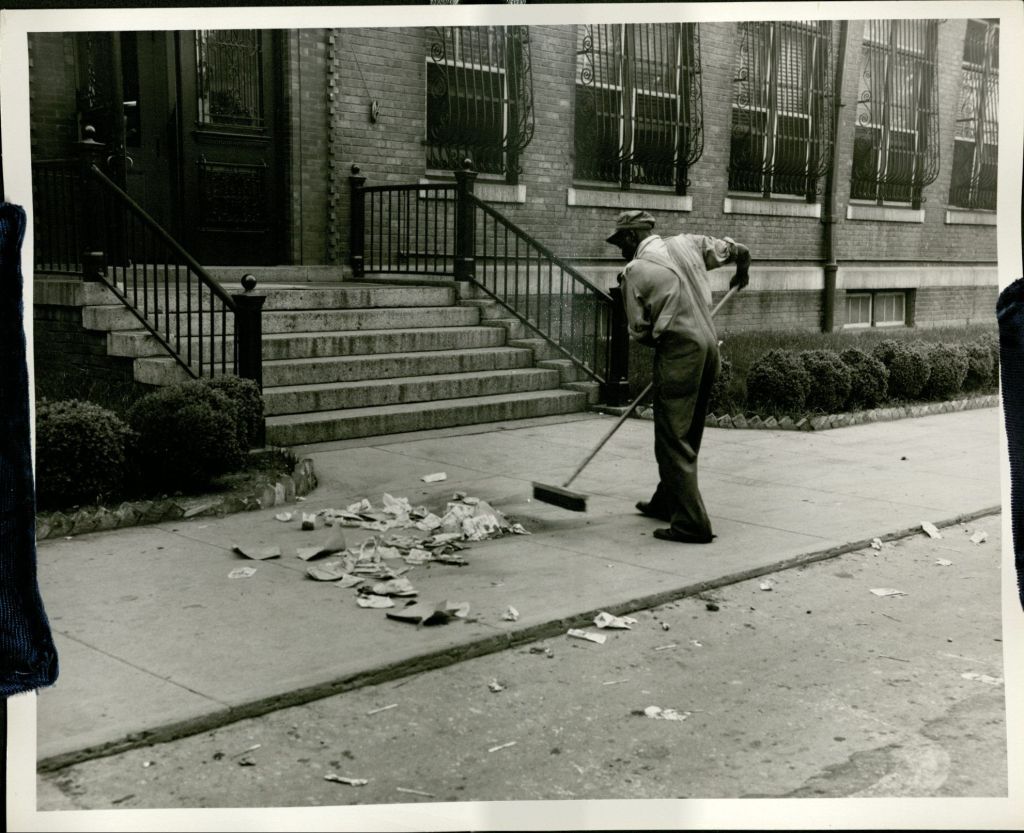
“Danville Moves to Higher Ground.” The Bee. June 1, 1950, page 6. December 1950 – March, 1951 – Textile Workers Union of America (TWUA), Affiliate of the CIO negotiate with Dan River Mills and threaten strike. In April, Dan River Mills workers go on strike led by the TWUA. By May 11th, the TWUA calls off strike at Dan River but tension again ran high in the village, with many divided on whether or not the strike was justified. Below are photos from the strike, courtesy of UNC-Chapel Hill Wilson Library’s Southern Historical Collection Dan River Inc. Papers.
July 1, 1951- Schoolfield annexed by the City of Danville. With Schoolfield’s annexation, the Black population of Danville decreases from 31 percent in 1950 to 24.8 percent in 1960 (from Edmunds, Emma. “Mapping Local Knowledge : Danville, Virginia 1945 – 1975.” Carter G. Woodson Institute for African American and African Studies at the University of Virginia, 2006, timeline).
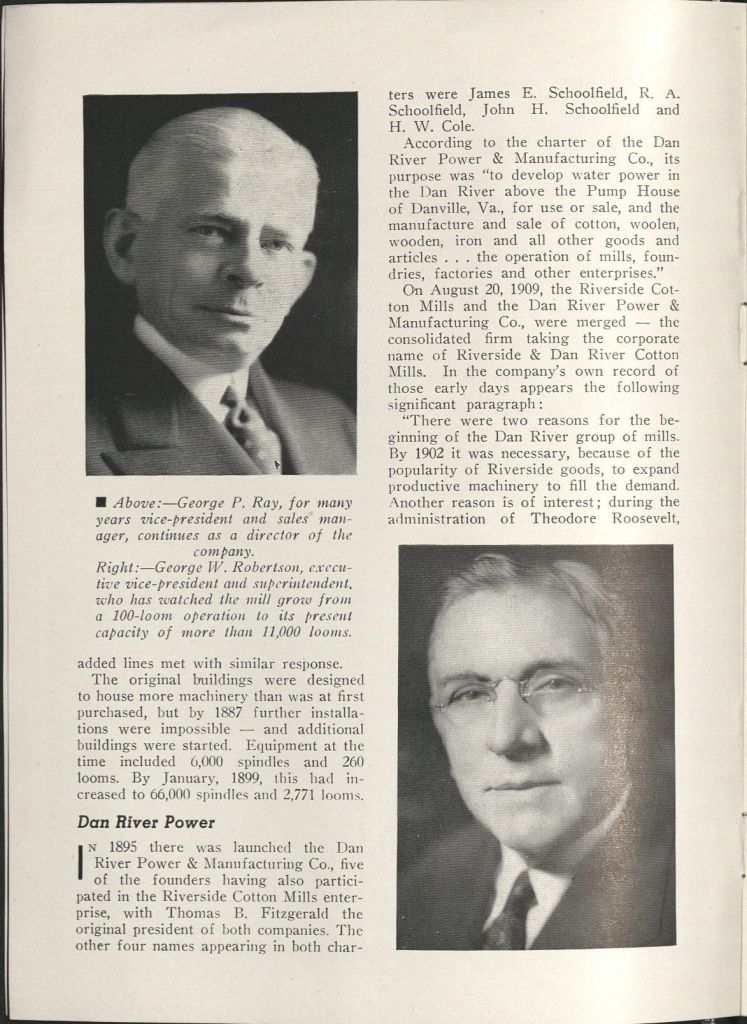
1952 – Russell B. Newton, president and treasurer of Dan River, resigns in November. That same month Basil Browder, who began at Dan River in 1916, is promoted to executive vice president.
1953 – William J. Erwin begins as mill president.
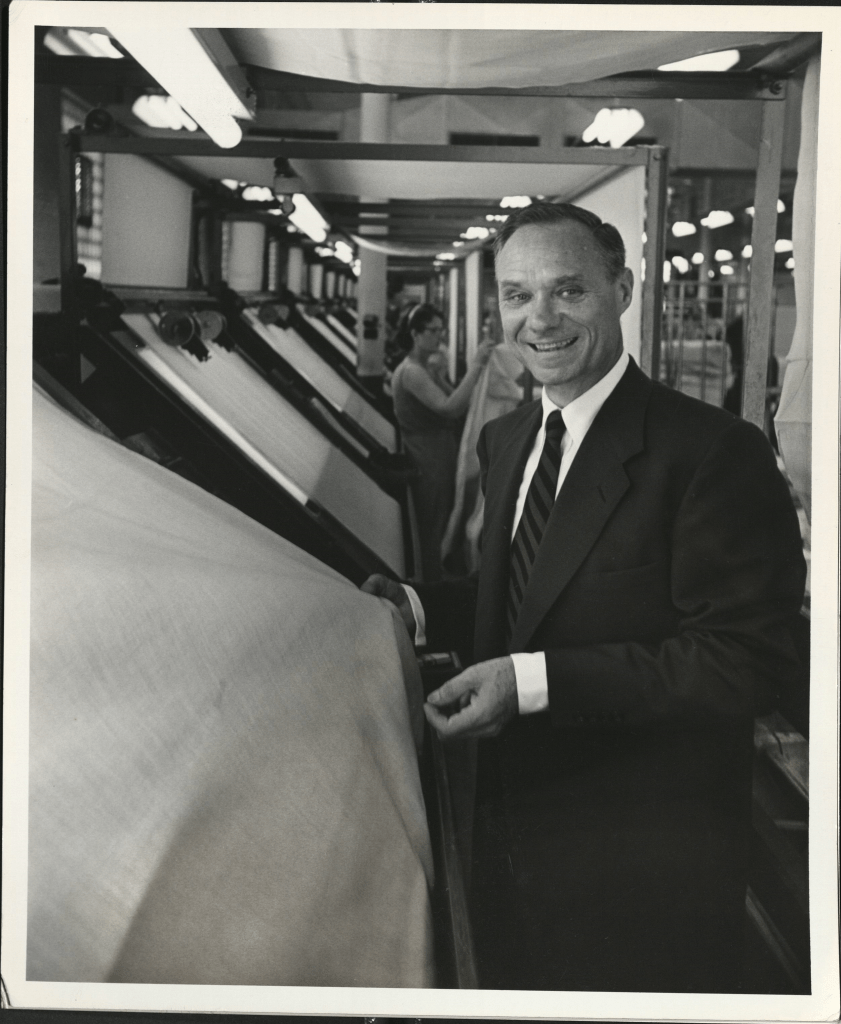
A photo from the 1950s of Erwin. Courtesy of UNC-Chapel Hill Wilson Library’s Southern Historical Collection Dan River Inc. Papers. 1954 – Schoolfield High School, a beloved school for Schoolfielders, closes and the students are merged in with Danville’s George Washington High School.
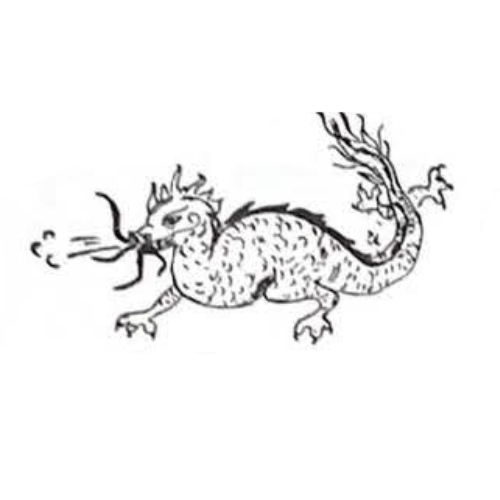
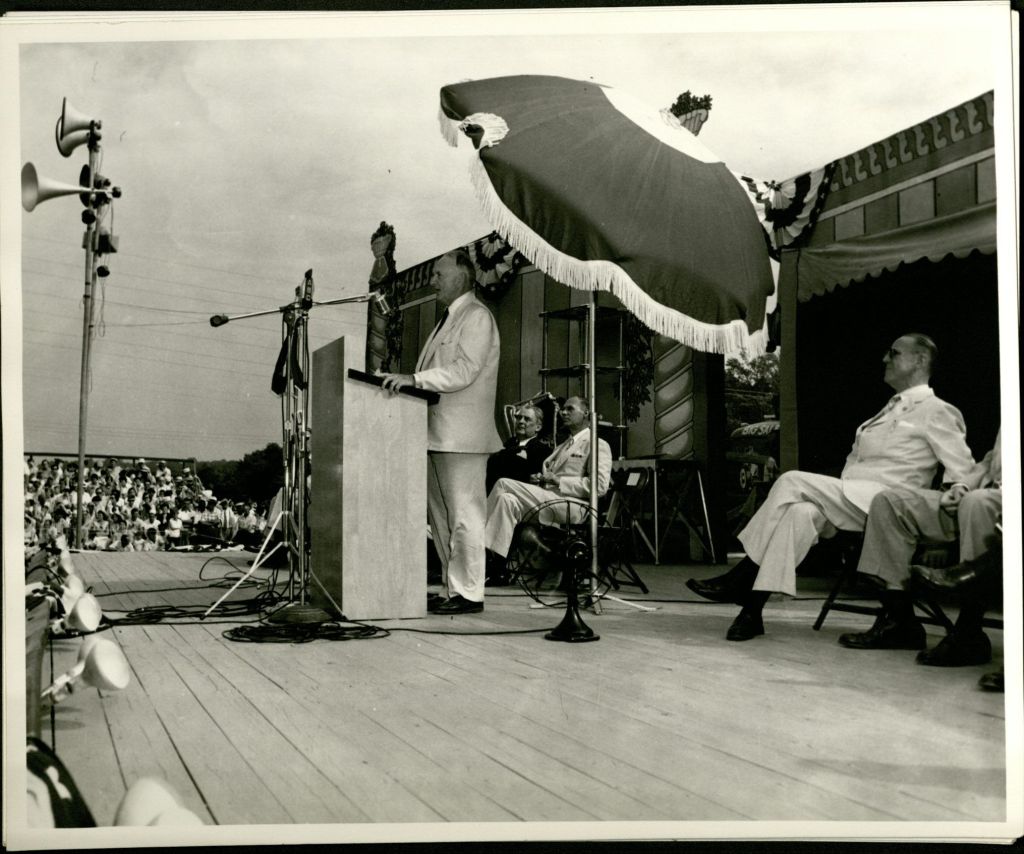
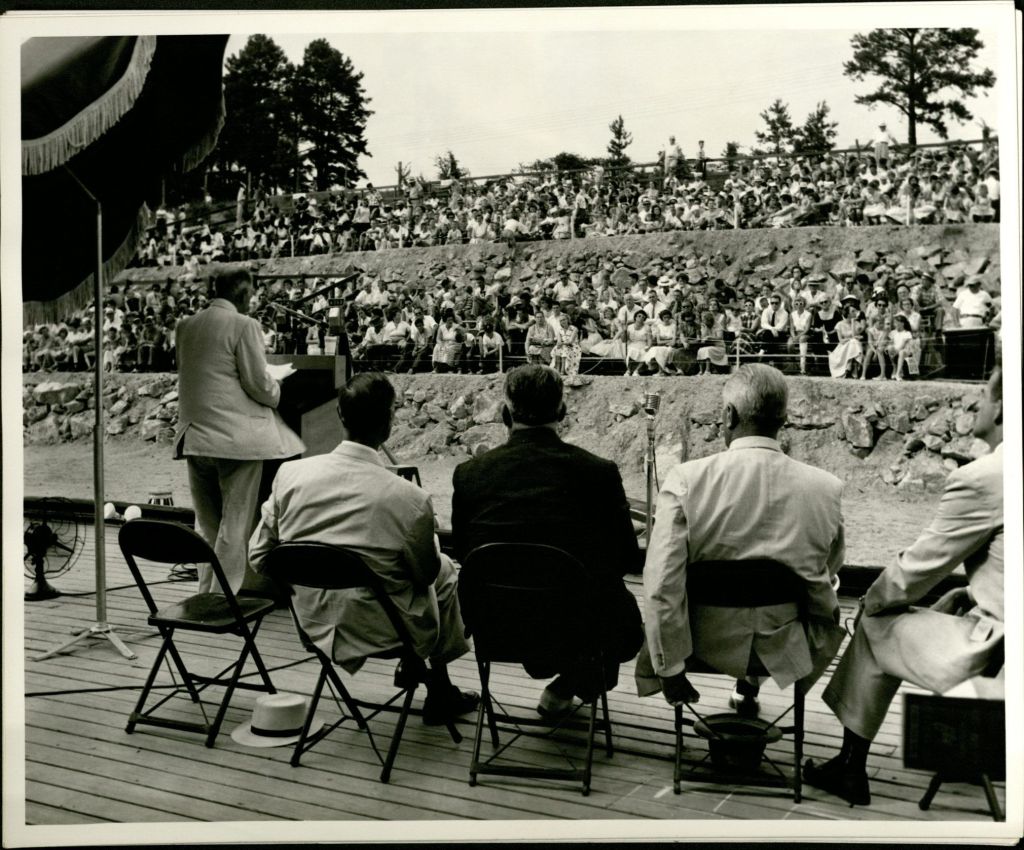
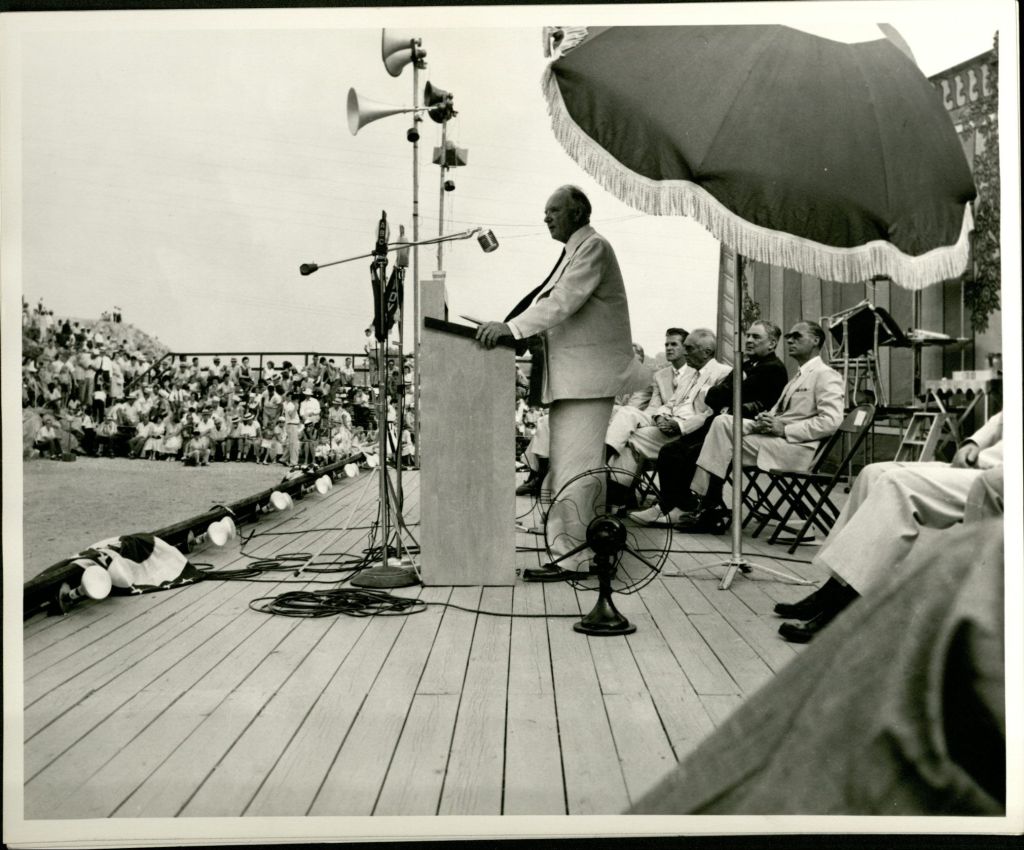
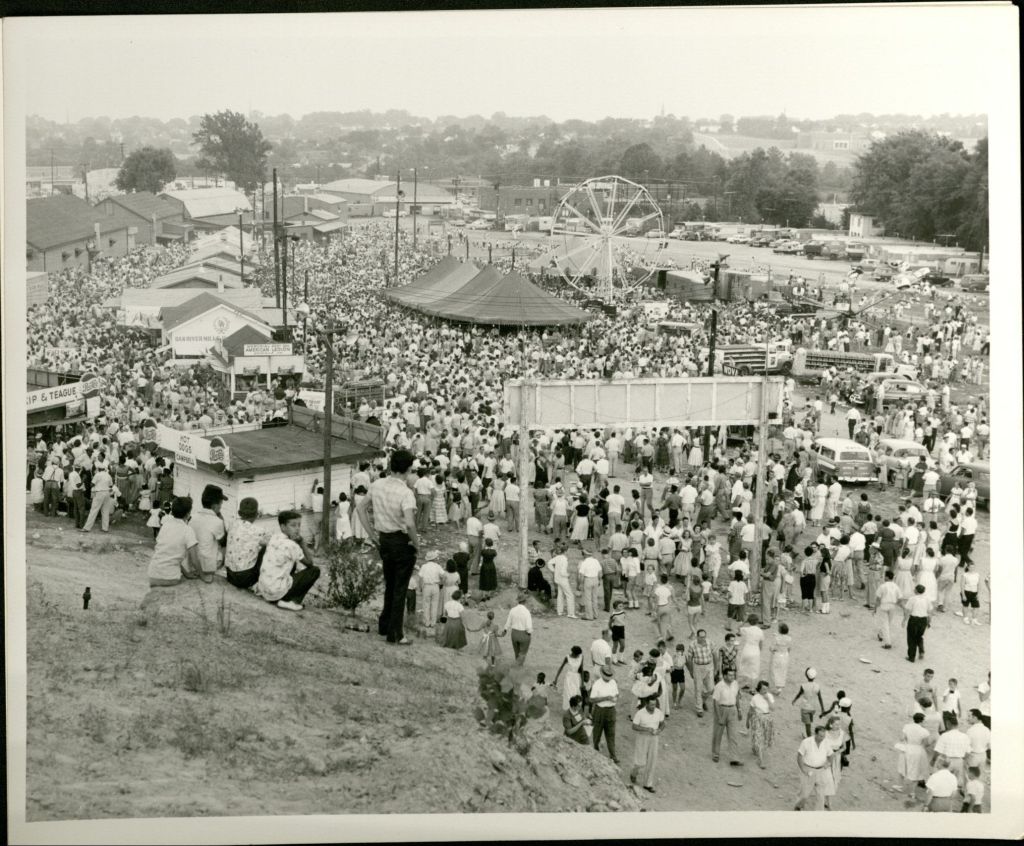
The Schoolfield Dragon, the official mascot of Schoolfield High School. Courtesy of UNC-Chapel Hill Wilson Library’s Southern Historical Collection Dan River Inc. Papers. 1955 – Dan River listed on the New York Stock Exchange. One of the largest groups of Dan River employees is recognized with gold watches for 50 years of service at the company.
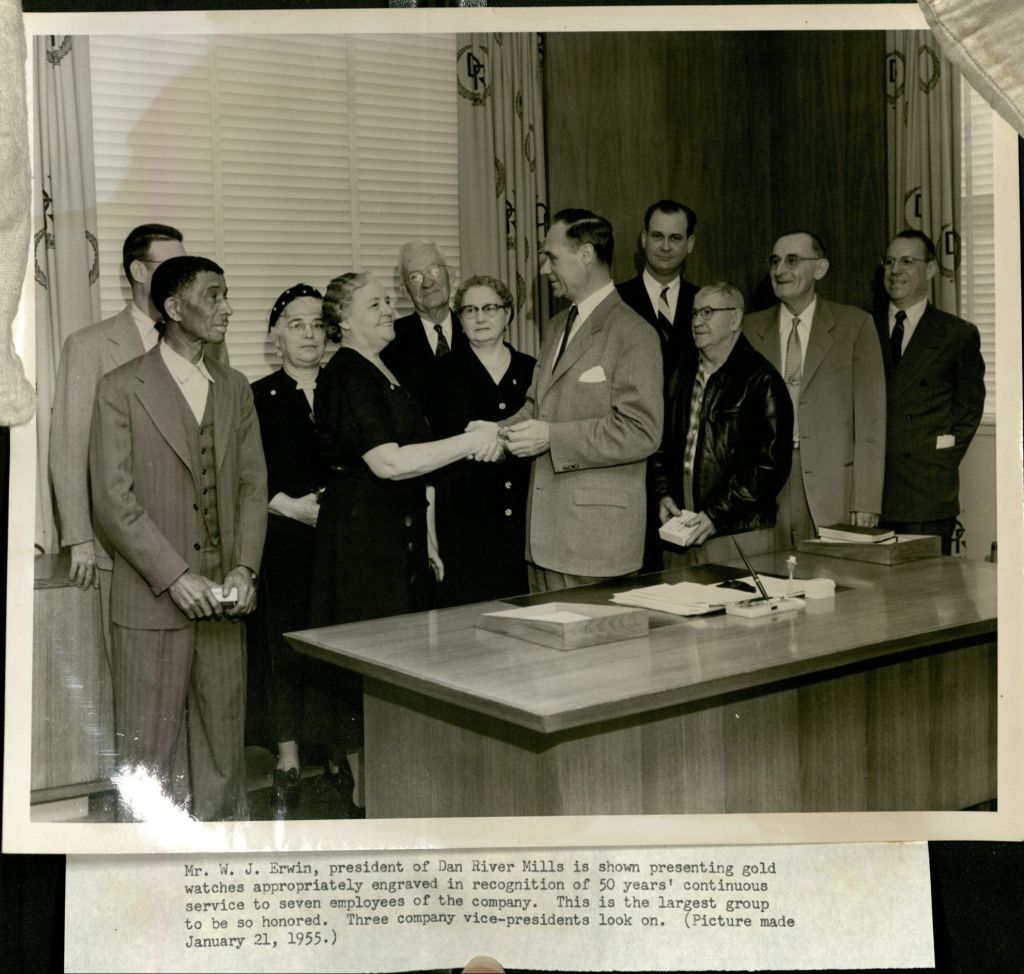
1956 – Dan River acquires Woodside Mills Division in Greenville, South Carolina.
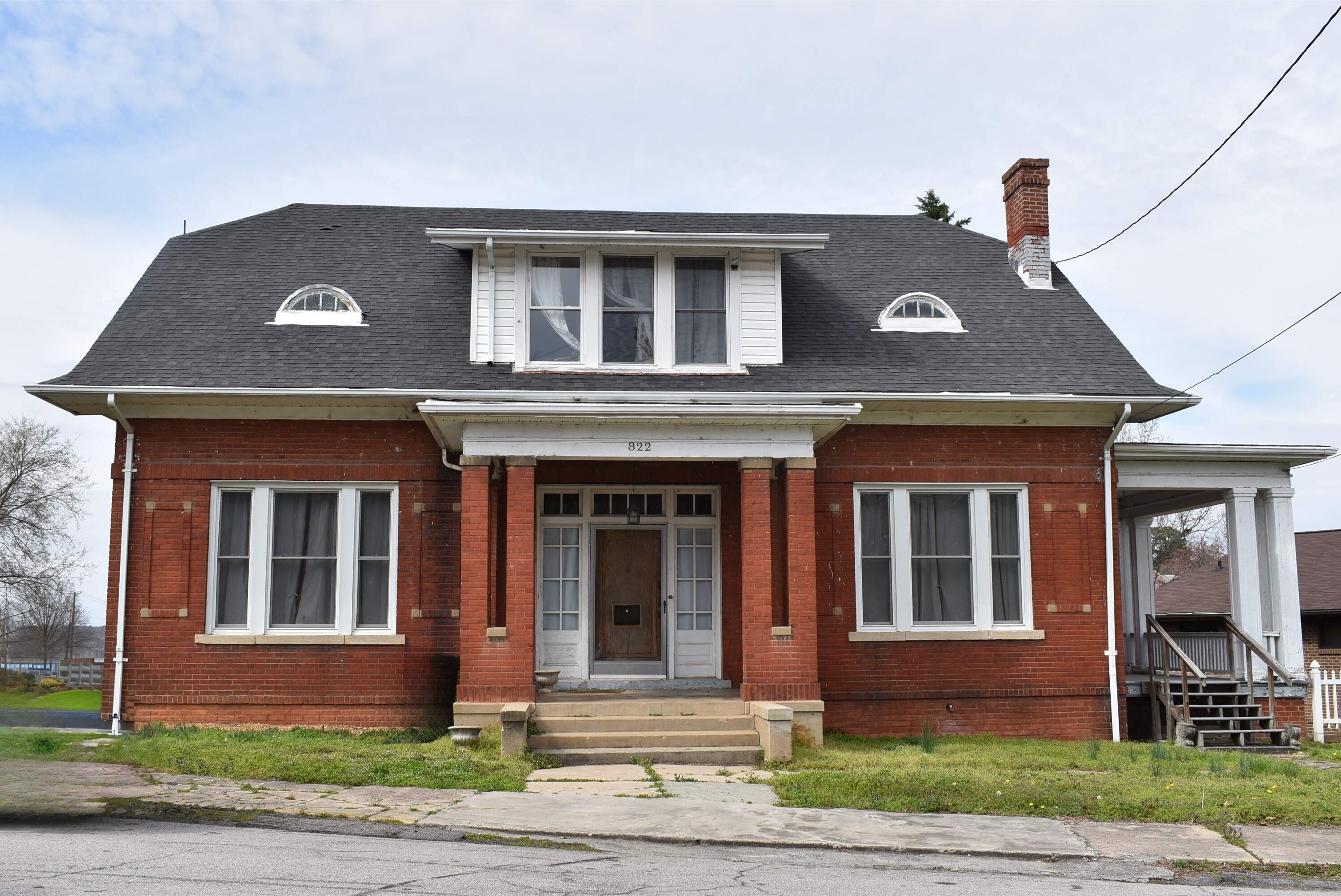
1959 – The local newspaper declares that Schoolfield mill village is all but gone as all mill houses are sold off, save for the orginial Spessard home at 822 W. Main Street.
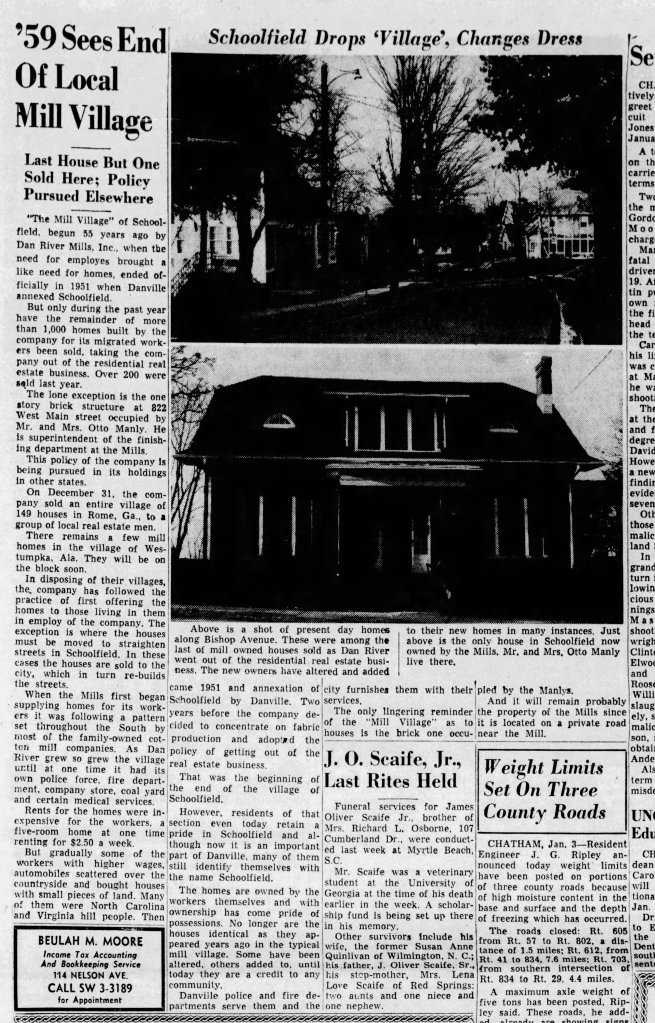
“‘59 Sees End of Local Mill Village.” Danville Register & Bee. January 4, 1959, page 13. Spring 1960 – Inspired by protests against racial segregation in Greensboro, NC, local civil rights groups organize the first protests in the City of Danville at Ballou Park and the Sutherlin Mansion, then the whites-only Danville Public Library.
Summer 1963 – In the summer of 1963 Danville civil rights activists demonstrate against racial segregation in the City of Danville. Demonstrators were met with deputized policemen who wielded billy clubs and fire houses as they demonstrated on what became known as Bloody Monday on June 10, 1963. Later, injunctions and ordinances railed against protestors limited their demonstrations. During the summer, the Student Nonviolent Coordinating Committee (SNCC) organized a general boycott of the Danville, Virginia-based textile giant Dan River Mills. Following previous city-sanctioned violence against civil rights activists in Danville, SNCC protesters wanted “the [Dan River] owners to use their influence” to stop further “police brutality and to provide equal job opportunities for Negroes.” As the largest employer in Danville, and the largest property owner, Dan River Mills did have influence. Managers at the company could have modeled a way forward for Danville by integrating black Danvillians into their 14,000 strong workforce in the 1960s. Other southern textile company towns, such as LaGrange, Georgia had quietly hired black workers into their workforce between 1925 and 1969. In Danville, Dan River allowed some black workers to work at the company as janitors, truck drivers, and plumbers. Yet Dan River resisted an open effort towards SNCC goals: integrate the mill’s operative and supervisory positions, historically held by white workers regardless of qualifications for the job.
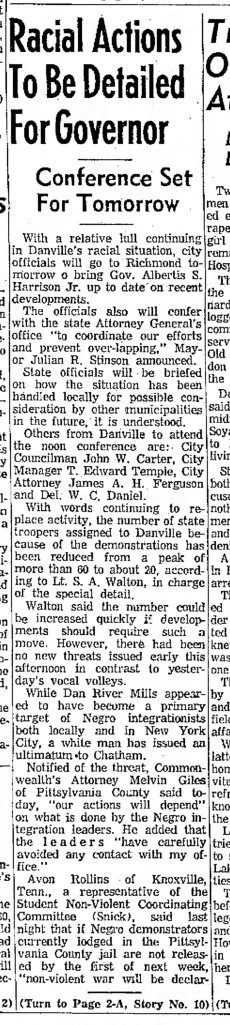
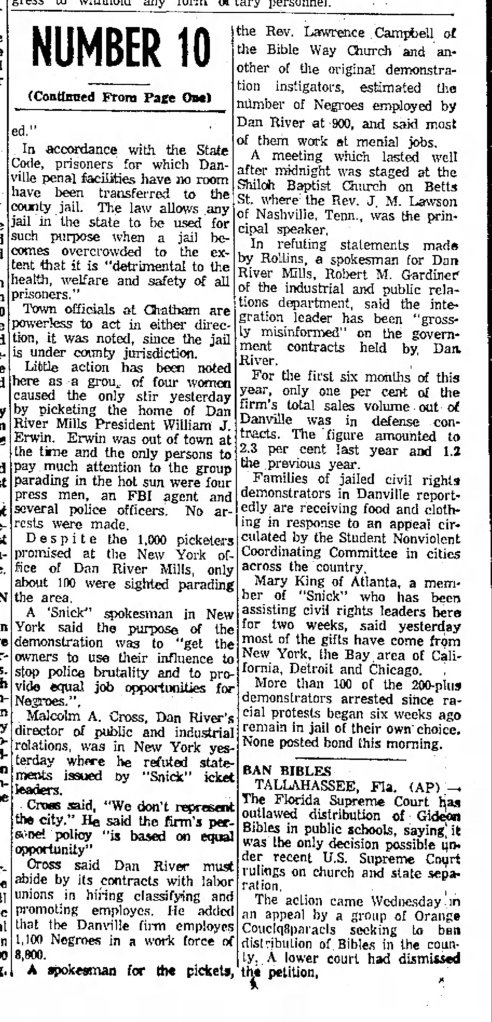
Racial Actions to Be Detailed for Governor.” The Bee. “July 18, 1963, sec. A 1964 – White, Georgia-based Kingston Mills and Roanoke, Va-based company, Marco, is acquired by Dan River Mills.
1965 – Dan River acquires multiple industrial corporations: Wunda Weave Plant; Spartanburg County, S.C.-based Clifton Manufacturing Co.; and Burlington, NC-based Webco Mills. In September, Dan River Buys its first company airplane “to facilitate executive travel within its expanding, geographically dispersed organizations. The plan, a twin turbine-powered Beechcraft King Air, will be based at the Danville Airport. Delivery is expected in December” (Dan River Focus Publication, October 1965 Page 3, Box 70 UNC archives).
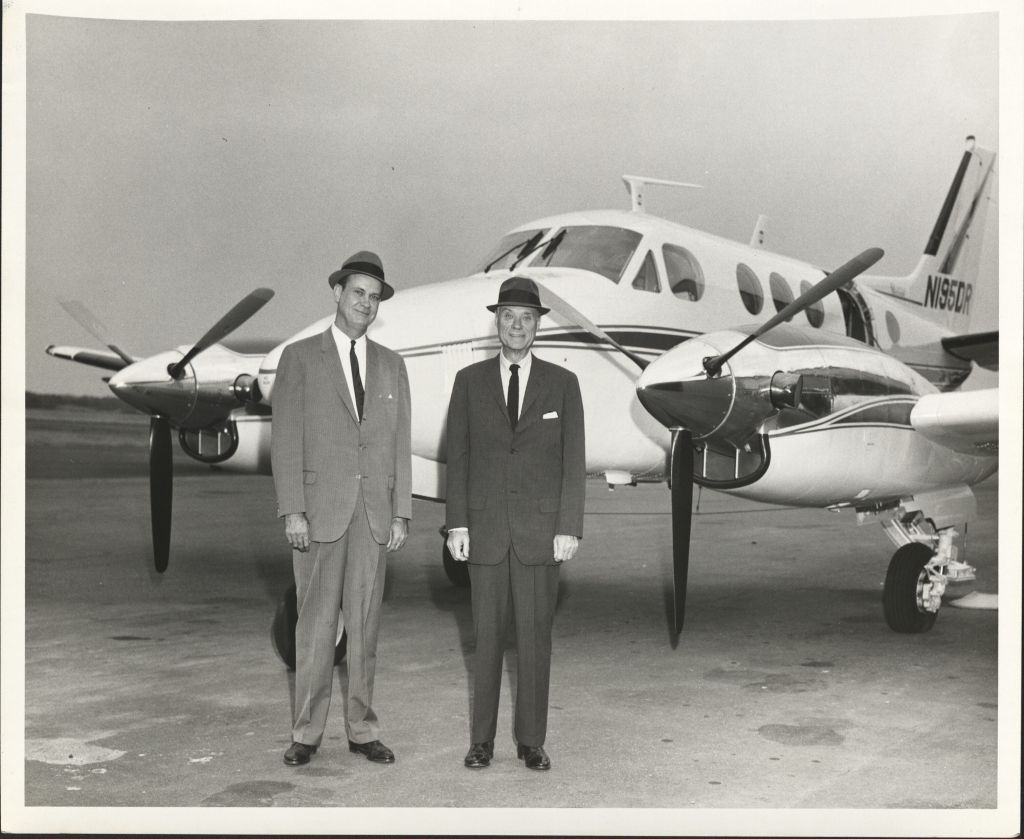
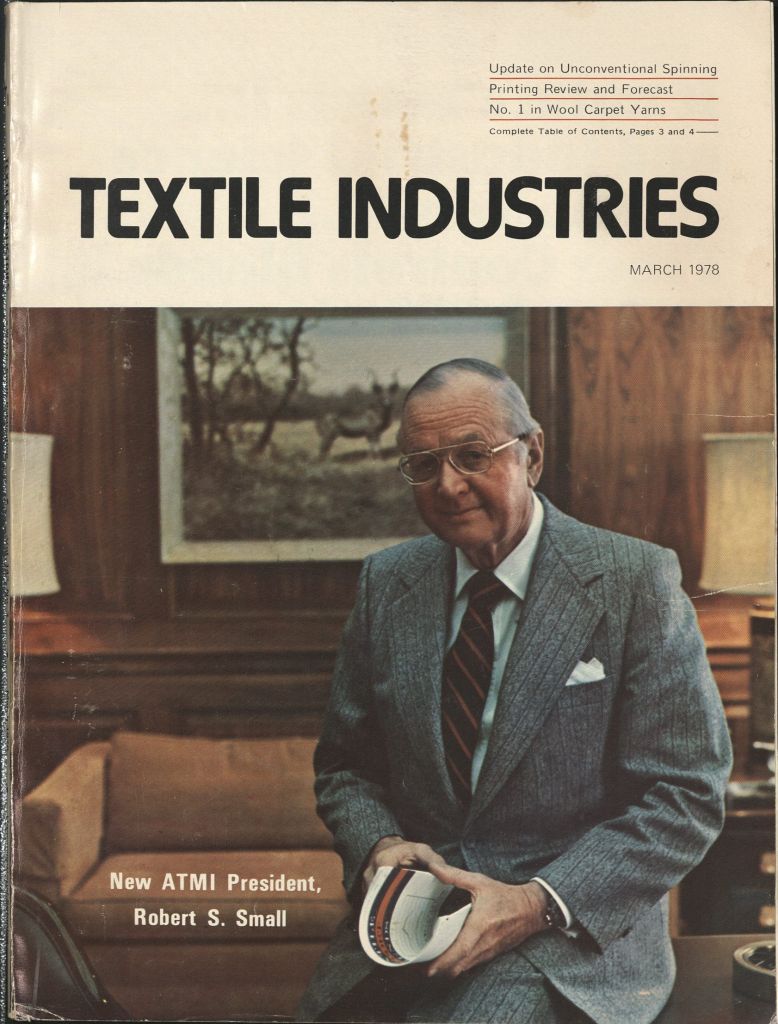
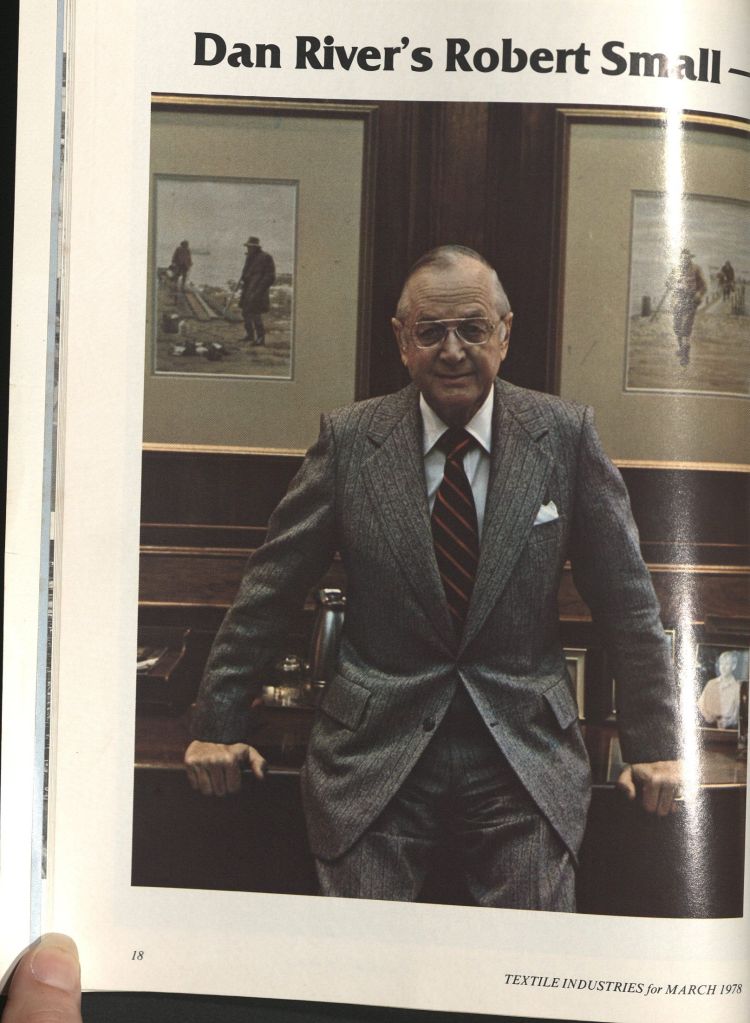
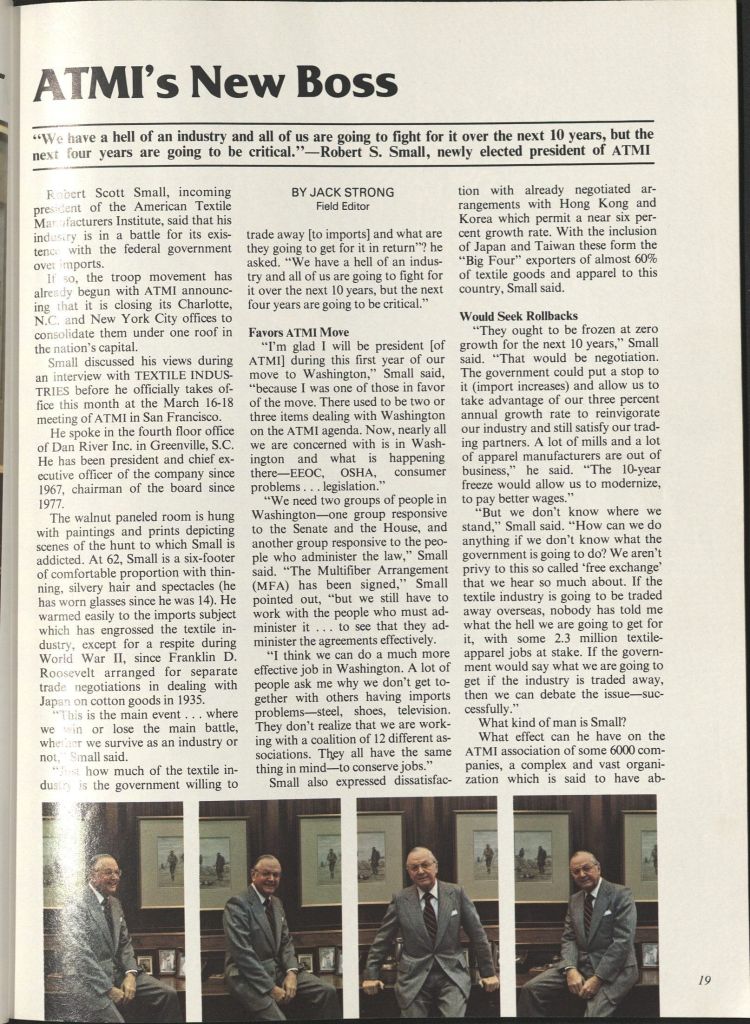
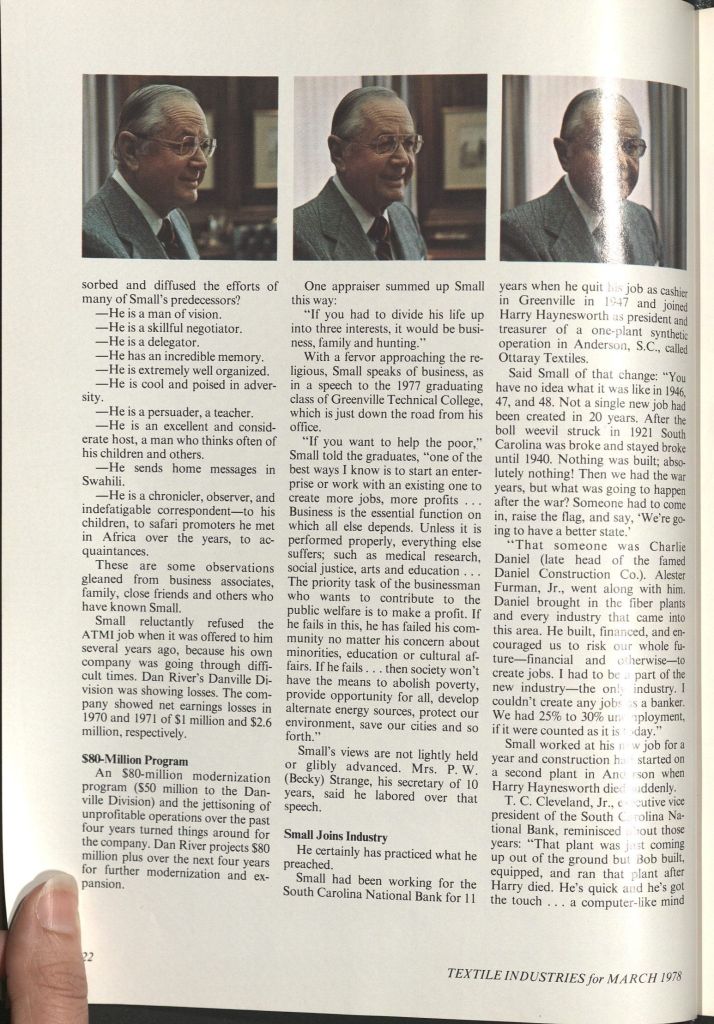
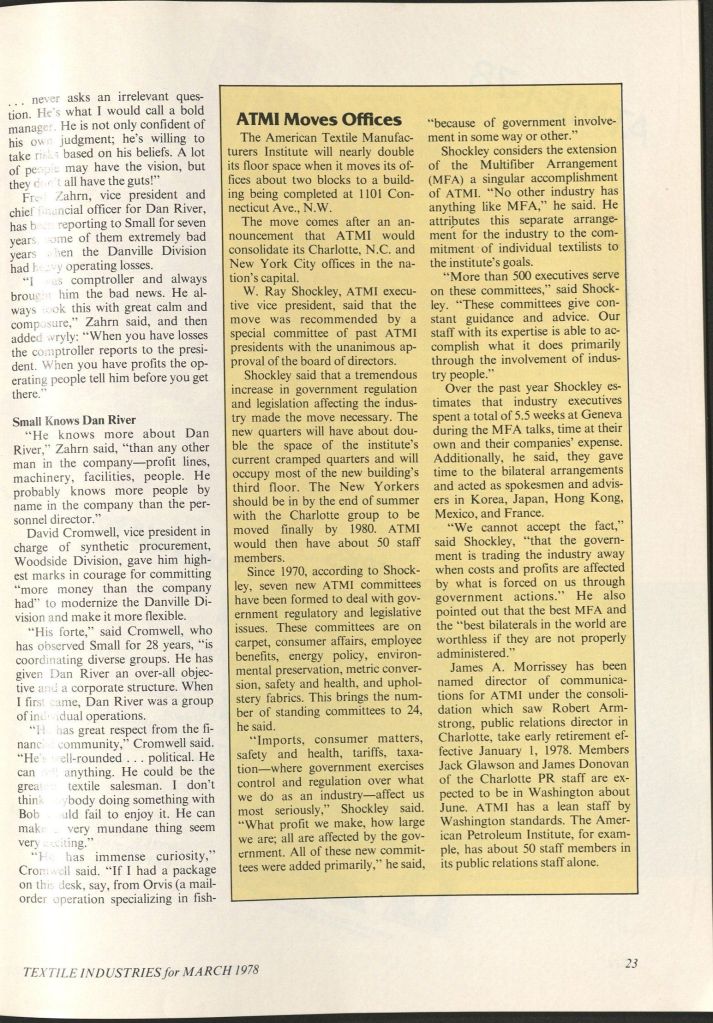
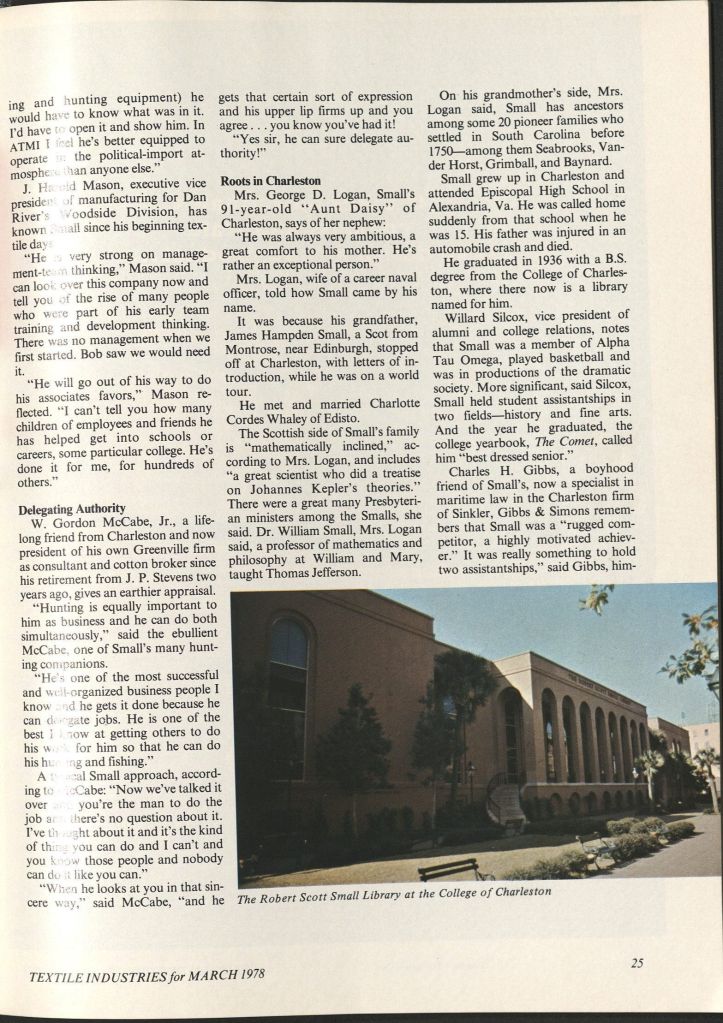
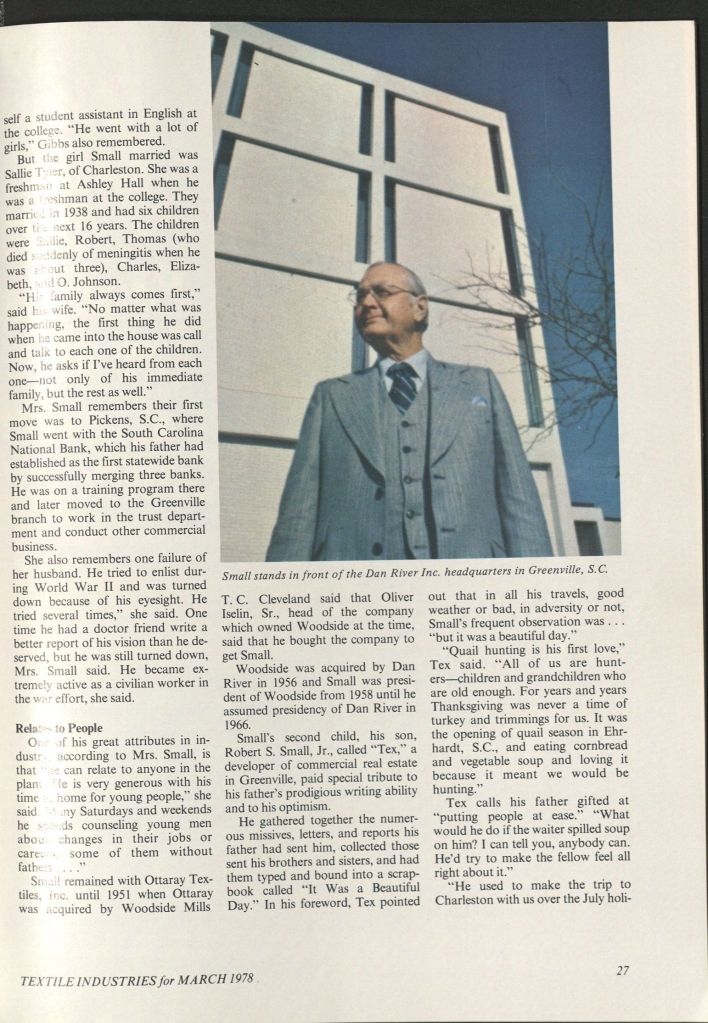
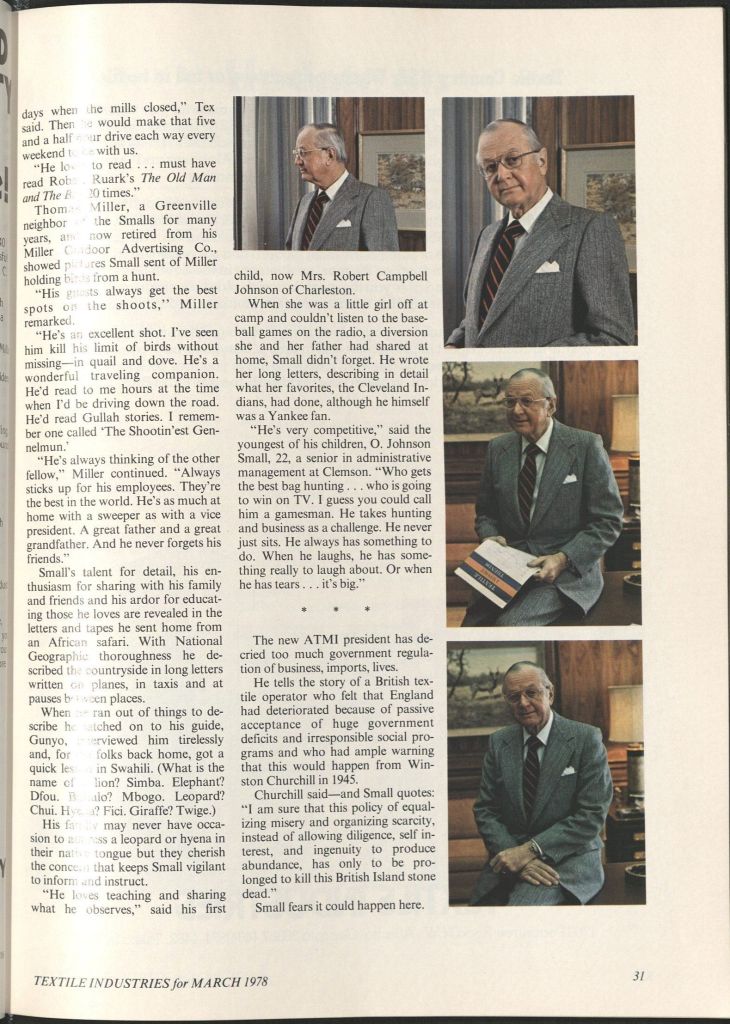
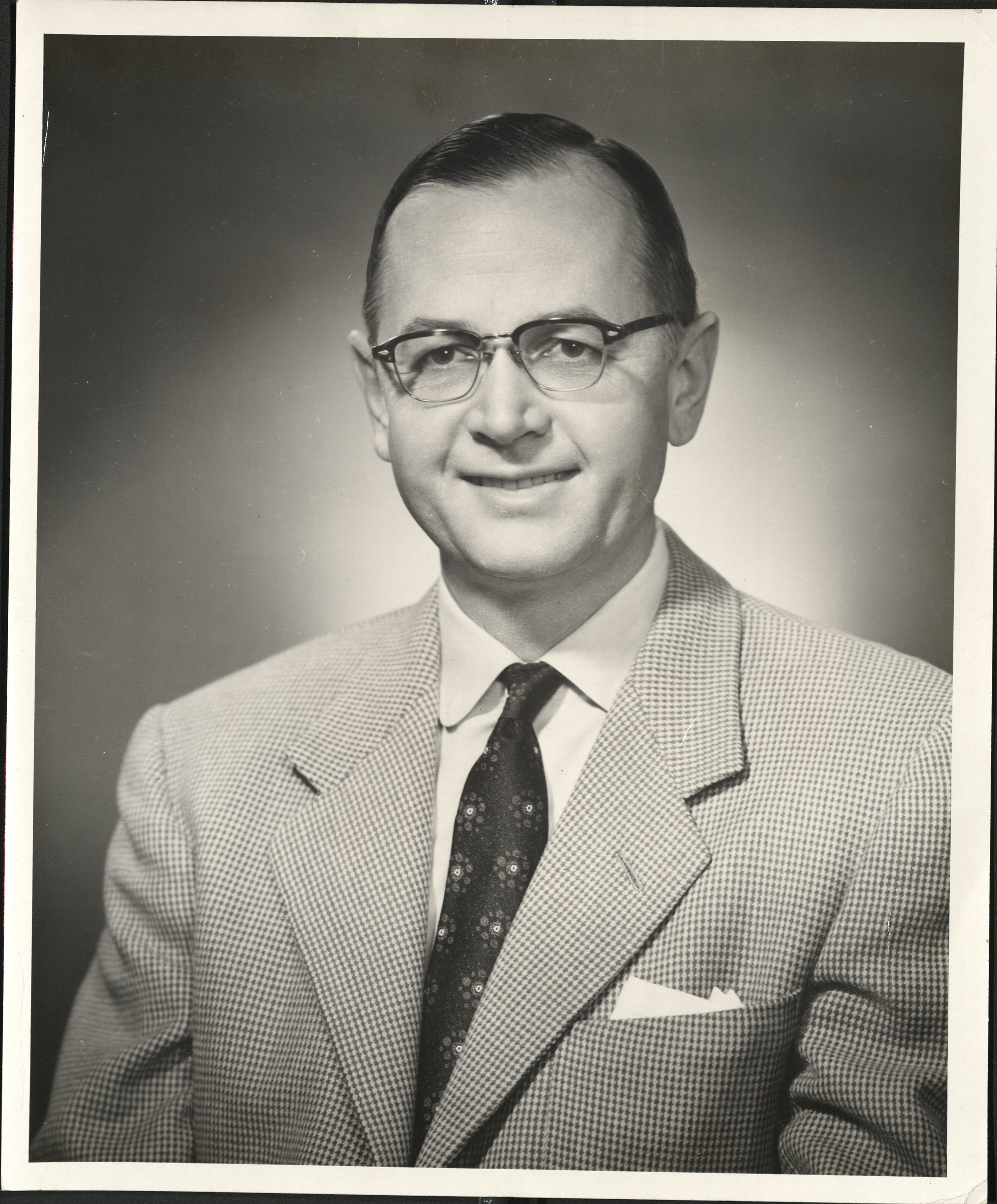
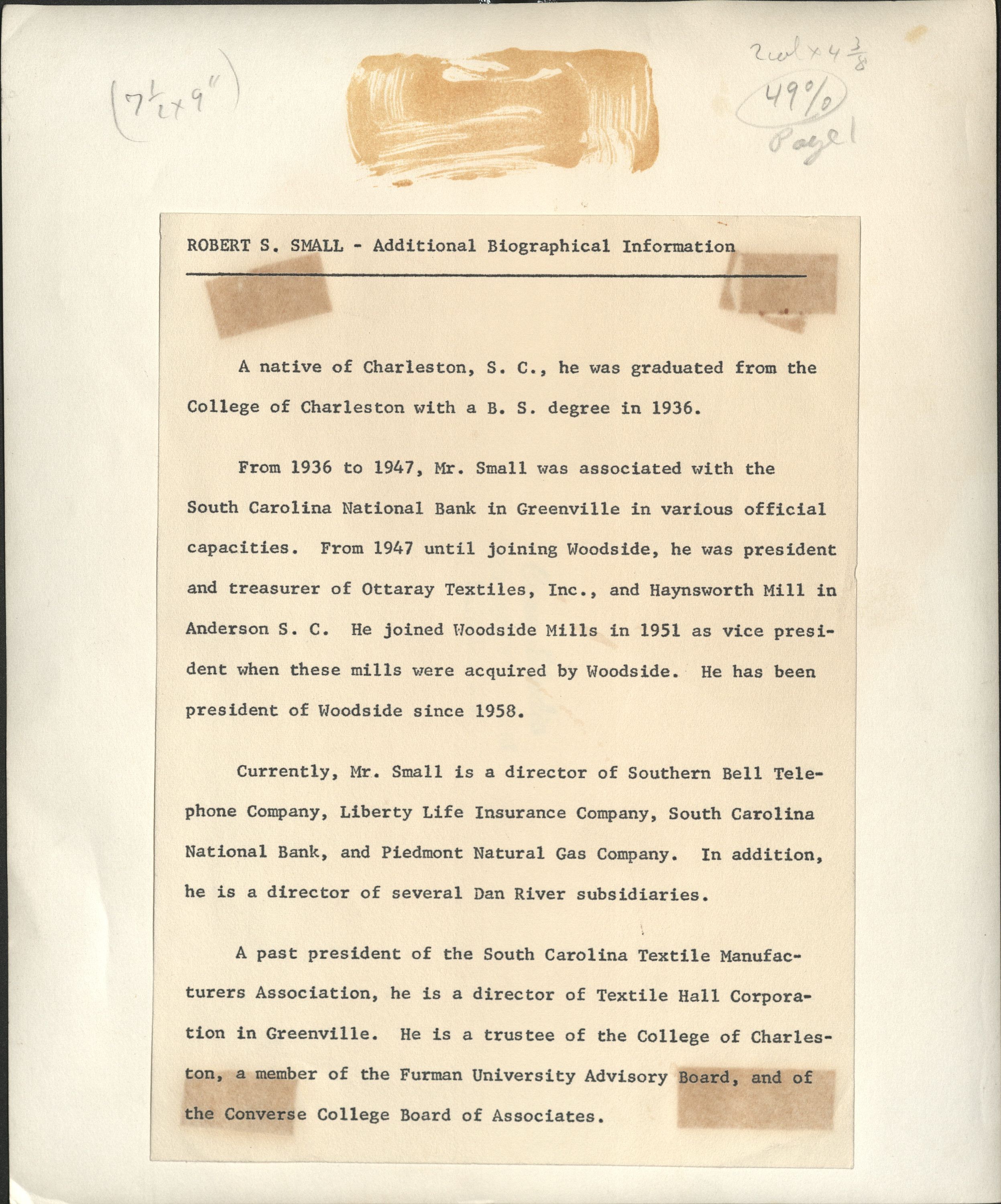
President Erwin and other management stand by the new Dan River company plane. Courtesy of UNC-Chapel Hill Wilson Library’s Southern Historical Collection Dan River Inc. Papers 1966 – Robert S. Small begins his tenure as president of Dan River. Below, Robert Small is pictured in a profile on his role as president of the American Textile Manufacturers Institute in a March 1978 magazine. The last photos is a portrait from the 1960s of Small and a brief background. Courtesy of UNC-Chapel Hill Wilson Library’s Southern Historical Collection Dan River Inc. Papers.
December 1966 – Dan River’s director of education and training, W. Leigh Taylor (white), pens a letter decrying Judge A.M. Aikens sentencing of demonstrators from the 1963 Civil Rights demonstrations in Danville. As a result of the letter, Aikens has Taylor arrested at his Dan River office and sentences Taylor to ten days’ work on the City Farm in addition to a $50 fine for contempt of court.
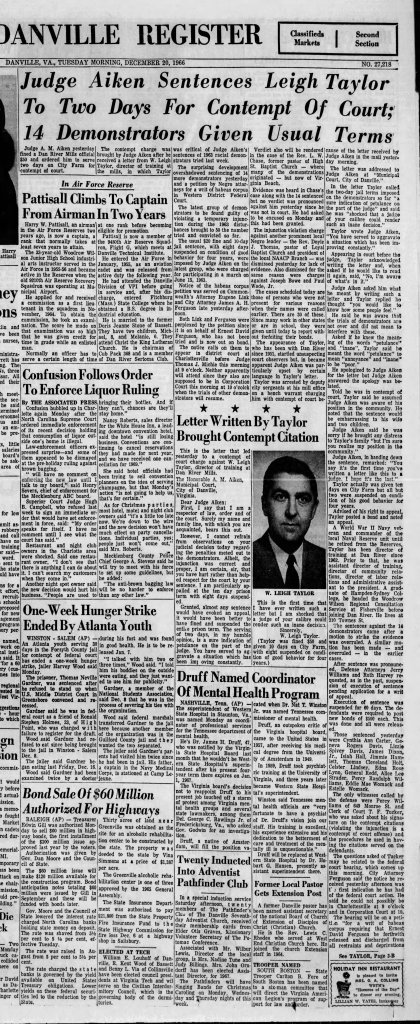
“Judge Aiken Sentences Leigh Taylor to Two Days for Contempt of Court.” The Register. December 20, 1966, sec. B. 1967 – Dan River completes its new Executive Office Building. The modern and sleek Miesian style building, secluded from the everyday workings of the mills secured its image as a corporate giant.
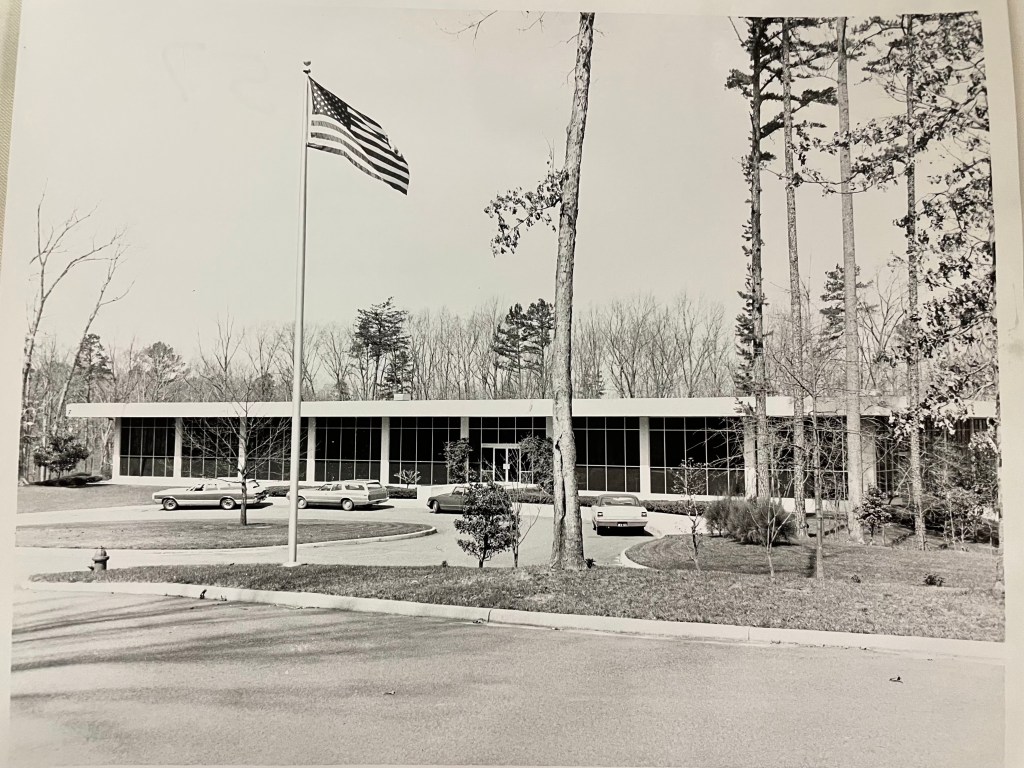
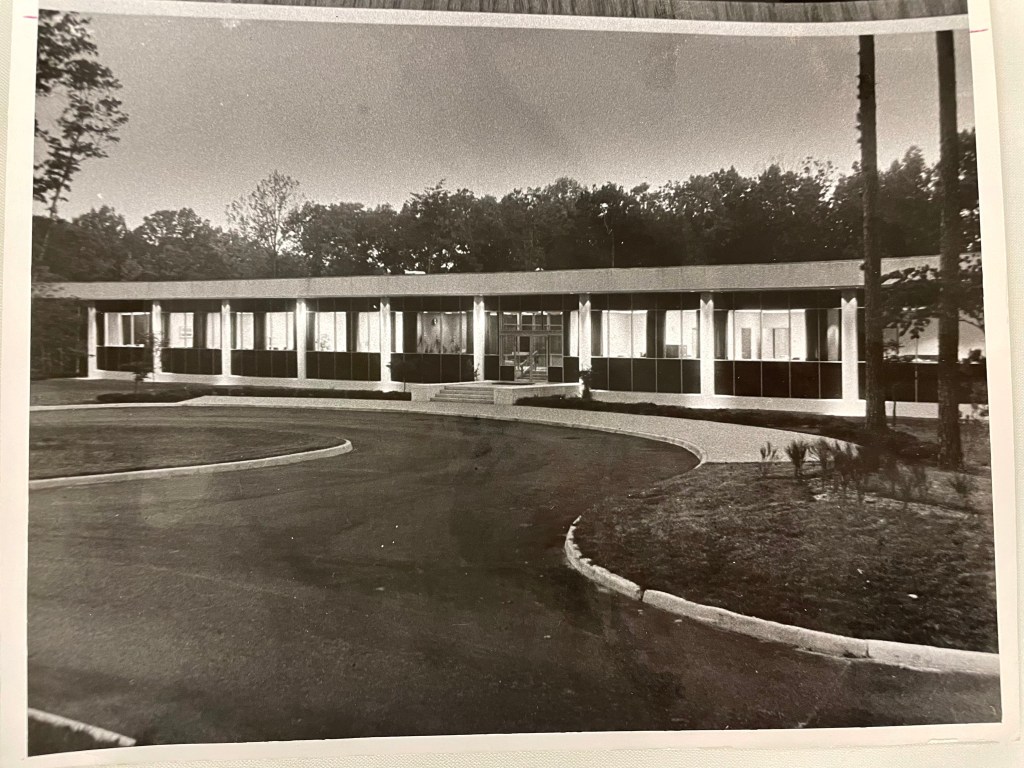
Photos from the 1970s Danville Chamber of Commerce Files. Courtesy of the Danville Historical Society. 1969 – Dan River is sued for unlawful discrimination in hiring practices under the lawsuit Julious Adams et al. v Dan River Mills, Inc. Wielding the Equal Employment Opportunity Commission of the 1964 Civil Rights Act, Adams and at least twenty-five other Black plaintiffs successfully sued the company for its segregationist policies and racially biased hiring and promotion practices. As a result of this lawsuit, Dan River was required to begin considering Black workers for production jobs for the first time in its almost 100-year history. The biggest impact this litigation had on the southern textile industry was on the hiring of Black women, who had in some cases made up as little 0.2 percent of the production workforce and had often faced more hiring discrimination than Black male workers.
1970 – Dan River Mills, Incorporated becomes Dan River, Incorporated aka Dan River Inc. The company reports its first profit loss in thirty years.
1972 – Park Place Mercantile Company, a long established store in the commercial section of the village since 1903, closes.
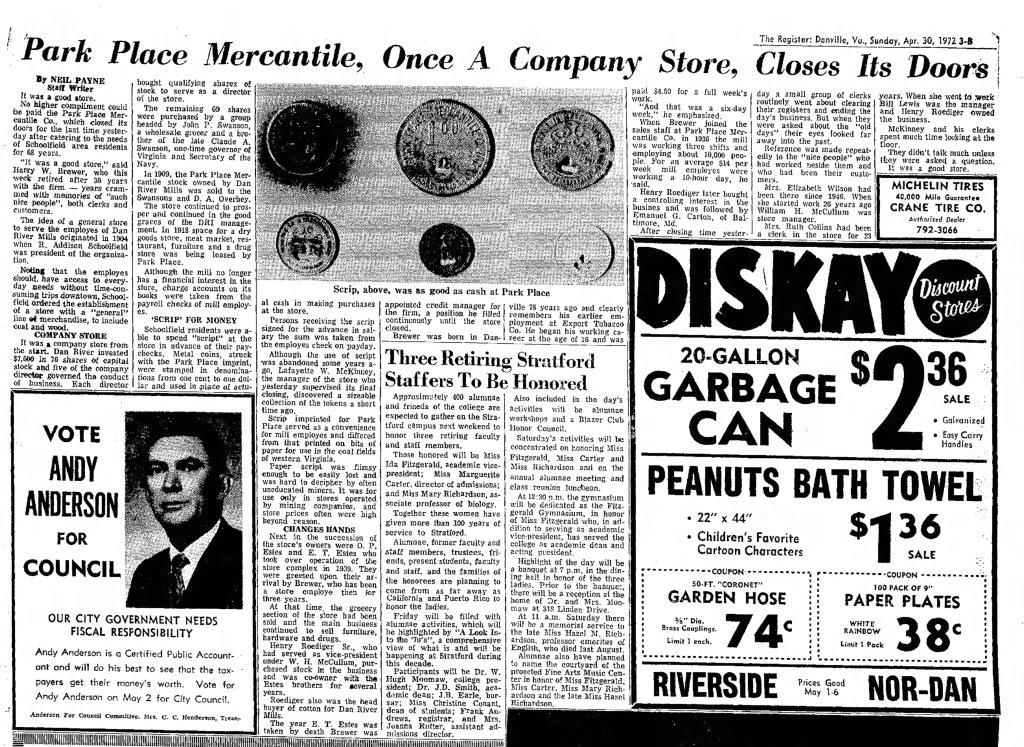
“Park Place Mercantile Company, Once a Company Store, Closes Its Doors.” The Danville Register. April 30, 1972, page 3B. 1974 – Labor strikes ripple through the mills once again.
1975 – Lura A. Rader is elected a director of the company, first woman to serve on Dan River’s Board of Directors.
1977 – David W. Johnston begins his tenure as Dan River president. Robert Smalls remains chairman of the board’s executive committee.
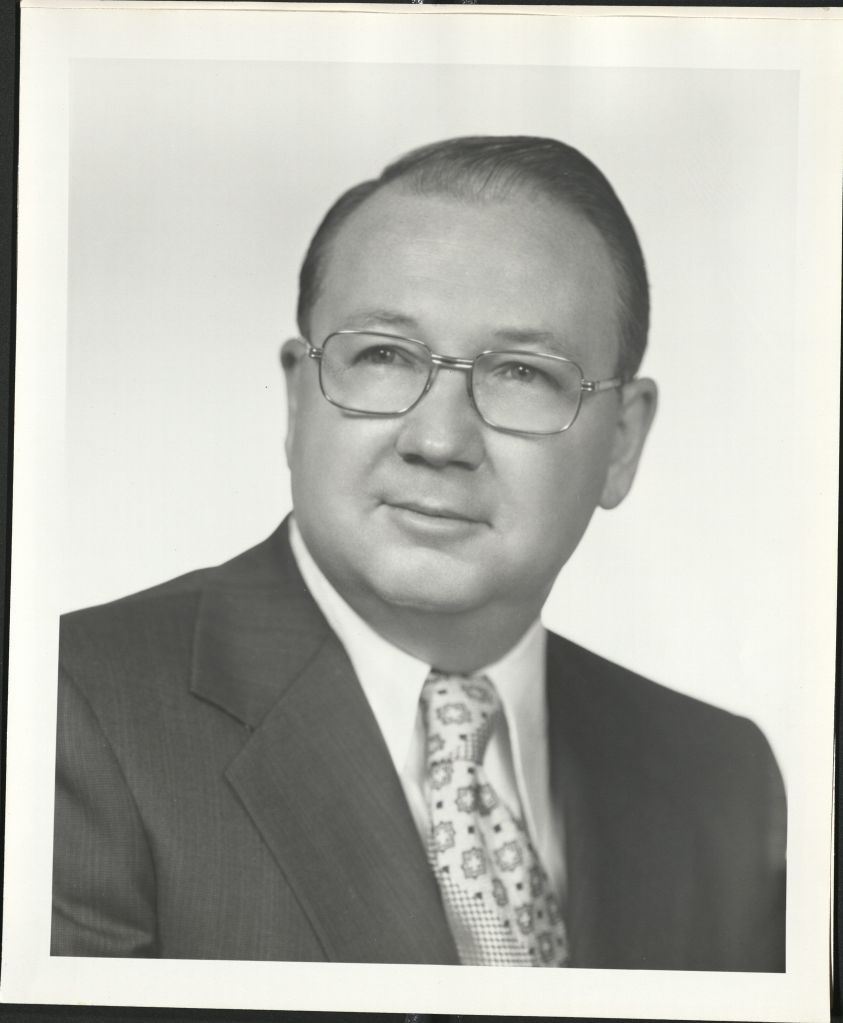
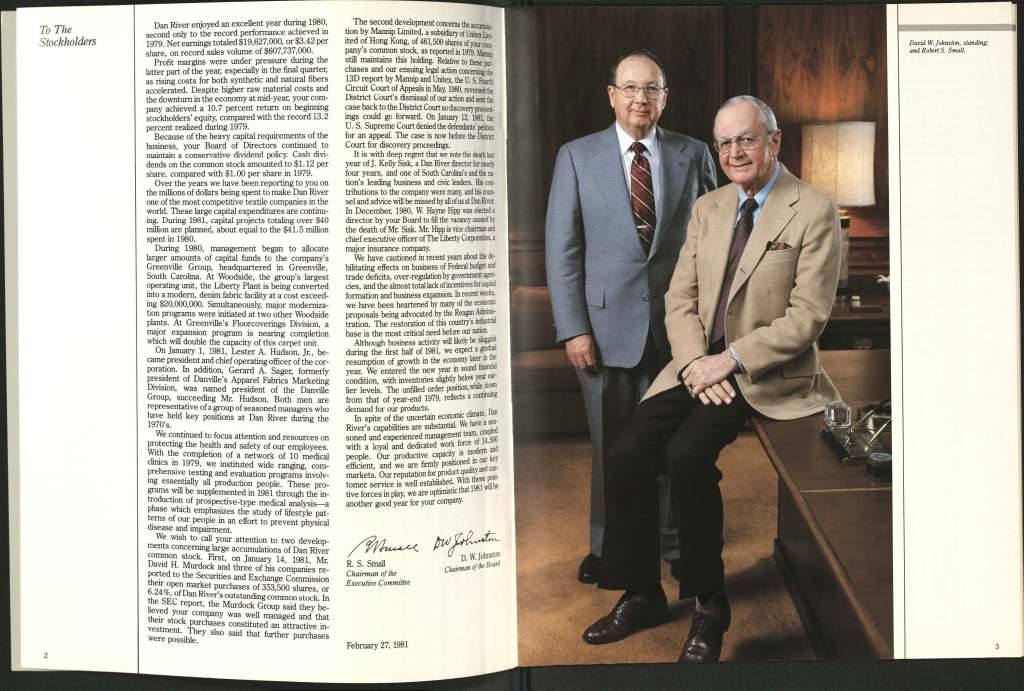
Above:An early portrait of Johnston. Below: 1980 Dan River annual report, showing Johnston (standing). Courtesy of UNC-Chapel Hill Wilson Library’s Southern Historical Collection Dan River Inc. Papers 1981 – After a shake-up at Dan River, Lester A. Hudson serves as mill president and Chief Operating Officer. Only 41 at the time, Hudson is said to have been the youngest president in Dan River’s history.
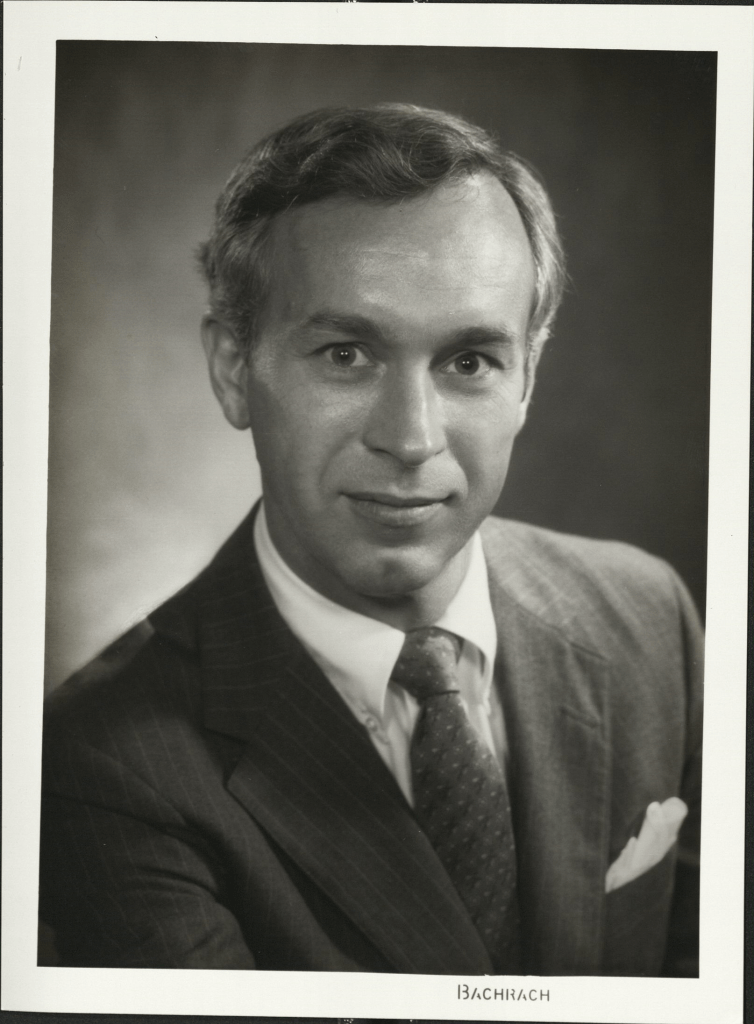
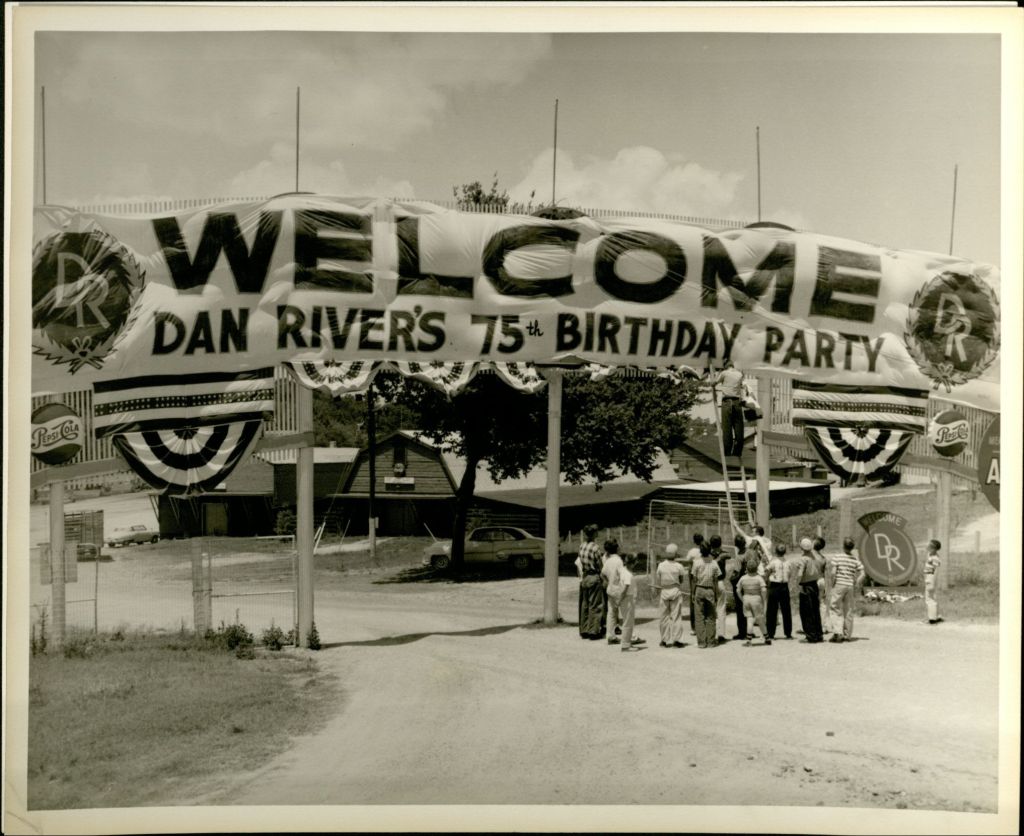
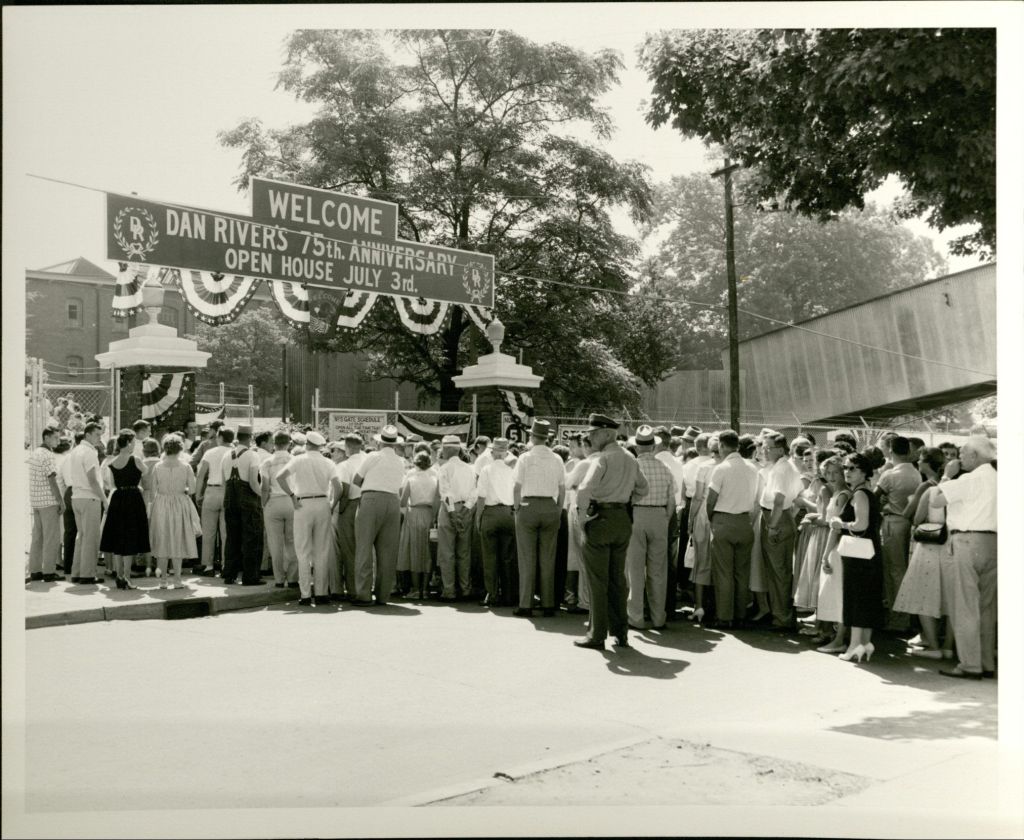
Lester Hudson’s portrait from the 1970s, courtesy of UNC-Chapel Hill Wilson Library’s Southern Historical Collection Dan River Inc. Papers 1982 – Dan River Inc. celebrates its 100th anniversary. In the 100th year of the company’s operation, Dan River reported another disturbing loss in net income— an $8.7 million loss, a huge decline from their previous years’ net income of $14.5 million and $19.6 million. The company also was fighting back a takeover by the infamous corporate raider Carl Icahn.
1983 – To resist Icahn’s buyout, Dan River formed a separate, employee-owned corporation to buy Dan River’s stock and privatize the company, taking out a $150 million loan to keep Dan River in local hands.
1989 – Dan River Inc. is purchased by Georgian and former textile businessman Joseph Lanier.
1994 – The North American Free Trade Agreement (NAFTA) comes into effect, removing trade barriers between the United States, Mexico and Canada. NAFTA did not impose standards for workers’ rights and fair wages, undermining American workers, whose standard of living required wages that could not compete with labor from countries like Mexico.
1995/6 – Despite the diminishing economic market for American manufacturing, Dan River continued to spend freely in the 1990s. In 1995, Dan River signed an optimistic fifteen-year, $2.6-million annual lease for two floors at the lavish 1325 Avenue of the Americas in New York City.
2000 – Whether due to NAFTA or the result of the broader global free market, by the early 2000s, Dan River’s net income was steadily declining and the company’s debt rising. In 2000, Dan River’s reported net income was down six million dollars from the previous two years reported net income.
2001 – One of Dan River’s biggest customers, Kmart, files for bankruptcy, forcing Dan River to take on bad debt while management waited for Kmart to reorganize.
March 2004 – Dan River files for chapter eleven bankruptcy, another last effort to reorganize and get control over hemorrhaging profit losses, reported at $153 million that year.
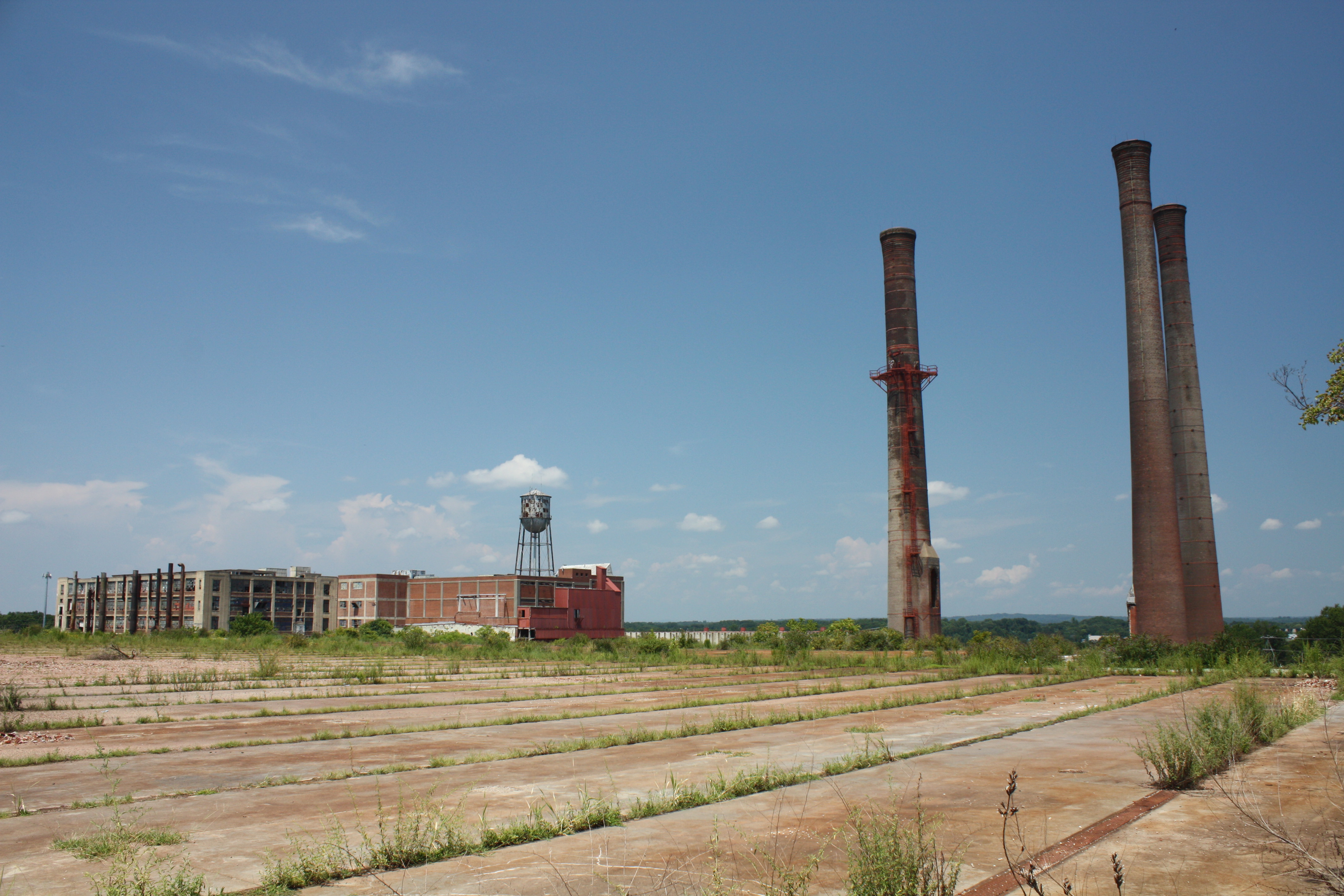
2006 – The company continued to lay off workers and consolidate or close divisions to reduce debt and payroll costs. Finally, in 2006, Gujarat Heavy Chemicals Limited, an India-based company, bought Dan River, stripped the mills for machinery, and shuttered U.S. operations. On December 29th, Dan River Closes its last operations at Schoolfield. The company’s vast real estate is sold off to the highest bidder.
2006/7 – Dan River’s 1916 YMCA was torn down for a CVS pharmacy store despite residents’ protests to save the Schoolfield landmark.
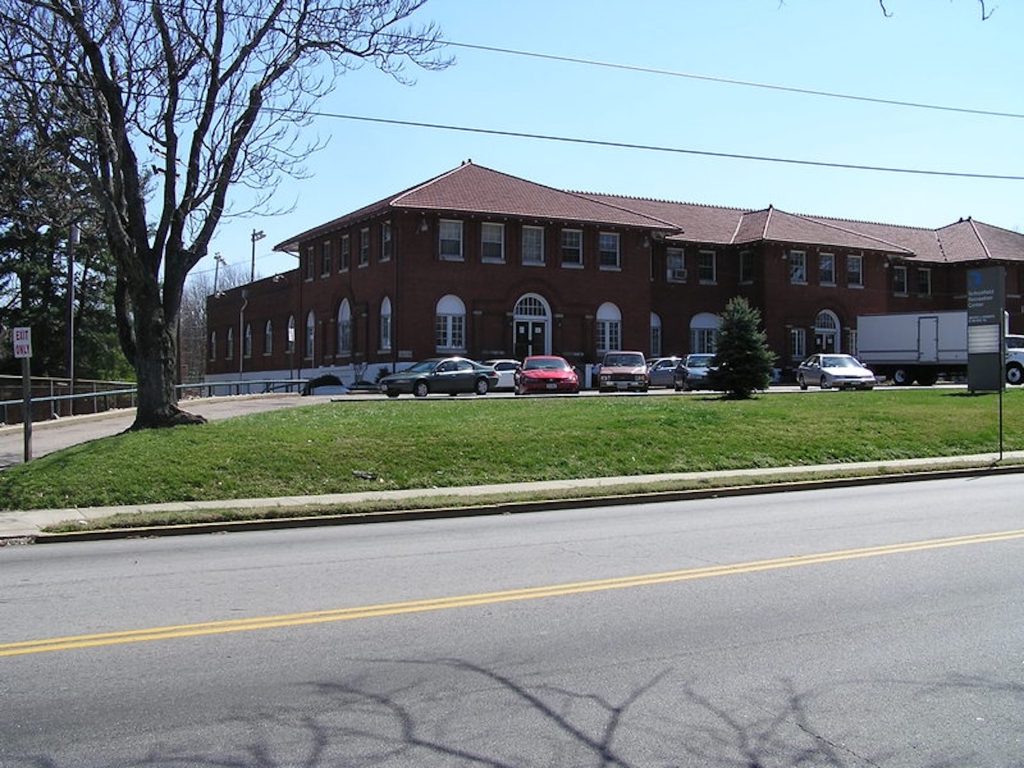
The YMCA in its final years, courtesy of the Virginia Department of Historic Resources. 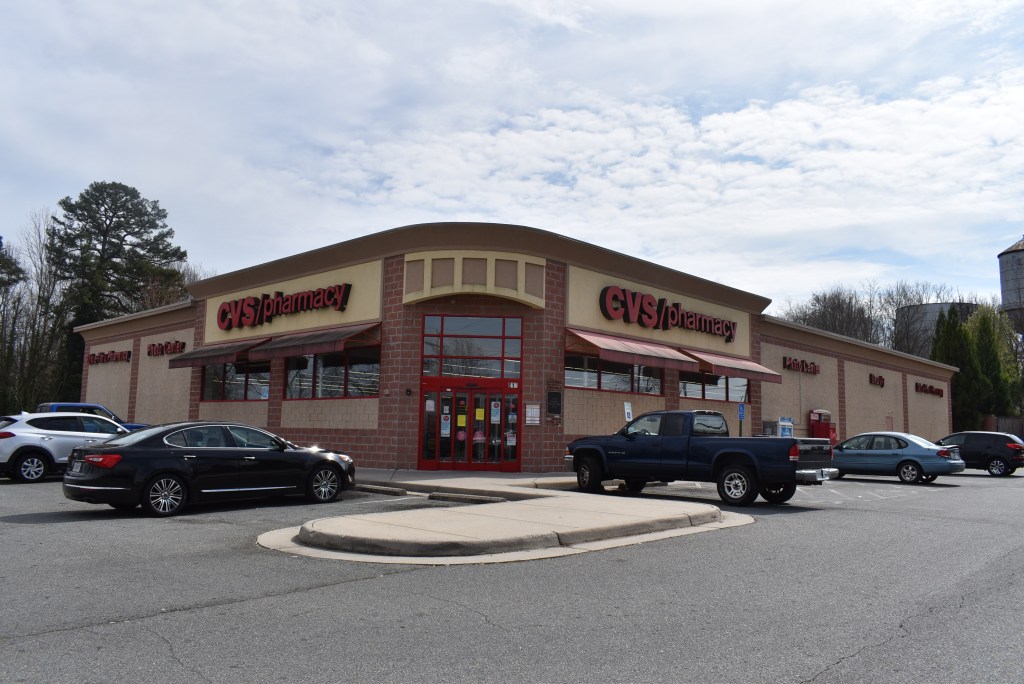
The former YMCA site as it is in 2024. 2008 – The industrial buildings on the Schoolfield mill site, including two weave sheds, mills number one, two, three, four and a part of mill number five, salvaged for bricks between 2008 and 2012.
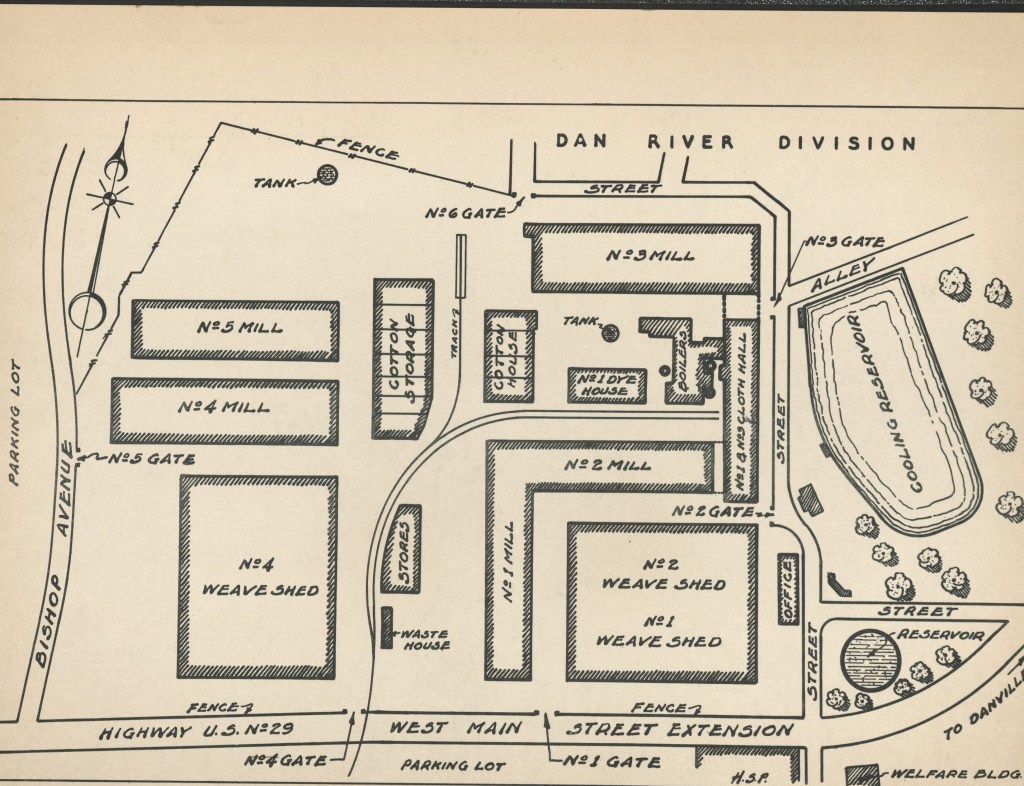
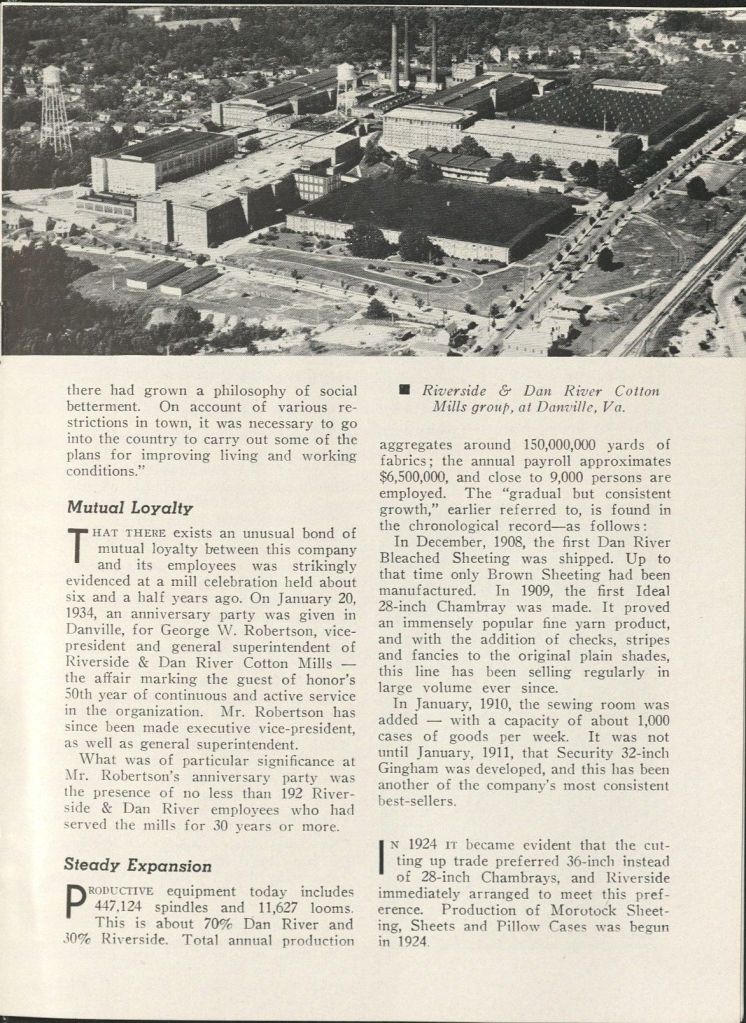
This 1940s map of the Dan River Division shows some of the oldest mills, though not the complete 82-acre campus that Dan River had built by the end of the 1960s. Courtesy of UNC-Chapel Hill Southern Historical Collection Dan River Mills Inc January 29, 2010 – Schoolfield Lunch closes after 95 years in business.
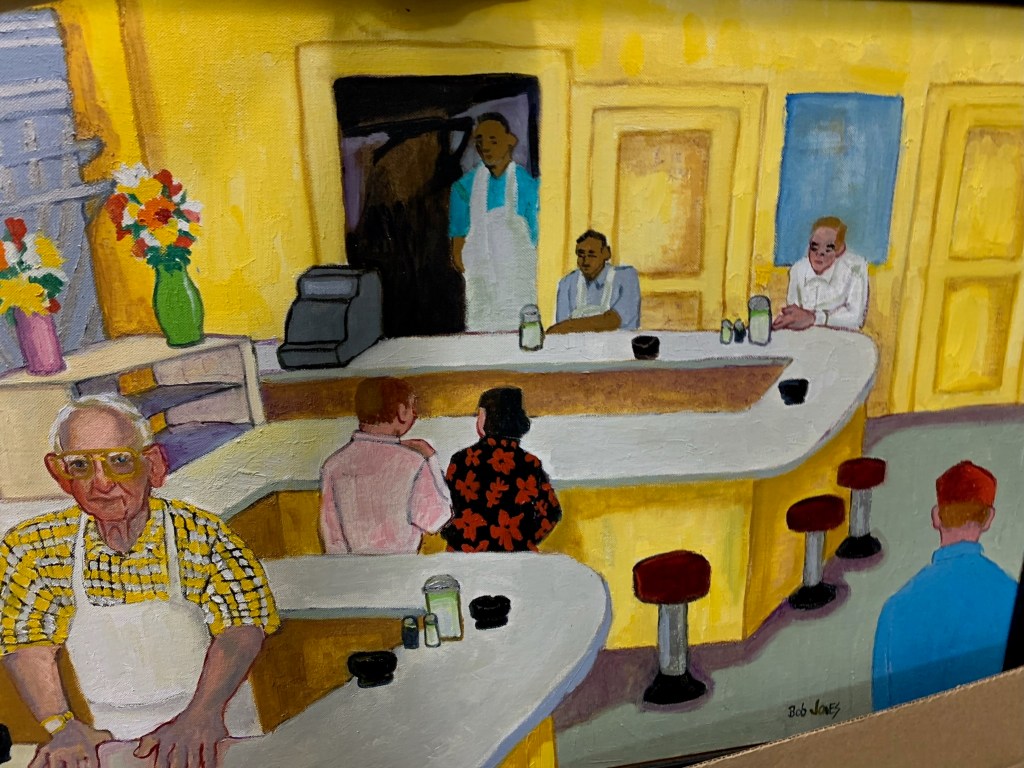
A Bob Jones Painting of Schoolfield Lunch with its horseshoe counters and owner Bill Kirios seen standing in front. Courtesy of the Schoolfield Preservation Foundation. 2011 – After the 1917 Welfare Building is purchased by a group of Schoolfield High School alumni and other Schoolfielders (collectively known as the Schoolfield Preservation Foundation), the Schoolfield Museum and Cultural Center opens to the public in the former Dan River Welfare/ Personnel Building.
2012 – Dan River’s Hylton Hall, built in 1919, burns due to arson and is later completely demolished.
2016 – John Shutts and Scott Sliney reopen Schoolfield Lunch as Schoolfield Restaurant.
January 2020 – The City of Danville hires WRT, a consultant company, to engage the community in developing a Schoolfield Revitalization Plan. Due to the Covid-19 pandemic, some processes are delayed but ultimately a master plan is published in 2023.
November 2020 – Danville citizens vote to allow a casino operation in Danville. The City of Danville selects Caesars as the casino operator for a new casino built on the former Schoolfield mill site.
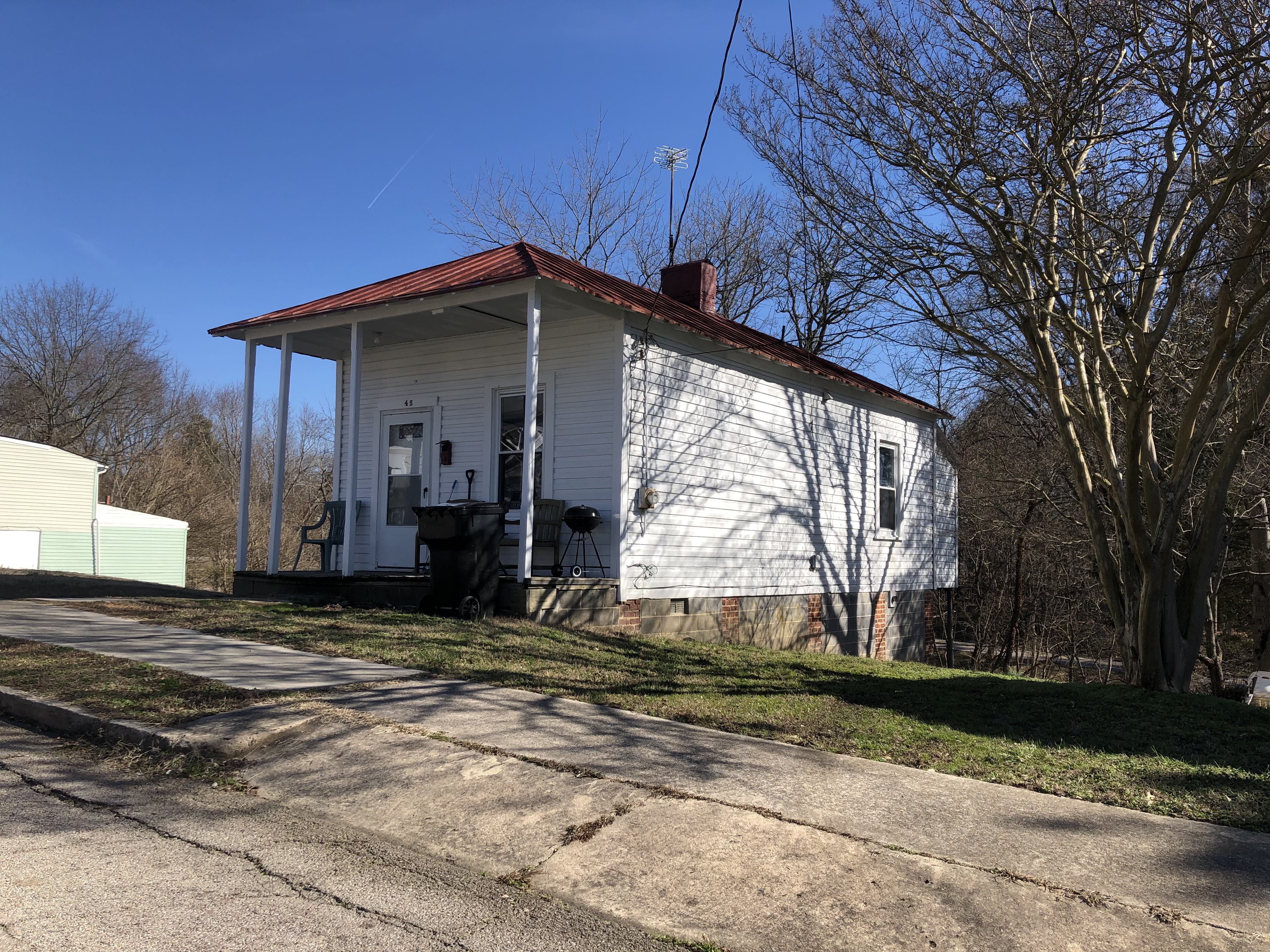
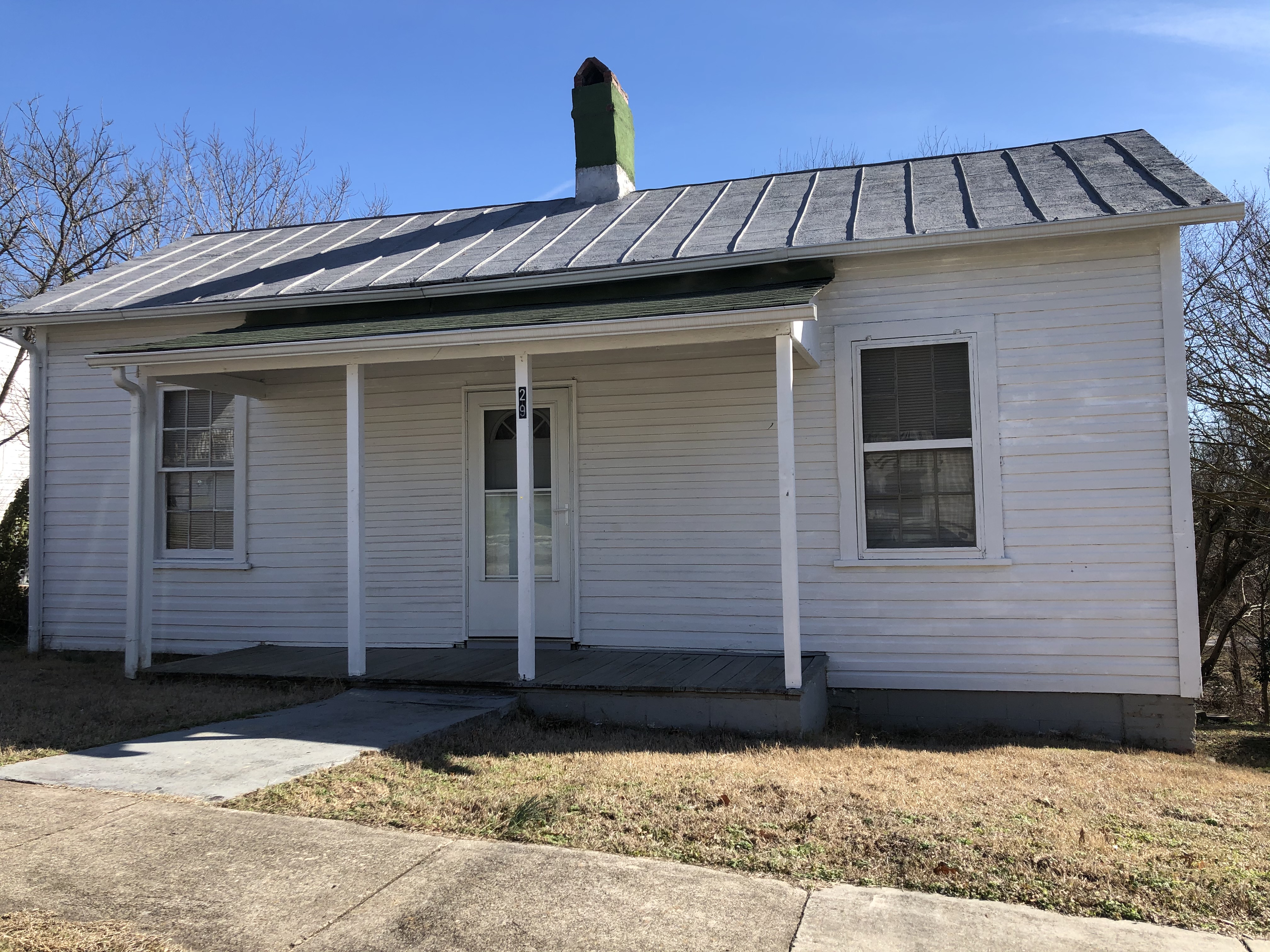
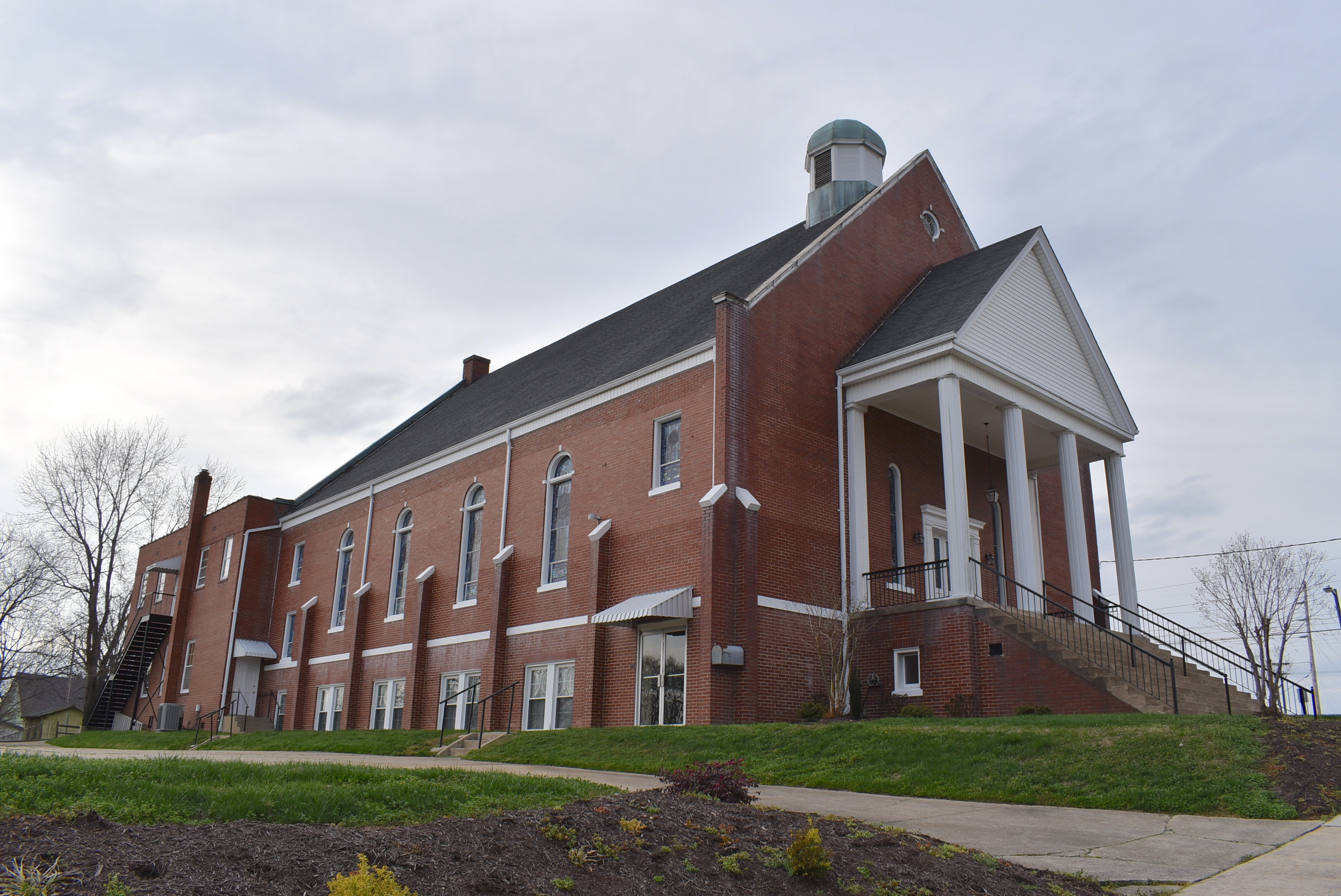
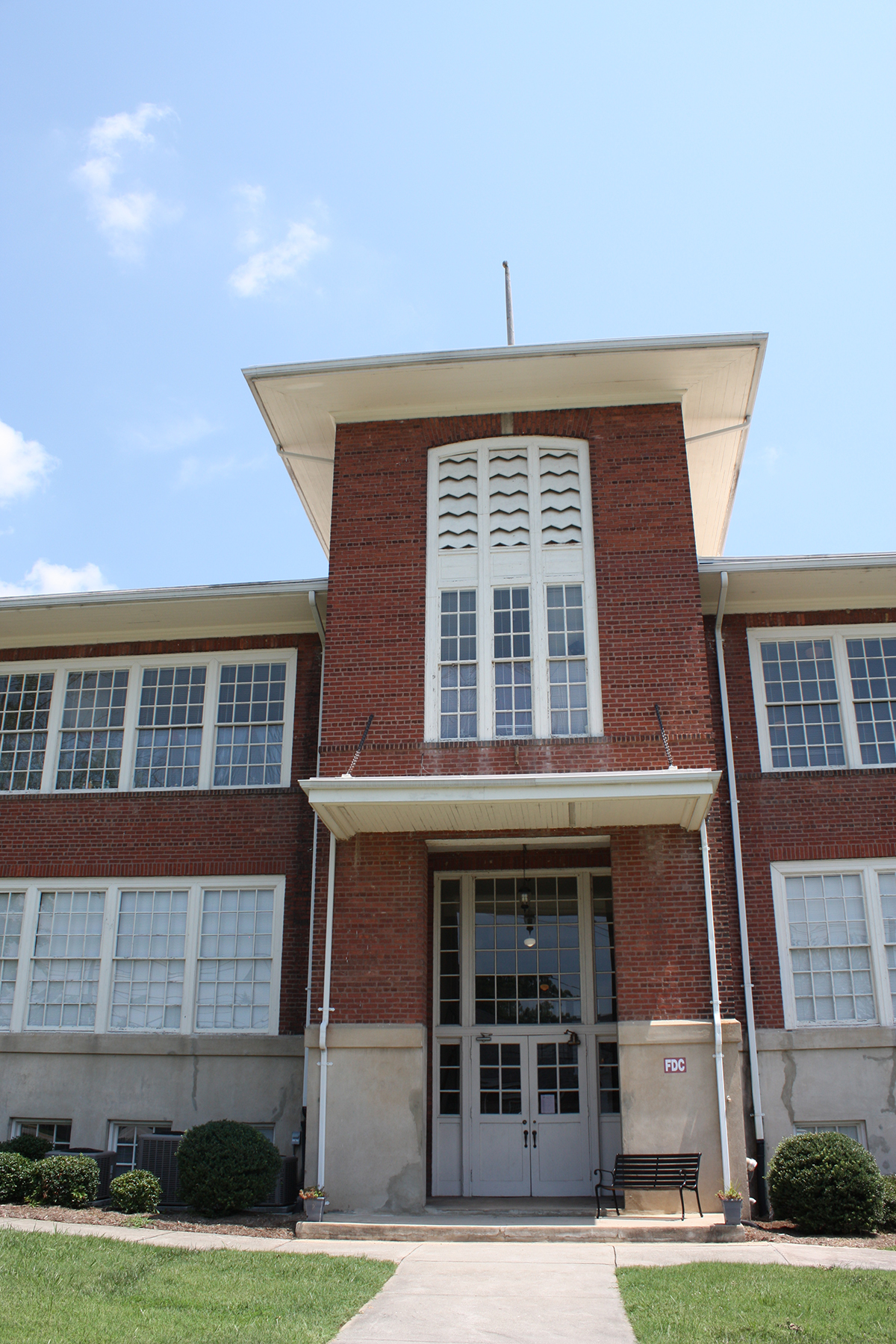
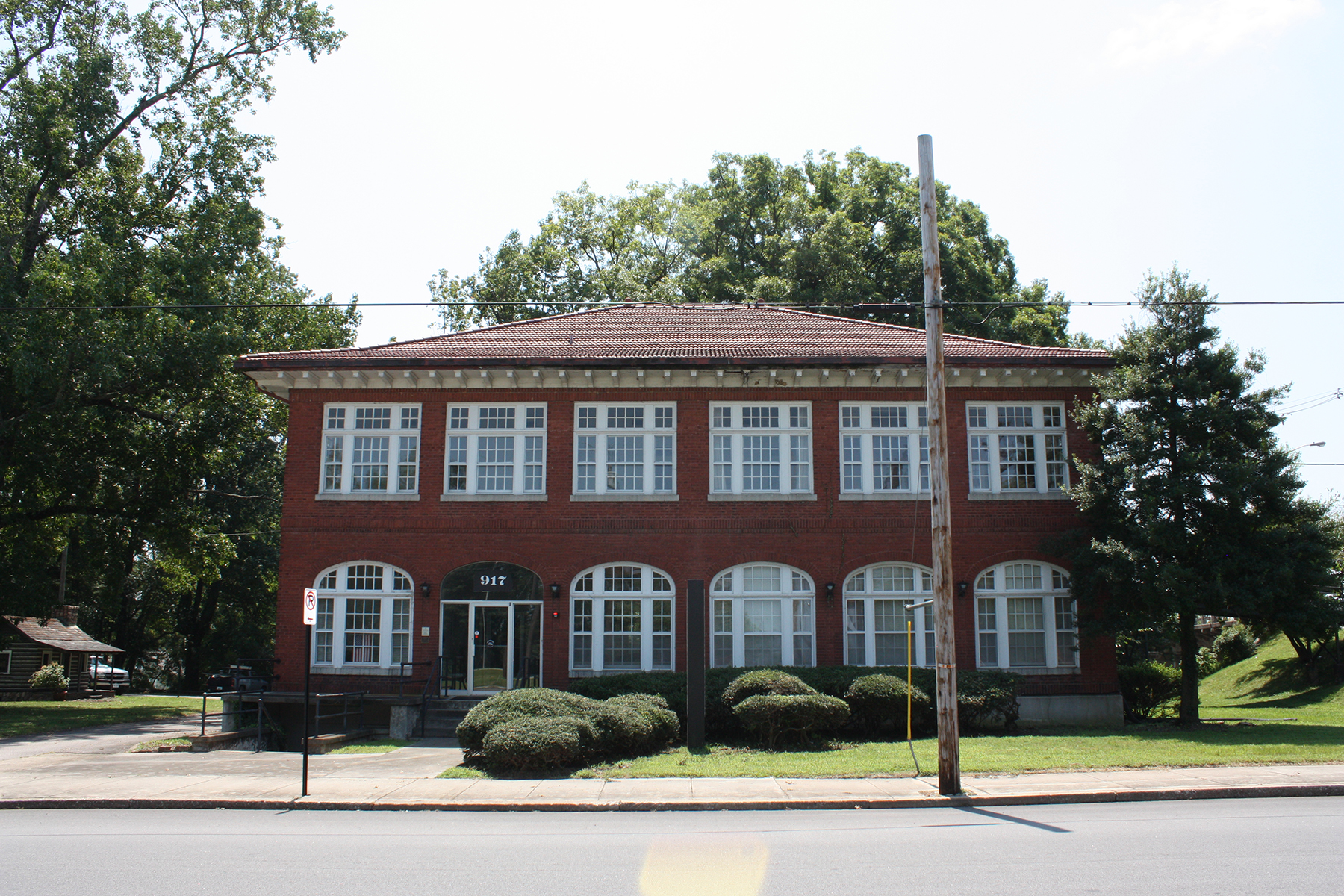
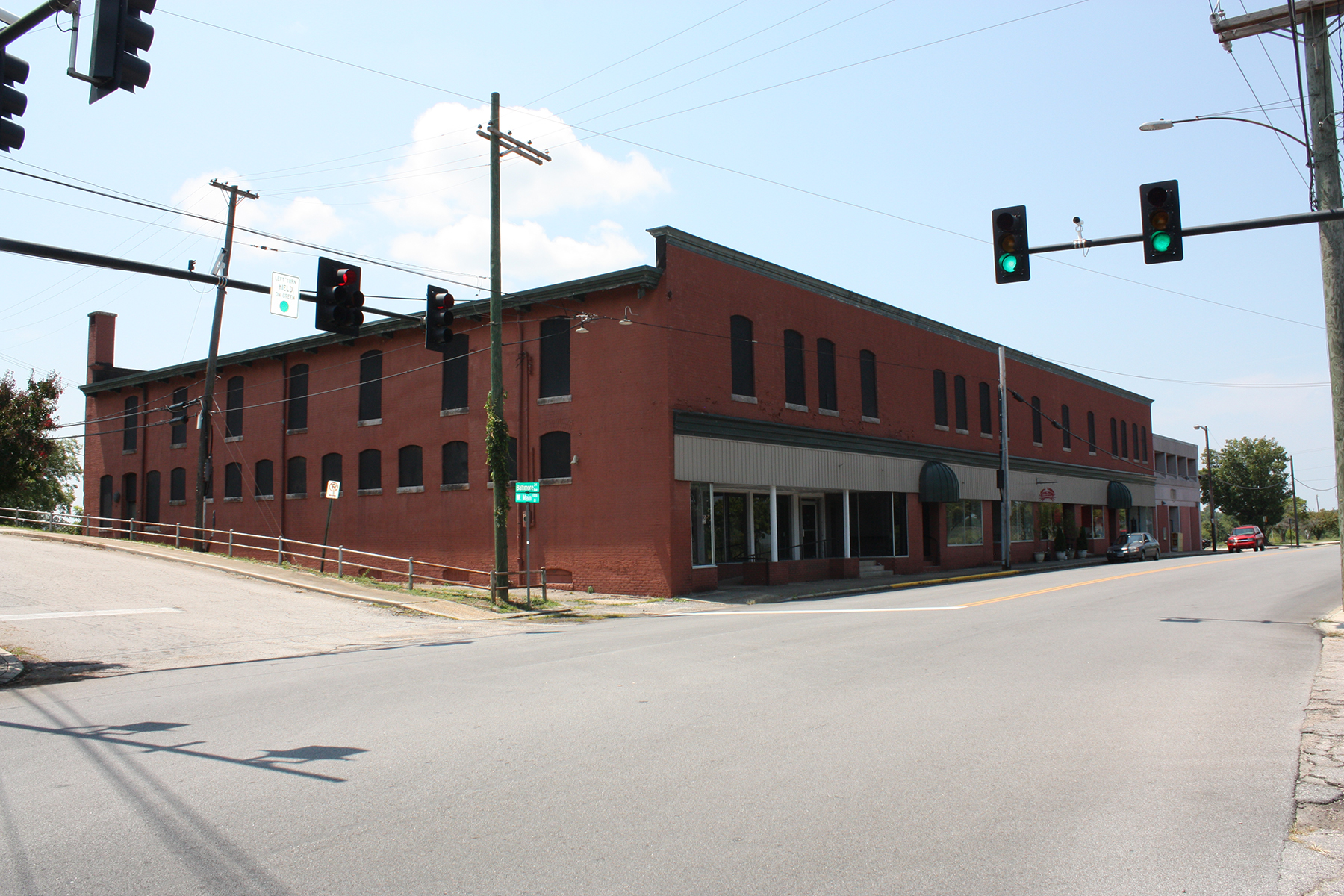
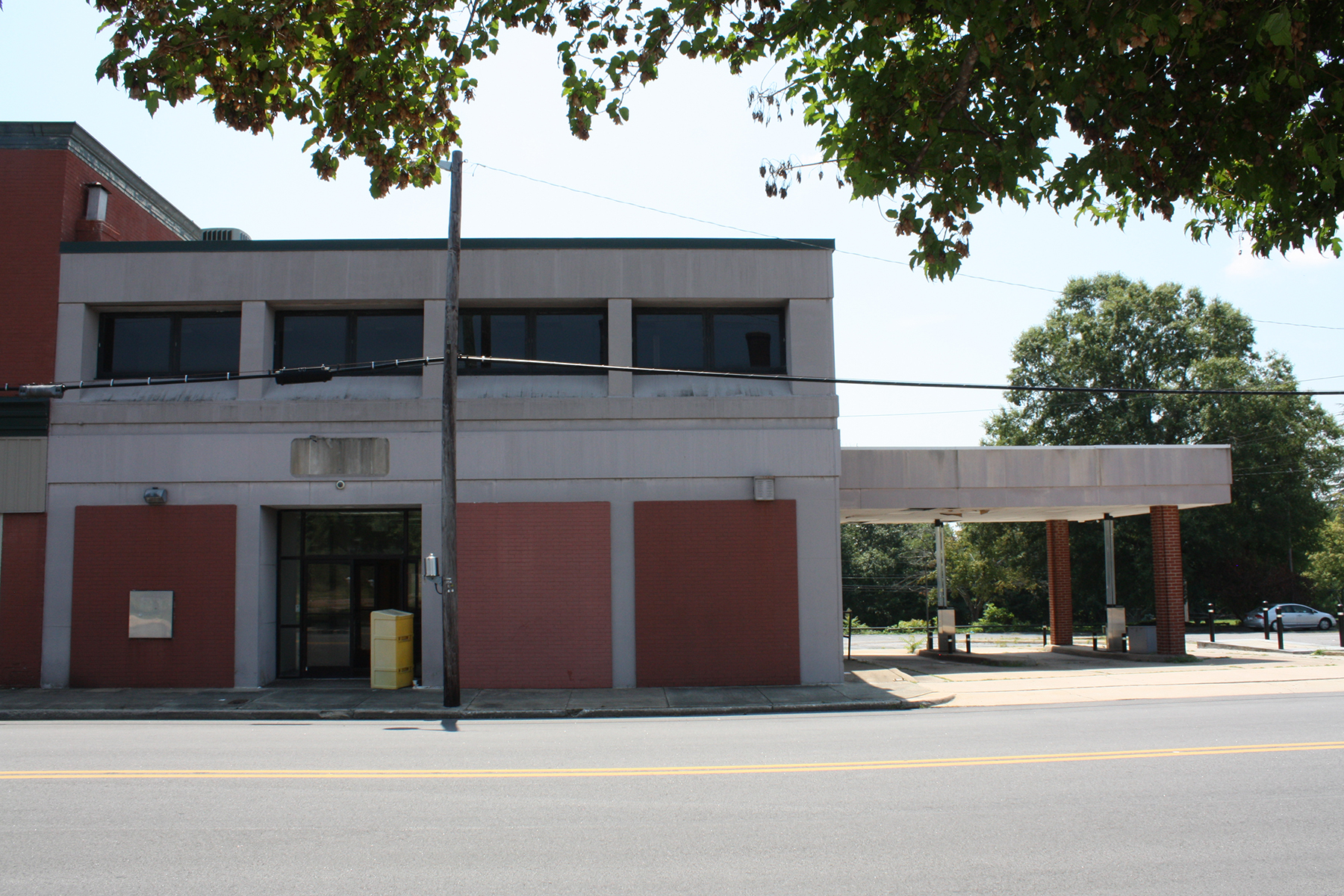
Fall 2020 – Schoolfield is listed on the Virginia Landmarks Register and National Register of Historic Places as the Schoolfield Historic District, boasting over 1,005 historical buildings including some 800 original mill workers houses. Below are some photos from the survey, courtesy of the City of Danville.
2022 – Danville Police Department moves its headquarters to the newly renovated 1967 Dan River Inc. Executive Office Building. Below is a photo of the renovated building, courtesy of the City of Danville.
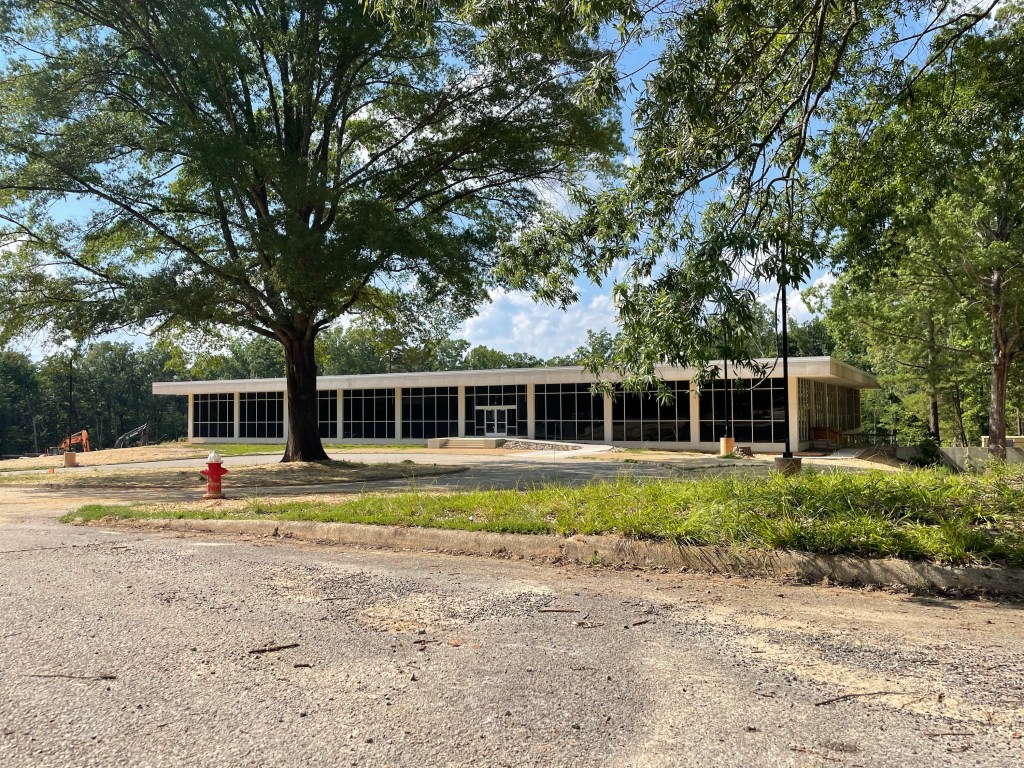
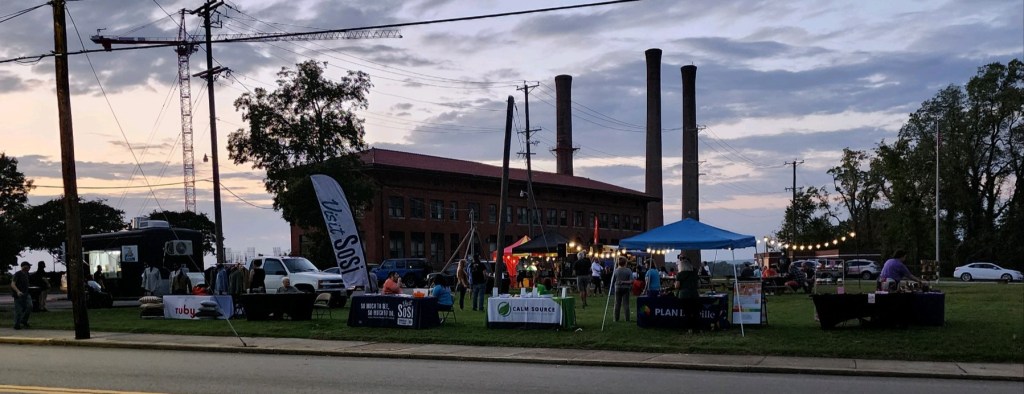
2023 – A Schoolfield Community Council is formed and begins hosting community events in Schoolfield that celebrate the village’s history and future.
 schoolfieldvillage.com