This ca. 1916 house at 822 West Main Street was built for Harry Spessard, who was the first director of the former Schoolfield Y.M.C.A., also built in 1916. When Spessard was hired, Dan River management built his home across the street from the YMCA so he could quite easily (and truly) oversee the recreational hub. Spessard’s home was also notable for its distinctive style among the wooden workers’ cottages prevalent in Schoolfield. The house’s distinctive brick construction and decorative features demonstrate a unique style of the 1910s, but also the importance of welfare program employees to the community of Schoolfield and the paternalistic business model of Dan River Mills.
Built in the Craftsman style with Colonial Revival influences, Spessard’s home was the only company housing in the village made of brick. Spessard’s house was a large double-pile, three-bay house with Flemish-variant-bond brick exterior and detailing, setting it apart from the other wood-clad residences in Schoolfield. Topping off the house is an unusual roof, of moderate pitch with clipped gables and flared eaves, that may have once been covered in terra cotta tile. The home welcomed visitors with an elaborate entry with a flat-roofed front portico supported by triple square brick columns connected to each other by a solid brick wall with concrete coping, all built on a raised concrete porch deck. The front door is framed with eight-light sidelights, and an eight-light transom. In every detail, Spessard’s house demonstrated a distinctive style of the 1910s underscoring Spessard’s own distinction over all other Dan River staff who lived in the village’s standard wood clapboard homes.
Deemed a “good humanitarian” by those Schoolfielders who knew him, Harry Spessard was a critical leader of Dan River Mills’ welfare program, particularly for male millhands. Spessard was born in 1878 to David and Barbara Spessard on a farm near Chewsville, Maryland, a small rural northwestern town near Hagerstown. Spessard’s background in farming was something he shared with many of Dan River’s millhands themselves, who often came to work at the mills from neighboring farms and rural mountain areas. In 1903, Spessard married a fellow rural Marylander, Alice, and had three children, one of whom, Richard, would later work at Dan River Mills as an engineer. Spessard was himself well educated and obtained advanced degrees from Lebanon Valley College in Annville, Pennsylvania, where he returned to teach mathematics, Latin, and English and even serve as a principal between 1903 and 1913 of a secondary feeder school within the college before arriving at Dan River. Spessard’s rural background combined with his education and administrative expertise no doubt made him a desirable candidate for whom Dan River would have wanted to keep in attractive accommodations as the Dan River Mills welfare program expanded in the 1910s.
When Schoolfield Village was annexed by the City of Danville in 1951, Dan River began to sell of its mill housing to its workers. A 1959 article from the Register and Bee, however, shows that this house remained in Dan River’s real estate portfolio. The home was occupied by other Dan River workers and their families such as Otto Manly, the superintendent in the finishing department in the 1950s and 60s. The building was sold off to a private owner in the early 2000s.
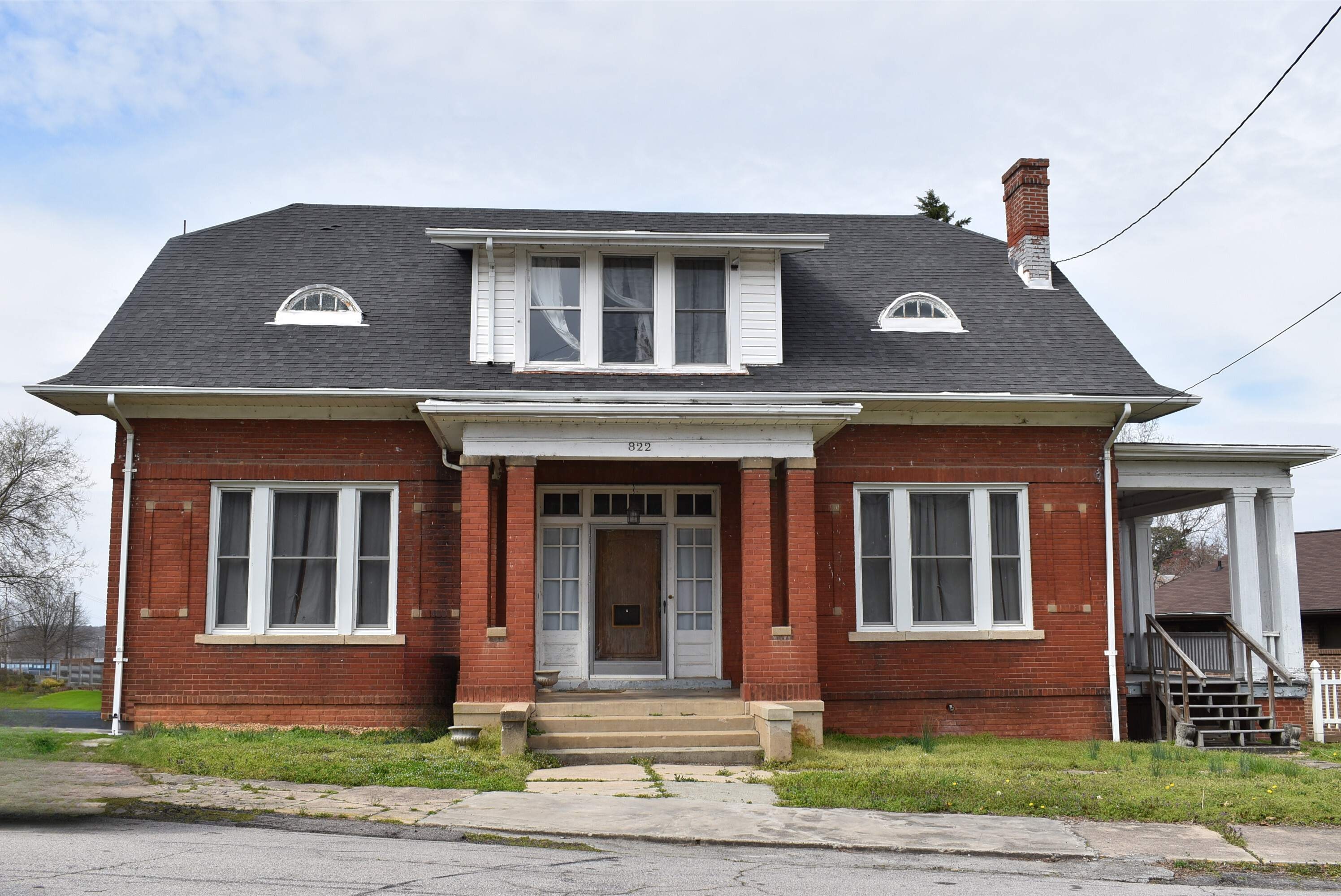
A 2020 photo showing the Spessard House at 822 W. Main Street. Photo on file with the City of Danville.
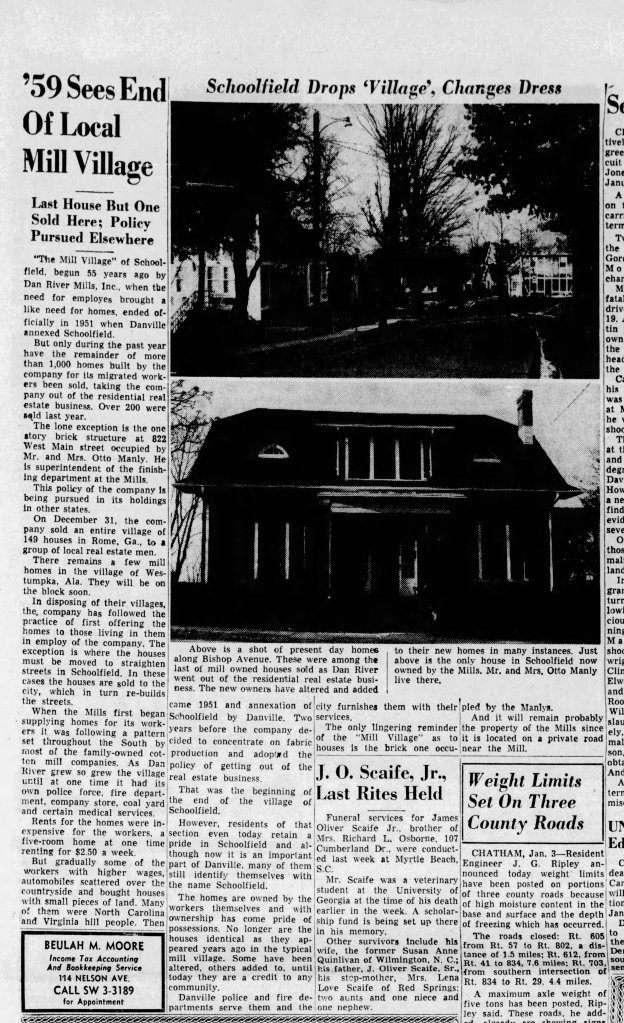
“’59 Sees End of Local Mill Village,” The Danville Register, January 4, 1959.
See also:
Smith, Robert S. Mill on the Dan: A History of Dan River Mills, 1882-1950. Duke University Press, 1960. https://babel.hathitrust.org/cgi/pt?id=uva.x000314340;view=1up;seq=9.
H.O. Hagood, interview by David E. Hoffman, August 22, 1984, Averett University Collections.
Spessard, Harry. Year: 1910; Census Place: Annville, Lebanon, Pennsylvania; Roll: T624_1362; Page: 3B; Enumeration District: 0135; FHL microfilm: 1375375, Ancestry.com.
Lebanon Valley College, Lebanon Valley College Catalog (Annville, Pennsylvania: Lebanon Valley College, 1903, 1909 and 1911; Internet Archive, 2011), pp. 8, 5, 5 respectively. http://archive.org/details/lebanonvalley190304leba
 schoolfieldvillage.com