As only one of a handful of Miesian Style buildings from the period in Danville, this former Dan River Executive Office Building’s distinction signaled the corporate sophistication of Dan River Mills at the peak of the company’s financial success in the 1960s. Built in 1967, the Executive Building capped off a decade of Dan River’s aggressive growth and acquisition of other manufacturing companies. These acquisitions required a new corporate structure and philosophy embodied in the location, design and layout of the Executive Building.
The Executive Office Building, now the Danville Police Department headquarters, stands to the south of the Dan River on the eastern shoulder of Memorial Drive. The building is located on a 60-acre large, wooded lot that slopes up southwardly from the river. The original two-story building is of concrete curtain wall construction with a 2022 addition to the rear of the building. The main floor exterior walls are faced with large plates of glass in aluminum-frames and the lower-level exterior walls have a stucco finish featuring white crushed rock. The lower story is open on the rear northern side of the building with concrete columns covered with similar white crushed rock stucco. The building’s flat concrete roof extends out from the main building plane to shelter the glass walls of the main floor. The main floor entrance contains single-leaf, glass aluminum-frame doors with sidelights. The basement entrances to the courtyard contain single-leaf, aluminum-frame doors with transoms. The basement entrances on the exterior walls contain single-leaf and double-leaf flush metal doors.
Though Dan River had begun as a southern and deeply paternalistic company, complete with its own company town of Schoolfield, following World War II the company came under northern professional management. These professional mill managers funneled money away from paternalistic schemes, selling off company-owned houses, and repealing direct welfare programming. In addition, new corporate managers sped ahead with a rapid acquisition program beginning in 1956 that by 1967 expanded Dan River’s manufacturing network beyond Danville by acquiring the following Woodside Mills in Greenville, South Carolina; Clifton Manufacturing Company in Clifton, South Carolina; Webco Mills, Inc., and began an Alabama Division, in addition to acquiring a new firm, Iselin-Jefferson. These new entities needed to be placed under a new reporting structure, giving new importance to corporate officers at the Danville Division who would have to oversee these sprawling organizations.
Centralized oversight would have been difficult as lead corporate staff was spread out in different locations in Danville. Before 1967, Dan River’s corporate officers were scattered between the 1903 Company Office Building, expanded once in 1921, and Hylton Hall, which had been a women’s dormitory but was remodeled for personnel offices in the 1940s. To centralized corporate officers, Dan River’s board began planning a combined headquarters for corporate staff in a centralized, off-site location. In 1966, the company announced that it had hired Carneal and Johnston, architects and engineers based in Richmond, to design and build a new headquarters on a segregated sixty-acre plot of land just west of the village of Schoolfield. These headquarters would be two floors, with a main entrance, reception area and cafeteria on the first floor, and a ground floor devoted to computers, which at that time required ample room for data processing. The main floor housed executive officers of the new consolidated organization that included the chairman of the board, the company president, and heads and principal officials of the finance, legal, cotton, research and public and industrial relations departments. John W. Daniel and Company, in Danville, was the general contractor for the building and the interior and surrounding landscaping was chosen with preference to outside vendors. The interior of the Executive Building was designed by Mitchell Associates from Wilmington, Delaware and the landscaping around the building was led by Stanley W. Abbott, a landscape architect based in Richmond, Virginia. The approach to the office swept in off Memorial Drive and curved along a wooded ravine, giving the grounds around the office a secluded, almost secretive feel.
The Executive Office Building also signifies the last gasp of a company’s heyday that would soon diminish. The building, in its rectangular form, was meant to be expanded, but that moment never came. With each passing decade after 1970, the fate of Dan River fell under a fateful shadow like so many other American manufacturing companies. In 1982, the hundredth year of the company’s operation, Dan River reported a disturbing loss in net income— the company had lost $8.7 million that year, a huge decline from their previous years’ net income of $14.5 million and $19.6 million. After struggling with over expansion, more labor strikes in the 1970s, and the onslaught of a national recession, in 1982 Dan River was also fighting back an attempt by the infamous corporate raider Carl Icahn to buy out Dan River’s publicly traded stock. The company was able to maintain local shareholder control, but not without damaging its own fiscal health. To resist Icahn’s buyout, Dan River formed a separate, employee-owned corporation to buy Dan River’s stock and privatize the company, taking out a $150 million loan to keep Dan River in local hands.
Under the weight of this debt and stretched thin by zealous acquisition of other textile companies in the south, Dan River floundered into the 1990s when globalization struck a final blow to its clothing apparel line and even its successful home fabrics line. In 1994, the North American Free Trade Agreement (NAFTA) came into effect, removing trade barriers between the United States, Mexico and Canada. NAFTA did not impose standards for workers’ rights and fair wages, undermining American workers, whose standard of living required wages that could not compete with labor from countries like Mexico. Whether due to NAFTA or the result of the broader global free market, by the early 2000s, Dan River’s net income was steadily declining and the company’s debt rising. In March of 2004, Dan River filed for chapter eleven bankruptcy, another last effort to reorganize and get control over hemorrhaging profit losses, reported at $153 million that year. The company continued to lay off workers and consolidate or close divisions to reduce debt and payroll costs. Finally, in 2006, Gujarat Heavy Chemicals Limited, an India-based company, bought Dan River, stripped the mills for machinery, and shuttered U.S. operations. Schoolfield was the last operating division of the company when Dan River closed at the end of 2006, with the last employee to leave her shift at the mill on December 29th. In the wake of its 2006 demise, Dan River’s vast industrial and commercial real estate was sold off to the lowest bidder, with much of the company’s industrial buildings ultimately destroyed.
This former Dan River building found new life beginning in 2021, however, when the Danville Police Department planned for its rehabilitation as their new headquarters. Finished in 2022, the building was given a new entrance off Bishop and a new address, 1 Community Way, to reflect the emphasis of priority of community in the Danville Police Department’s approach to policing.
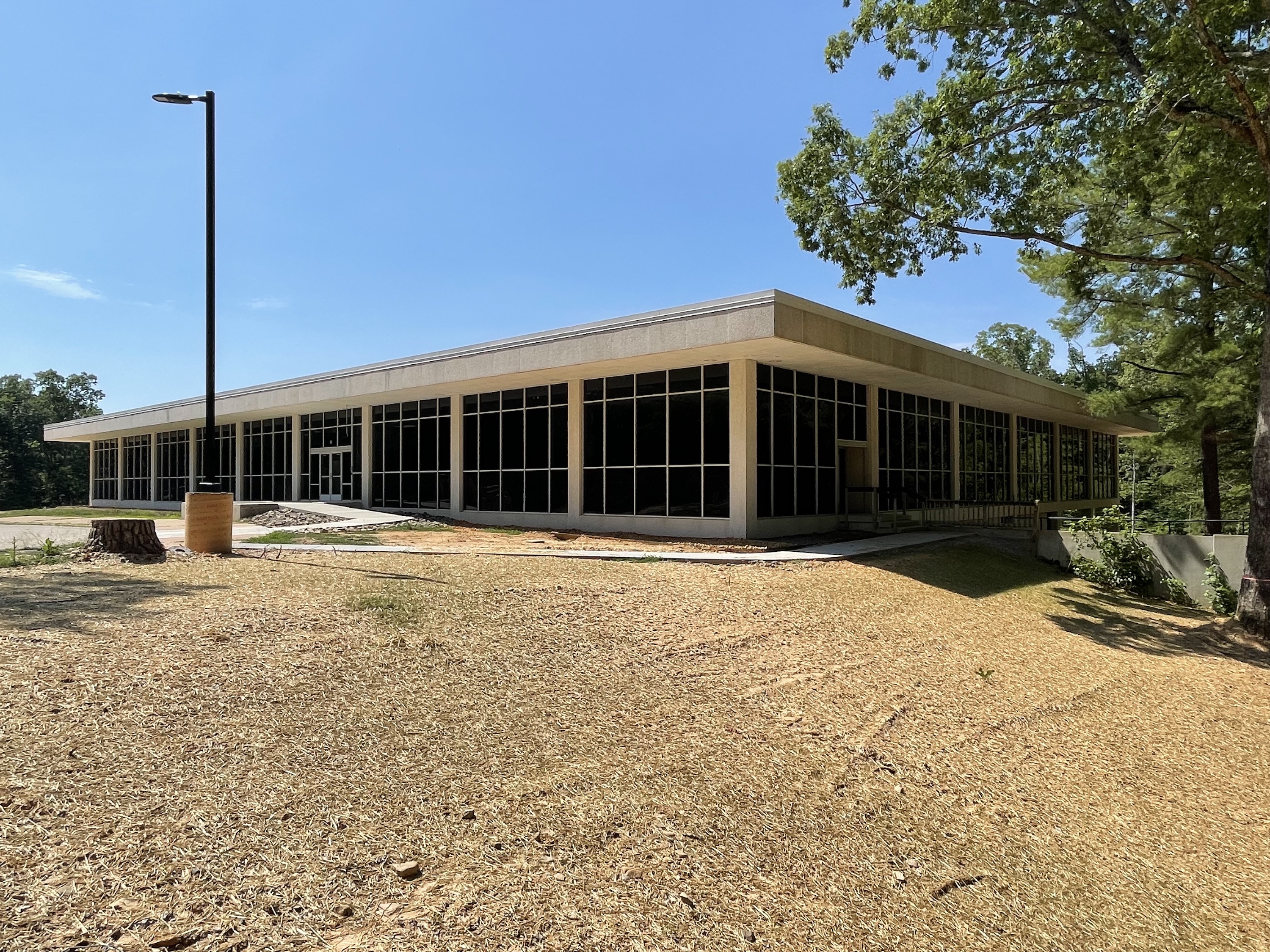
This 2021 photo shows the Dan River Executive Building when it was freshly renovated into the Danville Police Department offices. Photo courtesy of the author.

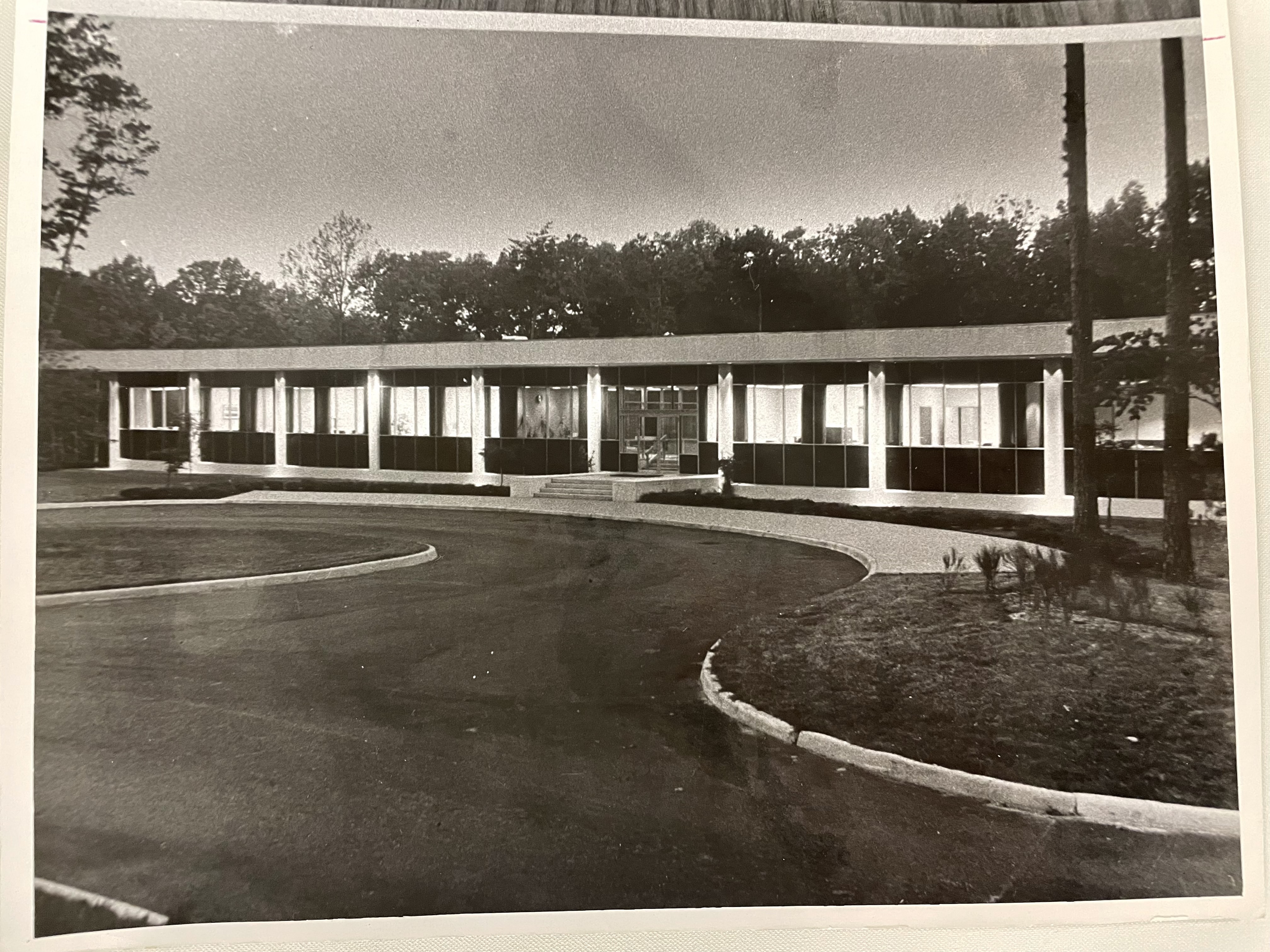
These Danville Chamber of Commerce photo from the 1960s and 1970s show the Executive Office Building when it was first built. Photo courtesy of the Danville Historical Society.
This 1981 Organizational Chart for Dan River shows its corporate prowess and complexity. Courtesy of UNC-Chapel Hill Wilson Library’s Southern Historical Collection Dan River Inc. Papers.
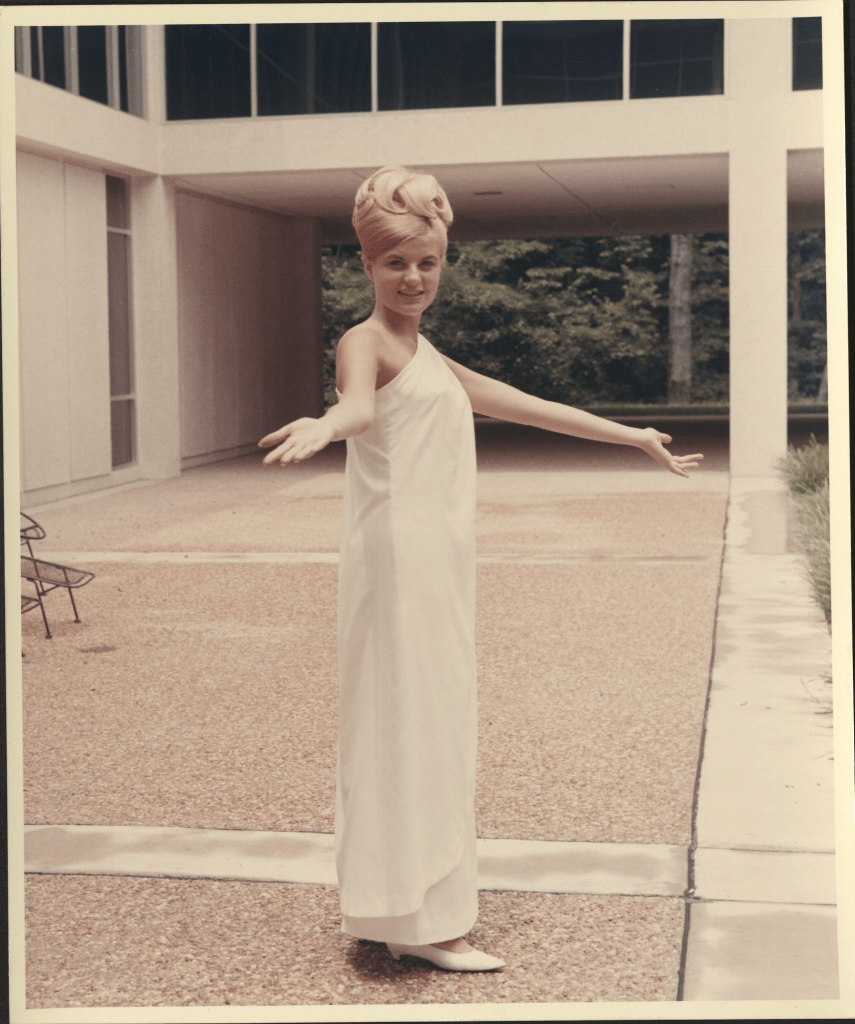
The 1968 Ms Danville shows off her fashion style in the courtyard of the Dan River Executive Building. Courtesy of UNC-Chapel Hill Wilson Library’s Southern Historical Collection Dan River Inc. Papers.
See also:
Mozingo, Louise A. Pastoral Capitalism: A History of Suburban Corporate Landscapes. Urban and Industrial Environments. Cambridge, Mass: MIT Press, 2011.
The Bee. “Dan River Headquarters Office Slated.” January 17, 1966, sec. 3. Newspapers.com.
Dan River Inc. “Dan River Inc. Annual Report.” Danville, Virginia, 2000. Mergent Historical Annual Reports.
Dan River Inc. “Dan River Inc Form 10-K,” 2004. Securities and Exchange Commission. https://www.sec.gov/Archives/edgar/data/0000914384/000119312504064676/d10k.htm.
Bagley, Carla. “Dan River Closing Mill; 490 People to Lose Jobs.” Greensboro News and Record. Accessed March 20, 2020. https://www.greensboro.com/business/dan-river-closing-mill-people-to-lose-jobs/article_9e60b7cb-510e-594e-b7f9-c1447e8ecd61.html.
Bozick, Tara. “The Rise and Fall of Dan River Inc.” NewsAdvance.com. Accessed March 20, 2020. https://www.newsadvance.com/news/local/the-rise-and-fall-of-dan-river-inc/article_2131dd6b-1abf-5143-958e-8111ee8d7d89.html
Danville Police Department moves its headquarters to the newly renovated 1967 Dan River Inc. Executive Office Building: https://www.wdbj7.com/2022/08/31/danville-police-department-moves-all-operations-into-new-headquarters/
 schoolfieldvillage.com